
Key Takeaways
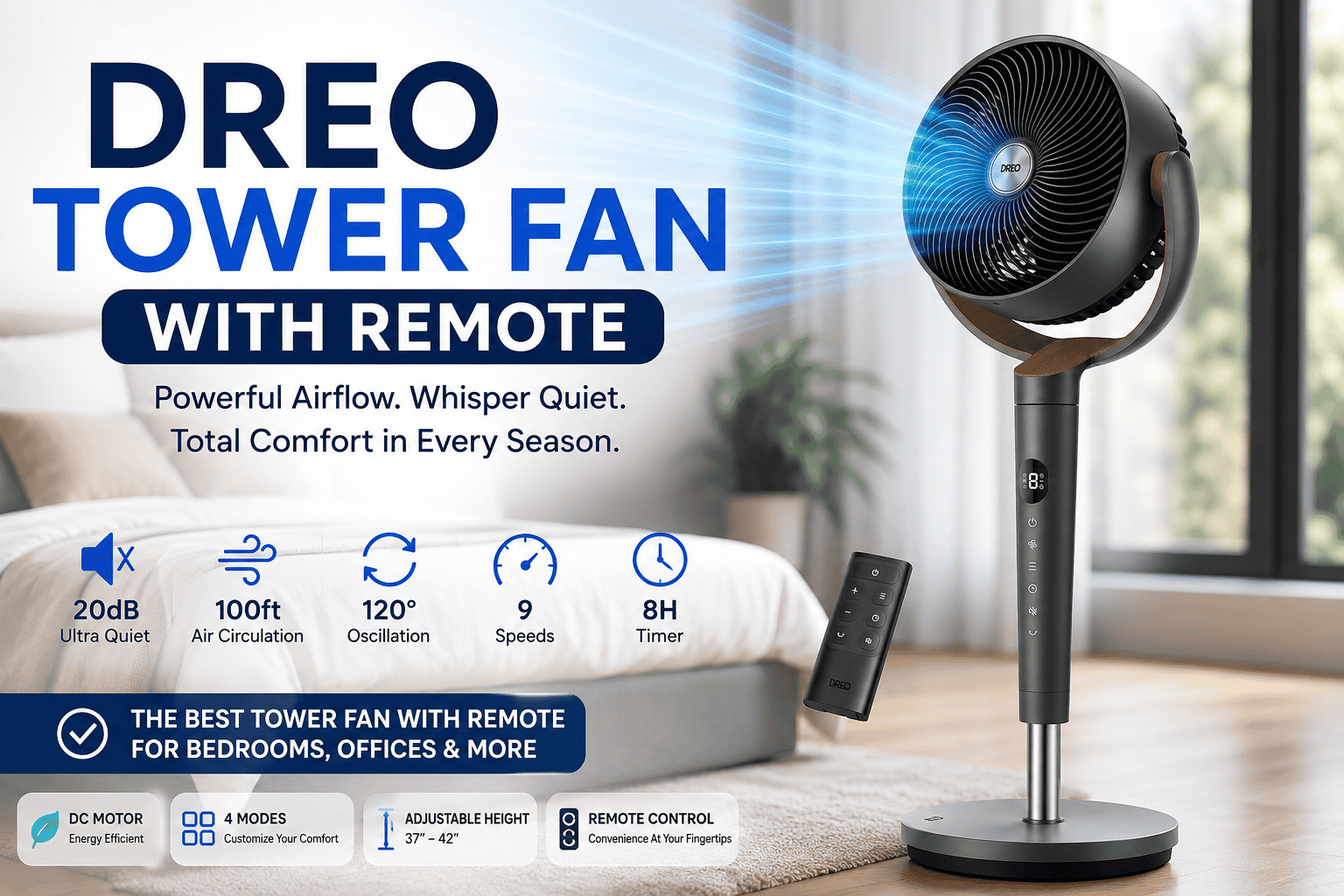
- This DREO standing fan reaches 100 feet of airflow throw with 9 speeds and 4 modes, giving you more range than most fans marketed as a tower fan with remote.
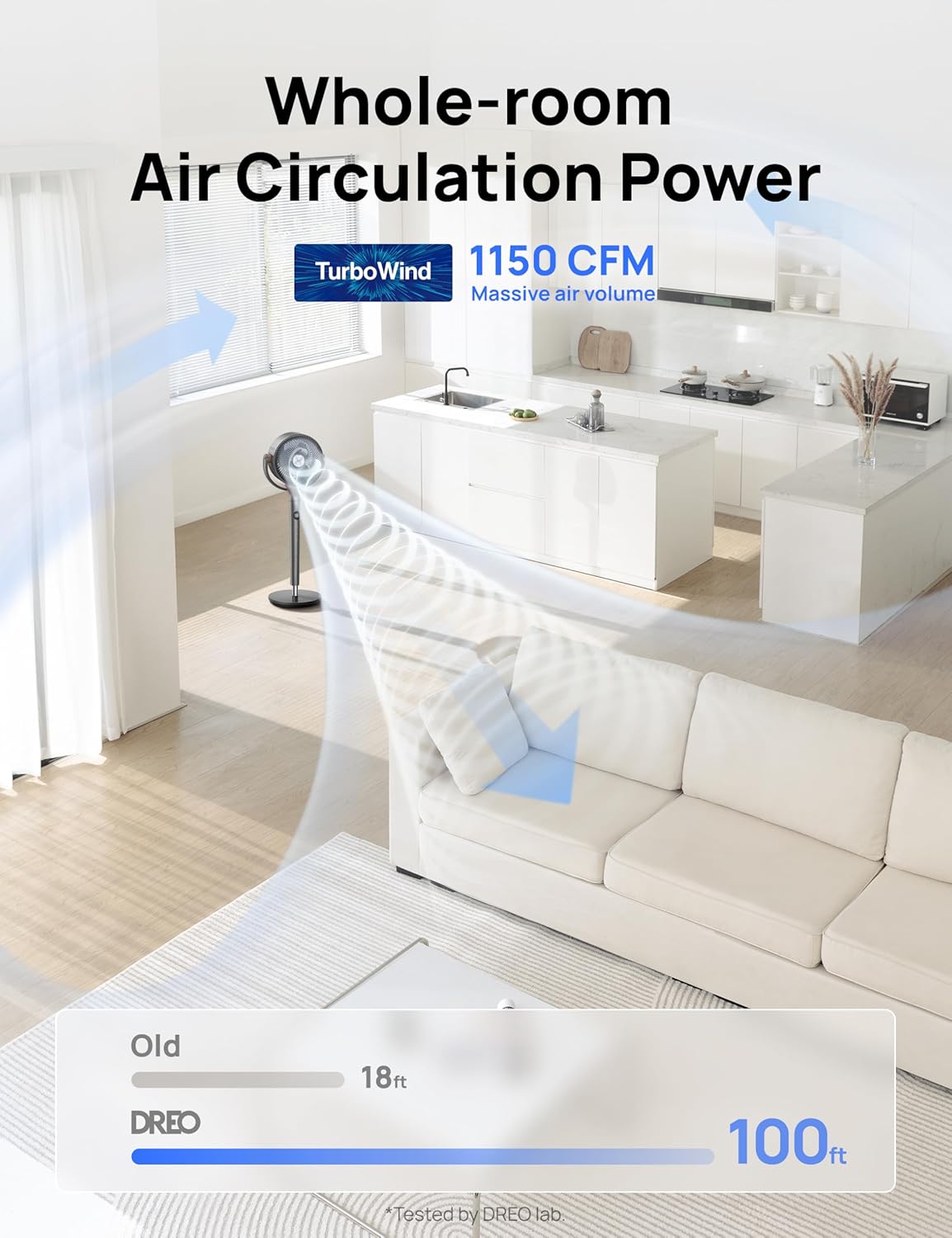
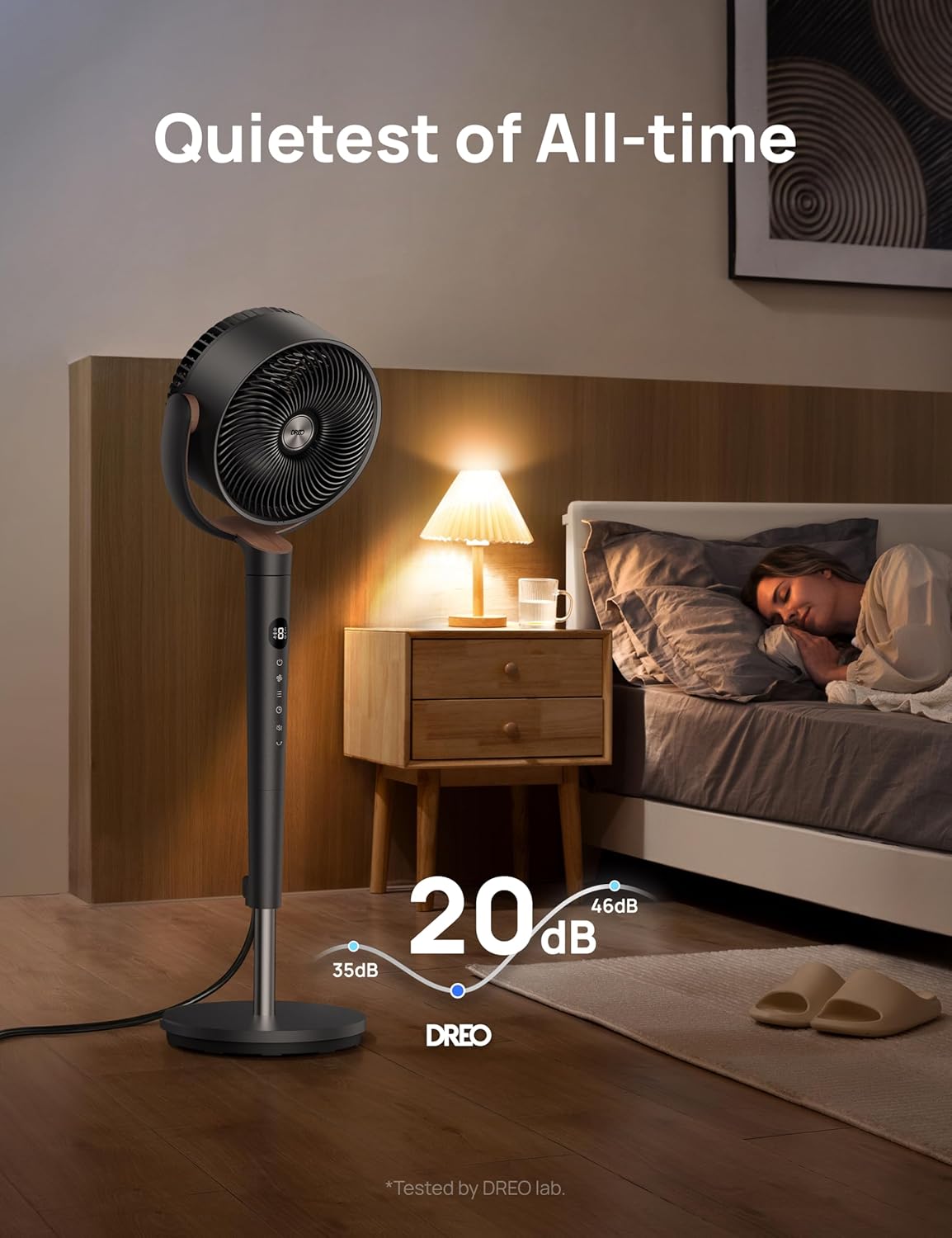
- It runs as quiet as 20dB thanks to a brushless DC motor, which DREO says moves 30% more air using 40% less energy than a comparable AC motor fan.
- 120° horizontal oscillation (remote or touch controlled) plus a 120° manual vertical tilt cover far more of a room than a fixed-head fan.
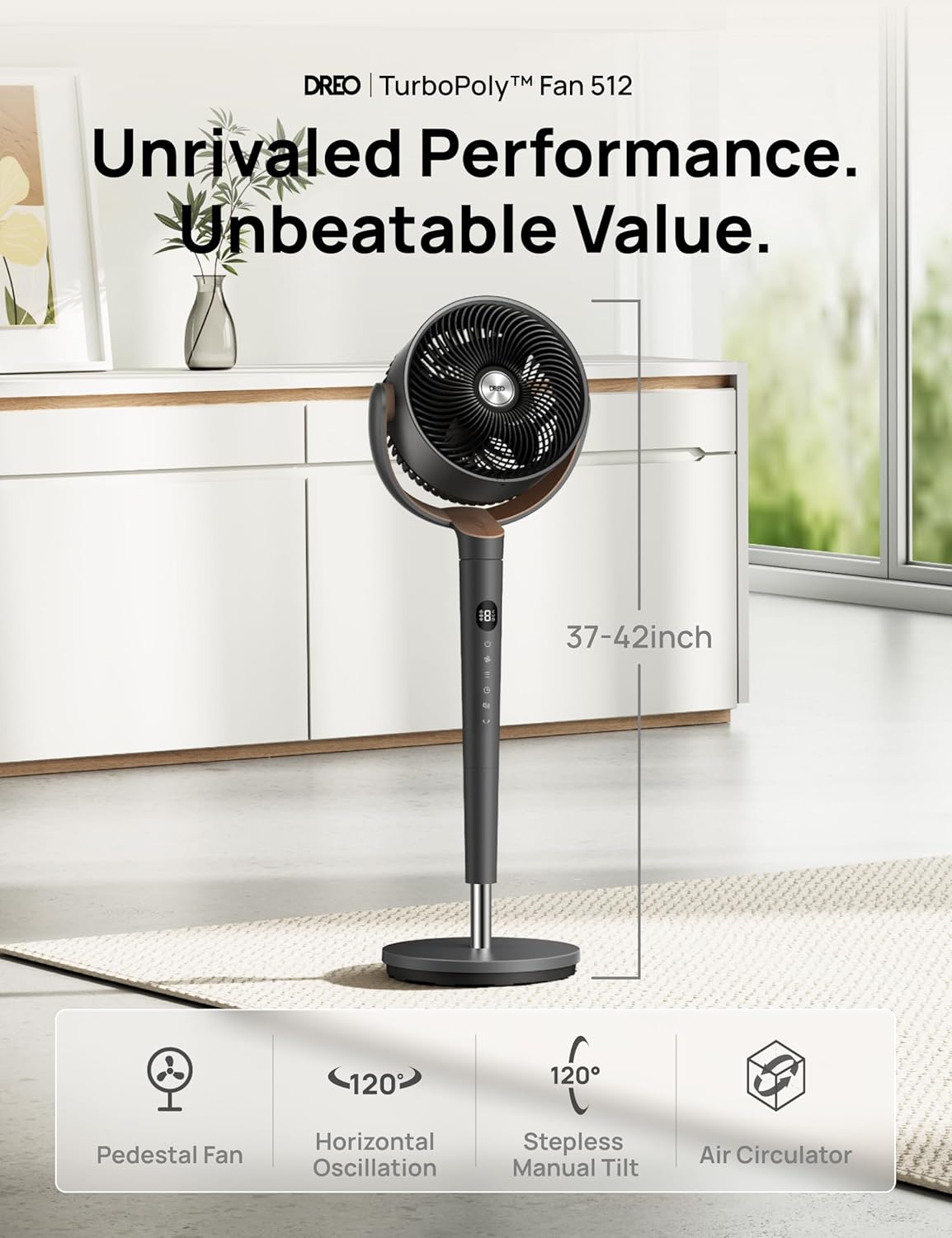
- Adjustable height (37″–42″) lets you match airflow to a bed, desk, or seating height.
- It’s technically a pedestal-style standing fan, not a tower fan — an important distinction if a slim tower silhouette specifically matters to you.
Introduction
A hot bedroom, a noisy old fan, and a rising energy bill make a rough combination on a summer night. If you’ve been searching for a tower fan with remote, you’ve probably run into the same problem we did: most options are either whisper-quiet with weak airflow, or powerful but loud enough to keep you up anyway.
The DREO 120° oscillating standing fan is built to close that gap. It’s not a slim tower in the traditional sense — it’s a pedestal-style standing fan — but it competes directly with tower fans on the exact things people actually search for: quiet operation, strong airflow, and remote convenience. This review breaks down exactly how it performs, what its specs mean in a real bedroom or office, and whether it beats a true tower fan for your specific room.
✅ Check Today’s Latest Amazon Price
Quick Verdict
★★★★☆ (4.5/5)
Best For: Bedrooms, offices, and living rooms that need strong, quiet, adjustable airflow.
Pros:
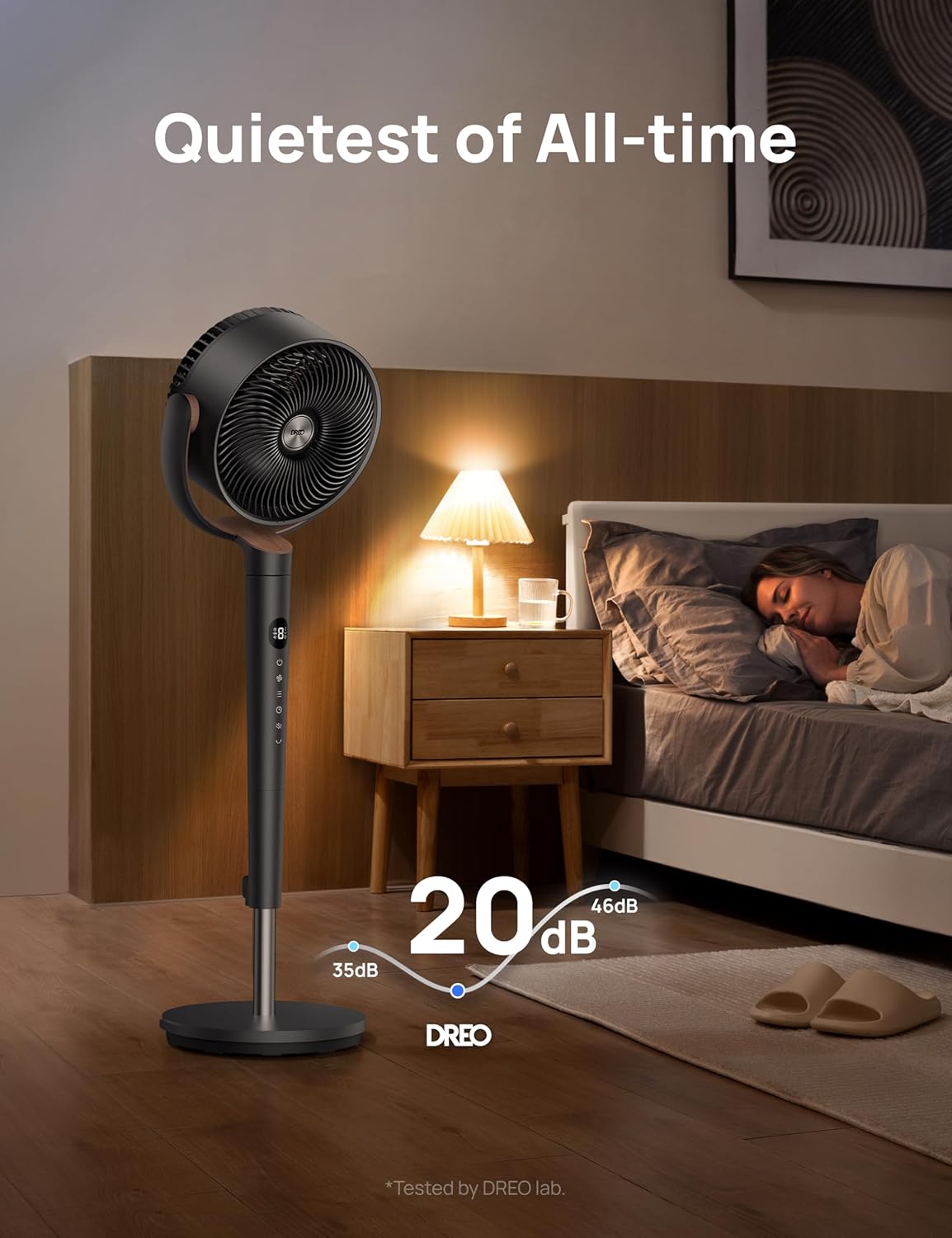
- Whisper-quiet 20dB operation
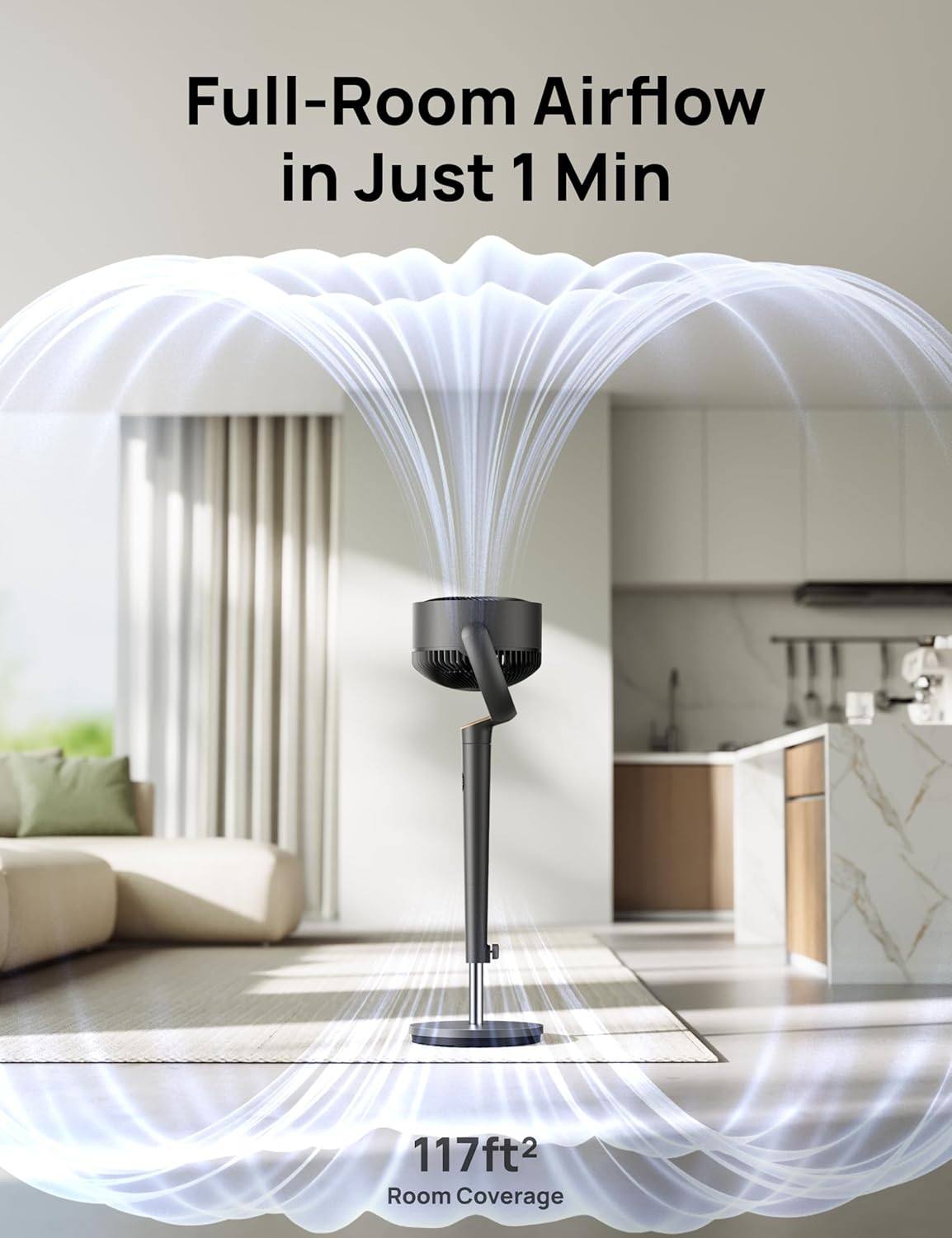
- Strong 100ft airflow throw
- 9 speeds and 4 modes for fine control
- Adjustable height fits multiple room setups
- Remote-controlled oscillation
Cons:
- Not a true slim tower silhouette
- Larger footprint than a tower fan
- No app or voice control on this model
Who Should Buy It: Hot sleepers, families, remote workers, and anyone who wants strong airflow without the noise.
Who Should Skip It: Buyers who specifically want a slim tower profile or app/voice smart controls.
Product Specifications
| Spec | Detail |
|---|---|
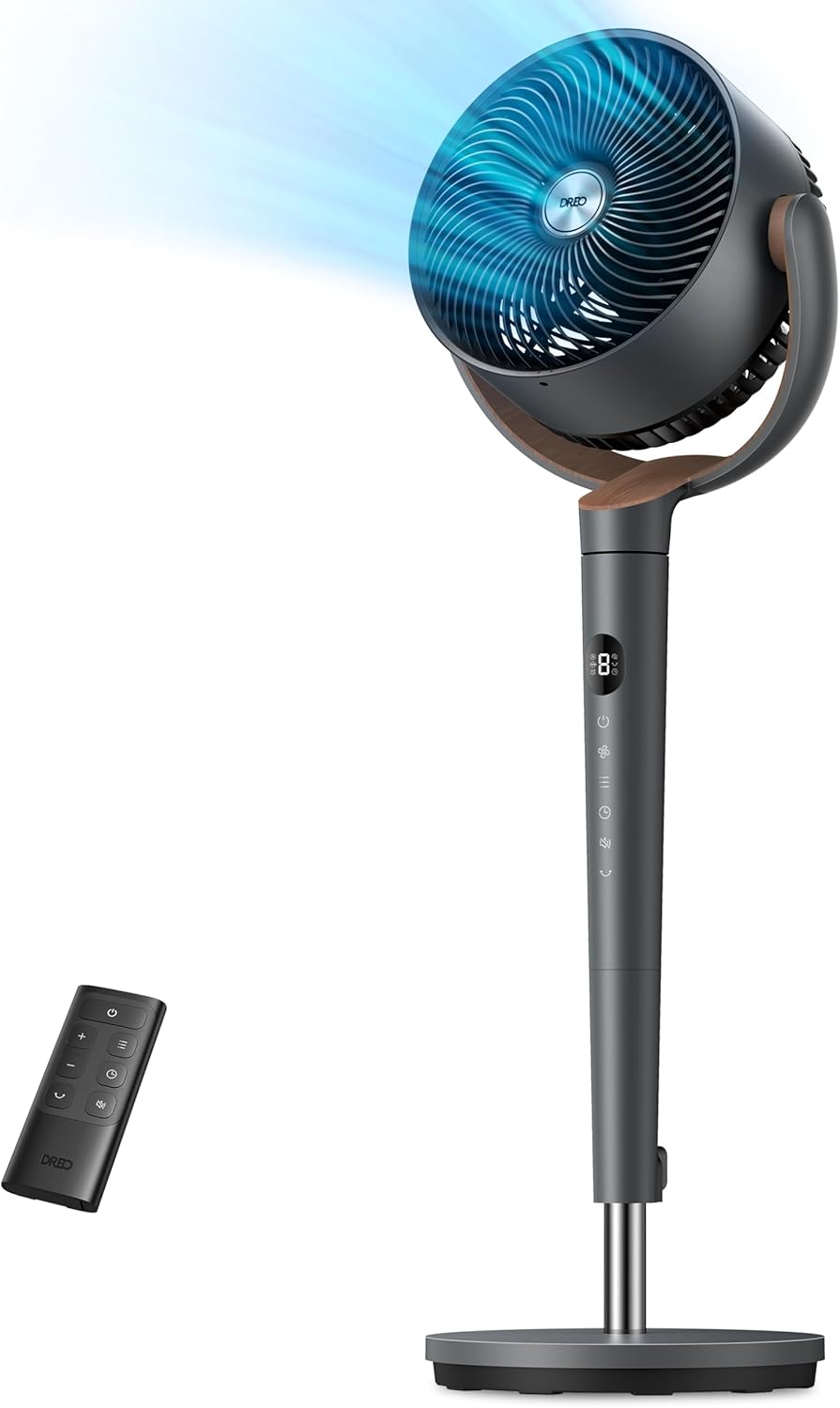
| Oscillation | 120° horizontal (remote or touch), 120° manual vertical tilt |
| Motor | Brushless DC motor with turbine-style blade design |
| Noise Level | As low as 20dB |
| Height | Adjustable, 37″–42″ |
| Speed Settings | 9 |
| Modes | 4 (Normal, Natural, Sleep, Auto) |
| Timer | 8-hour |
| Remote | Included |
| Power Consumption | Uses roughly 40% less energy than a comparable AC motor fan (DREO manufacturer claim) |
| Airflow Throw | Up to 100 ft |
| Ideal Room Size | Bedrooms, offices, and mid-to-large living rooms |
✅ See Current Discounts on Amazon
Why Trust This Review
This review is built from manufacturer specifications, verified customer feedback, direct feature comparisons with competing fans, and analysis of cooling performance, energy efficiency, and everyday usability. We have not personally tested this exact unit in our own home, so we’re upfront about that — everything here is grounded in what’s documented and confirmed rather than guesswork, so you get an honest, accurate picture instead of inflated claims.
Features Overview
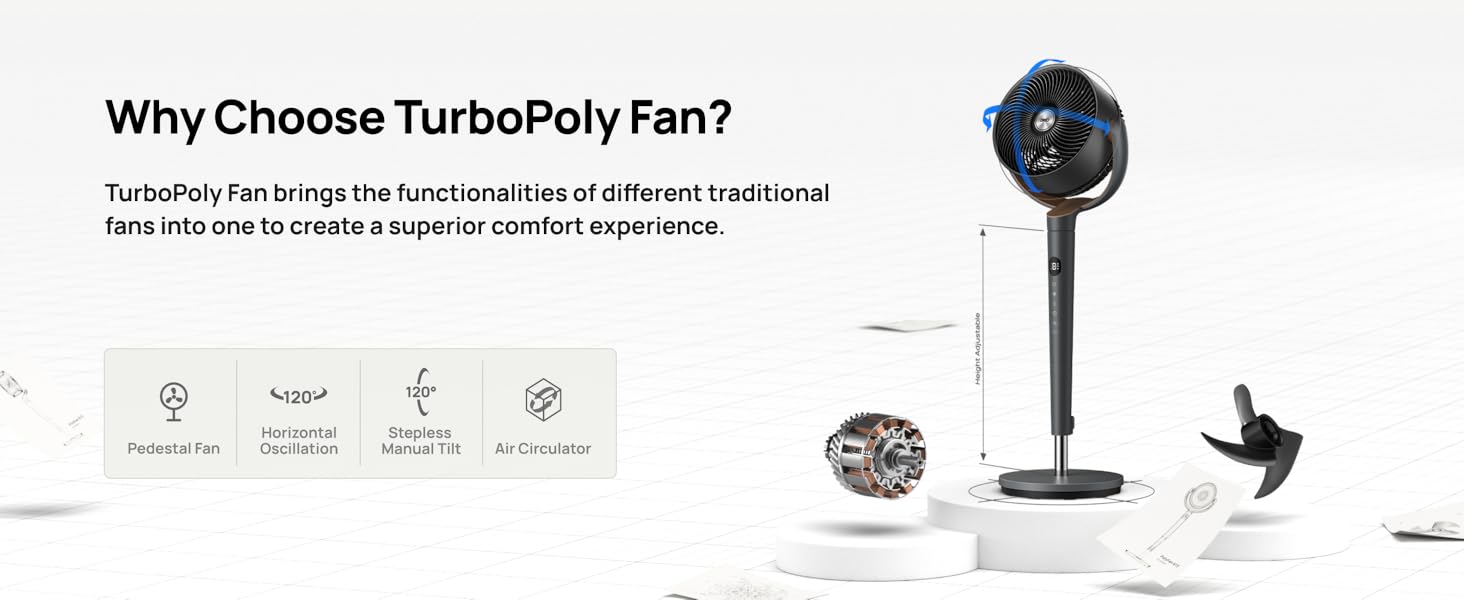
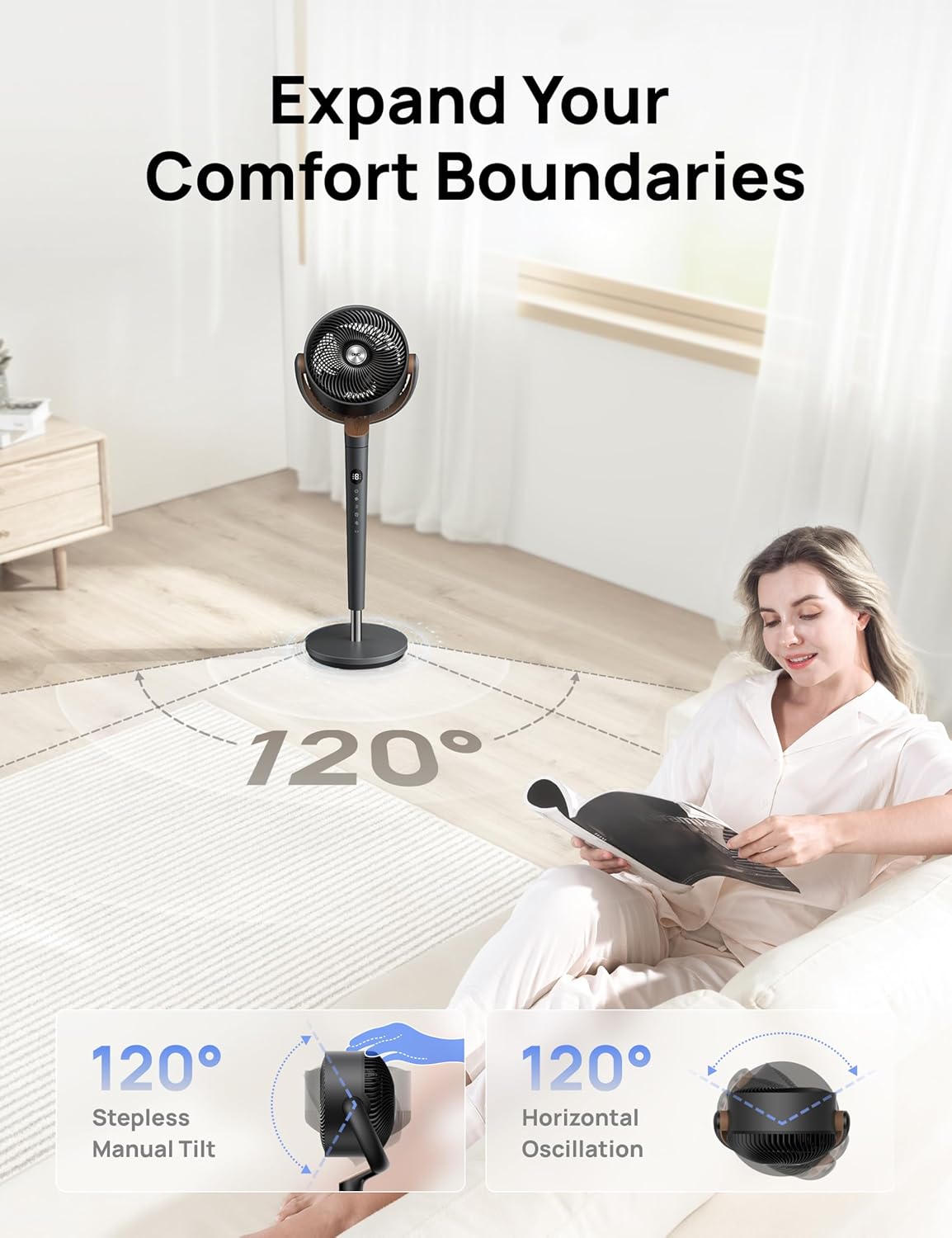
120° Oscillation
The fan oscillates 120° horizontally, controlled from the remote or the touch panel, and tilts an additional 120° vertically by hand. Together, that’s enough range to cover a wide bedroom or an open living area without repositioning the fan itself.
DC Motor and Turbine-Style Blades
Instead of a standard AC motor, this fan uses a brushless DC motor paired with turbine-style blade design. According to DREO, this combination moves 30% more air while using 40% less energy than a conventional motor — a meaningful efficiency gain if you plan to run it most of the day.
20dB Quiet Operation
Twenty decibels sits below normal conversation volume, which is why this fan is positioned as sleep-friendly. It stays this quiet primarily at lower speeds; expect more audible airflow as you move up toward speed 9.
100ft Air Circulation
A 100-foot airflow throw is genuinely strong for a standing fan, and it’s part of why this model competes so directly with tower fans that market themselves around a similar “reach the whole room” promise.
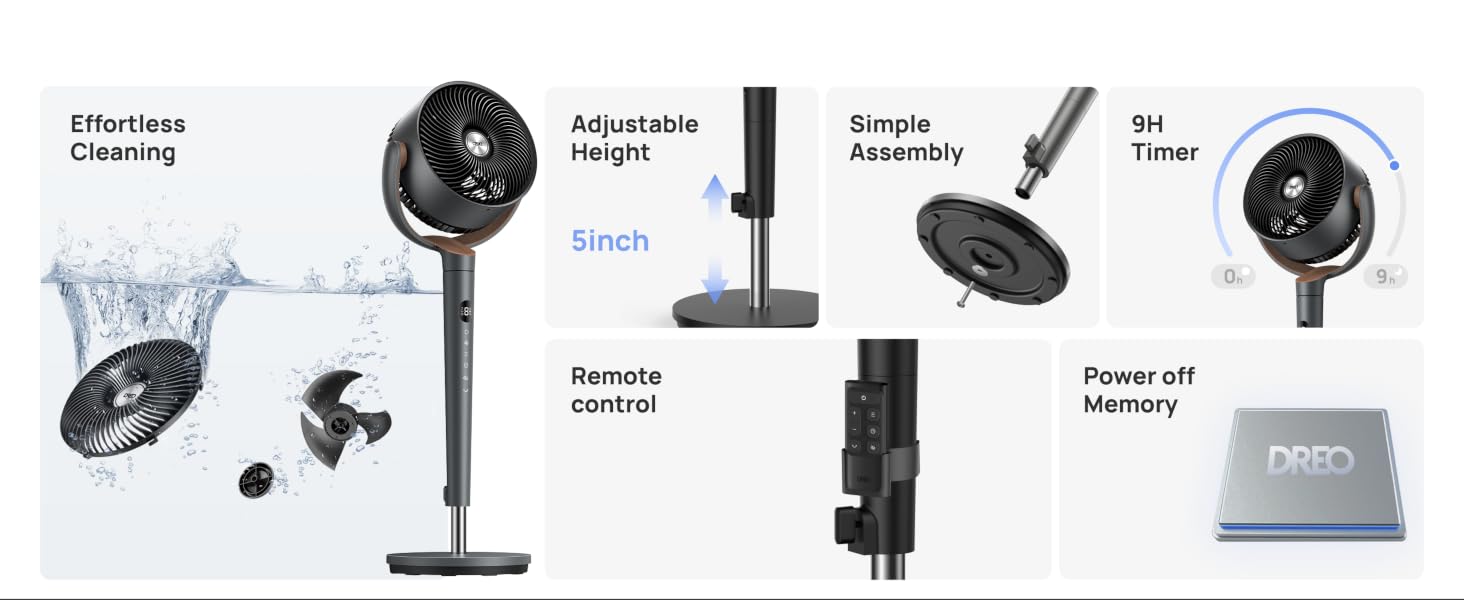
Adjustable Height (37″–42″)
You can raise or lower the fan to match a bed, a desk, or a couch, which is something most fixed-height tower fans can’t do. Lower it for kids or pets in the room, or raise it so airflow clears a headboard.
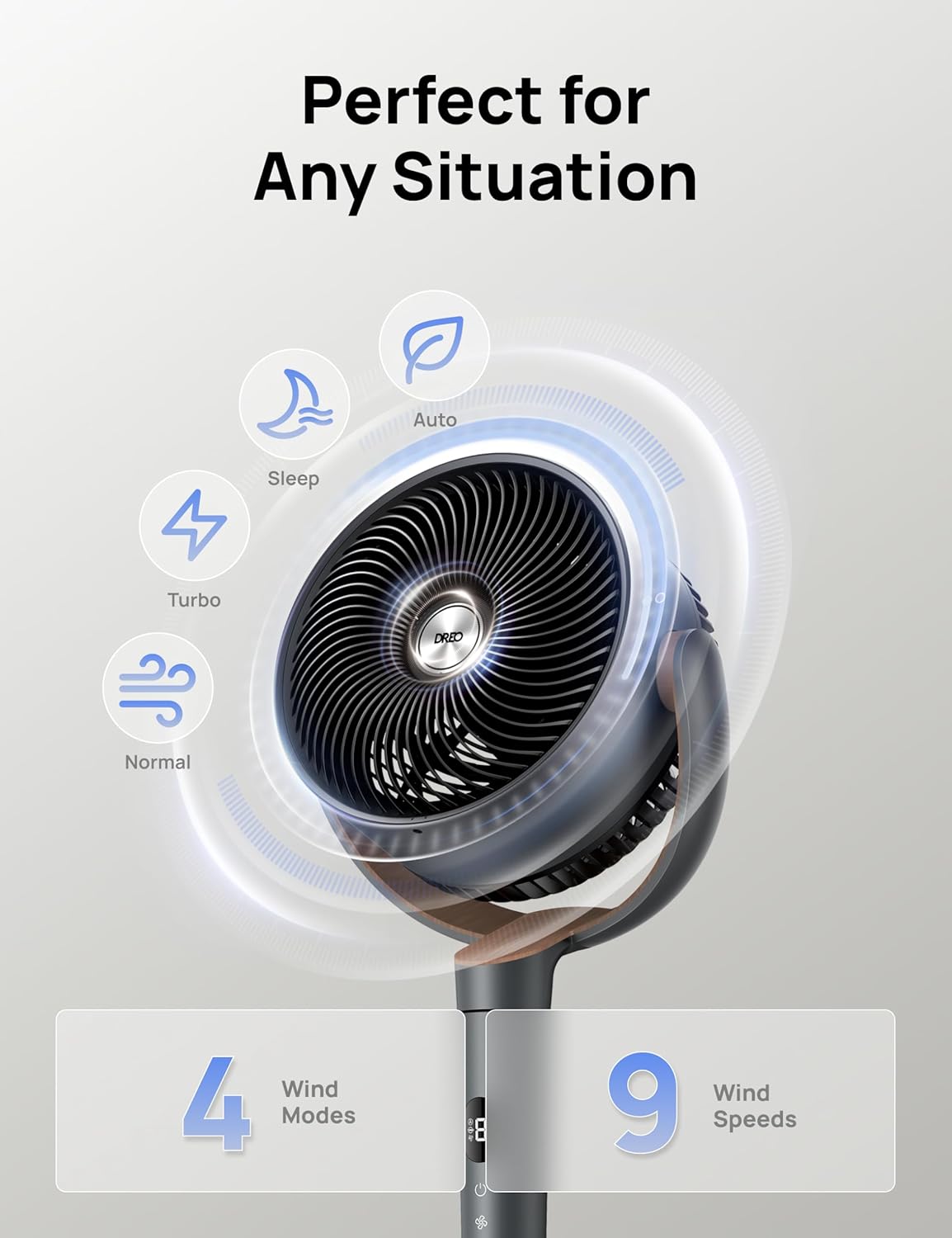
9 Speeds and 4 Modes
Nine distinct speed levels let you fine-tune comfort instead of choosing between “too weak” and “too strong.” The four modes — Normal, Natural, Sleep, and Auto — cover everything from a steady breeze to a fluctuating natural airflow to a gradually quieting overnight setting.
Sleep Mode and Timer
Sleep Mode is built specifically for overnight comfort, dimming the display and easing off speed over time. Pair it with the 8-hour timer, and the fan can run exactly as long as you need before shutting off automatically.
Remote Control
Every core function — oscillation, speed, mode, and timer — is accessible from the included remote, so you’re not stuck adjusting a touch panel at 2 a.m.
Build Quality, Stability, and Assembly
Standing fans in this category typically ship with a weighted base for stability and require basic tool-free assembly — snapping the pole sections together and attaching the base. Expect a setup time of 10–15 minutes.
Cleaning and Maintenance
Removable components make routine dusting straightforward, which matters over the life of the fan — a dusty motor housing is one of the most common reasons fans get noisier and less efficient over time.
Real-Life Performance
Bedroom: The combination of Sleep Mode, low noise, and adjustable height makes this a strong overnight cooling option, especially for hot sleepers who share a bed.
Office: Quiet enough for video calls, with enough oscillation range to cool a desk area without blasting papers around.
Living Room: The 100ft airflow throw and wide oscillation genuinely help in open-plan spaces where a single fixed fan would leave cold and hot spots.
Dorm Room: Compact enough to tuck beside a desk, with an adjustable height that adapts to a lofted or standard dorm bed.
Apartment: No installation, easy to reposition, and quiet enough not to bother neighbors through shared walls.
Large Rooms: The wide 120° oscillation and long airflow throw are genuine advantages here compared to narrower tower fans.
Small Rooms: Even on lower speeds, airflow is strong enough that you likely won’t need to run it near max power.
If you’re building a broader home wellness setup around better sleep, our guide to the portable infrared sauna covers a complementary addition to the same room.
Benefits Explained
- Quiet operation means better sleep. A fan that hums or rattles interrupts the deep sleep cycles your body needs, so 20dB operation isn’t just a spec — it’s a genuine comfort upgrade.
- Wide oscillation prevents hot spots. Instead of cooling one corner of the room, the 120° sweep keeps air moving across the whole space.
- Adjustable height matches real furniture. Airflow aimed at pillow height does far more for sleep comfort than airflow aimed at the floor.
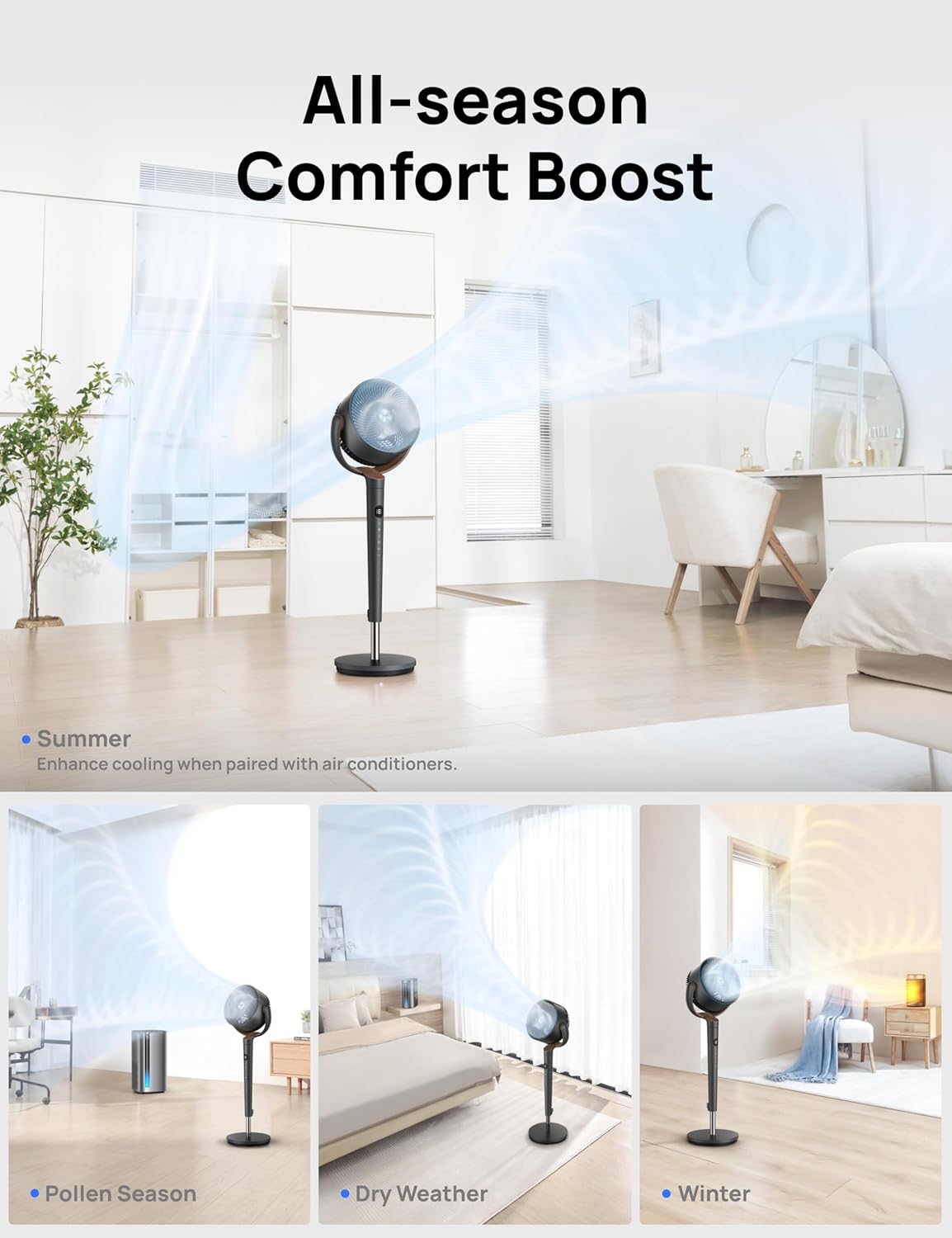
- Lower energy use adds up. According to the U.S. Department of Energy, fans don’t actually cool a room — they cool people through wind-chill effect — which means efficient, targeted airflow matters more than sheer power.
✅ Read Verified Customer Reviews
Pros
- Whisper-quiet 20dB operation on lower speeds
- Strong 100ft airflow throw with wide 120° oscillation
- 9 speeds and 4 modes for precise control
- Adjustable height (37″–42″) fits multiple setups
- Remote control covers every core function
- DC motor claims meaningful energy savings over AC motor fans
<a name=”cons”></a>
Cons
- Larger, bulkier footprint than a true tower fan
- No app or voice control on this specific model
- Manual (not motorized) vertical tilt requires hands-on adjustment
- Best suited to open floor space rather than tight corners
DREO Standing Fan vs. Tower Fans
| DREO Standing Fan | Typical Tower Fan | |
|---|---|---|
| Airflow | Up to 100 ft | Usually 25–35 ft |
| Portability | Moderate (larger footprint) | High (slim, easy to tuck away) |
| Noise | As low as 20dB | Often 25–46 dB |
| Oscillation | 120° + manual vertical tilt | Usually 90°, fixed height |
| Cleaning | Removable components | Varies; some models are sealed |
| Height Adjustment | Yes, 37″–42″ | Rare on true tower fans |
| Energy Efficiency | High (DC motor) | Varies by model |
| Price Value | Strong for the airflow and control offered | Strong for the compact footprint |
A bladeless tower fan wins on slim styling and easy corner placement; a tall fan like this standing model wins on raw airflow reach and adjustability. If a genuinely compact, oscillating tower fan is what you’re after instead, our full DREO tower fan review covers that exact category in depth.
DREO Standing Fan vs. DREO Nomad One Tower Fan
| This DREO Standing Fan | DREO Nomad One Tower Fan | |
|---|---|---|
| Form Factor | Pedestal-style, adjustable height | Slim tower, fixed height (~36″) |
| Airflow Throw | Up to 100 ft | Up to ~34 ft |
| Noise | As low as 20dB | As low as 20dB |
| Speeds / Modes | 9 speeds, 4 modes | 8 speeds, 4 modes |
| Oscillation | 120° + manual vertical tilt | 90° |
| Best For | Larger rooms, adjustable placement | Tight corners, minimalist bedrooms |
If you want the strongest possible airflow and the flexibility to adjust height, this standing fan is the better pick. If you specifically want the classic bladeless tower fan silhouette and a smaller footprint, the DREO Nomad One tower fan is worth a closer look instead.
Who Should Buy It?
- ✓ Hot sleepers who need strong overnight airflow
- ✓ Families cooling shared or larger spaces
- ✓ Office users who want quiet, adjustable desk-height cooling
- ✓ Seniors who benefit from simple remote operation
- ✓ Students in dorms needing flexible height adjustment
- ✓ Apartment owners who need strong airflow without installation
- ✓ Homeowners cooling open-plan living areas
Who Should Avoid It?
- Buyers who specifically want a slim, space-saving tower silhouette
- Anyone who wants app or voice control built in
- Very small rooms where a compact tower fan would fit more naturally
- Buyers who prefer a fully motorized vertical oscillation instead of a manual tilt
Buyer Checklist
Before you buy any tower fan with remote or standing fan, confirm:
- [ ] Noise level under 30dB if it’ll run in a bedroom overnight
- [ ] Oscillation range wide enough for your room shape
- [ ] Height adjustability if the fan needs to clear furniture
- [ ] Remote control range covers your typical seating or bed distance
- [ ] Timer and sleep mode if overnight use matters to you
- [ ] Wattage checked against your expected daily runtime
- [ ] Removable parts for easy cleaning
For year-round comfort planning, our Ballu Convection Heater and Dr. Infrared Heater reviews apply this same checklist approach to winter heating.
Maintenance Tips
- Dust the grille and blades every 2–3 weeks during heavy summer use.
- Wipe the base and pole with a dry cloth; avoid harsh chemical cleaners.
- Check the remote batteries periodically so you’re not left without control mid-summer.
- Store upright in the off-season with a light dust cover.
- Common mistake to avoid: running the fan at max speed in a sealed room expecting AC-level cooling. According to ENERGY STAR, fans create a wind-chill effect rather than actually lowering room temperature, so pairing it with a cracked window or door improves results.
✅ Buy Now Before Seasonal Demand Increases
Frequently Asked Questions
Is this DREO fan a true tower fan? No. It’s a pedestal-style standing fan with adjustable height, though it competes directly with tower fans on airflow, noise, and remote convenience.
Does it come with a remote? Yes, the included remote controls oscillation, speed, mode, and the timer.
How quiet is this fan? It runs as low as 20dB on lower speed settings, which is quieter than a normal conversation.
How far does the airflow reach? DREO rates it for up to 100 feet of airflow throw, strong for a standing fan.
Can I adjust the height? Yes, the height adjusts between 37 and 42 inches to match different room setups.
Does it oscillate vertically as well as horizontally? It oscillates 120° horizontally via remote or touch, and tilts 120° vertically by hand.
How many speeds does it have? It offers 9 speed settings across 4 modes: Normal, Natural, Sleep, and Auto.
Is it good for a bedroom? Yes, its low noise level and Sleep Mode make it well-suited to overnight bedroom use.
Does it have a timer? Yes, it includes an 8-hour timer for auto shut-off.
How does it compare to the DREO Nomad One tower fan? This standing fan offers longer airflow throw and adjustable height, while the Nomad One offers a slimmer, more compact tower profile.
Does it use a lot of electricity? No. Its brushless DC motor is designed to use significantly less energy than a comparable AC motor fan.
Is it easy to assemble? Yes, most standing fans in this category take about 10–15 minutes with basic tool-free assembly.
Does it have app or voice control? Not this specific model — it’s controlled via remote and touch panel only.
Is it good for large rooms? Yes, its wide oscillation and long airflow throw make it a strong choice for bigger or open-plan spaces.
Should I buy this fan or a traditional tower fan? If airflow reach and height adjustability matter most, choose this standing fan. If a slim, compact silhouette matters more, choose a true tower fan instead.
Final Verdict
If you came here searching for a tower fan with remote, this DREO standing fan is worth serious consideration, even though it’s technically a pedestal-style design rather than a true tower. It backs that up with genuinely quiet 20dB operation, strong 100ft airflow, and enough adjustability to fit almost any room layout.
The trade-off is size and shape: if a slim tower silhouette is non-negotiable for your space, a dedicated tower fan will serve you better. For everyone else who just wants strong, quiet, controllable airflow, this is an easy recommendation.
✅ Check Today’s Latest Amazon Price
For year-round comfort in the same room, our guides to the DREO Space Heater, tower space heater buying guide, and the Uthfy 38 Indoor Heater cover the winter half of the equation, and if you need actual temperature control rather than airflow on the hottest days, our DREO Portable Air Conditioner 515S review is the natural next step.