Short Product Summary
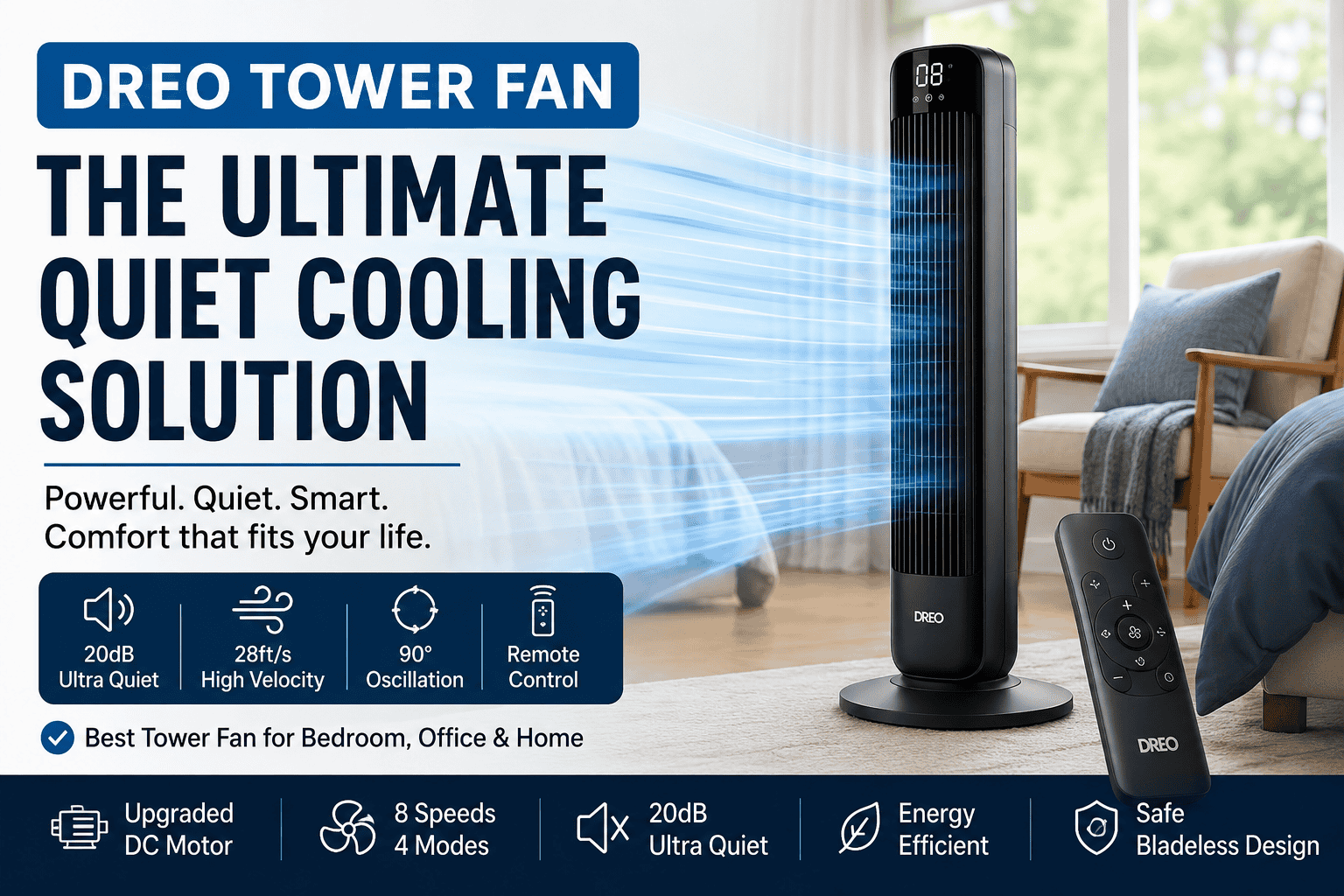
The DREO Tower Fan for Bedroom (model DR-HTF007) is a bladeless, 90° oscillating standing fan built around an upgraded brushless DC motor. It pushes air up to 28 ft/s, runs as quiet as 20dB on its lowest setting, and gives you 8 speeds across 4 modes — Normal, Natural, Sleep, and Auto — all controllable from the included remote or the onboard touch panel.
Key Takeaways
- The DREO tower fan reaches 28 ft/s wind velocity with an air throw of roughly 34 feet, strong enough for bedrooms, offices, and mid-size living rooms.
- It runs as low as 20dB on its quietest setting, making it one of the more genuinely quiet standing fans in its price range.
- 8 speeds and 4 modes (Normal, Natural, Sleep, Auto) give you far more control than a typical box or pedestal fan.
- The bladeless, removable-grille design makes it safer around kids and pets and easier to clean than blade-style fans.
- At roughly 9 lbs and 36 inches tall, it’s light enough to move between rooms but stable enough not to tip easily.
Introduction
A hot night with a loud, wobbly fan is its own kind of misery. That’s the exact problem the DREO tower fan sets out to solve. Instead of the rattly box fan you grew up with, this bladeless standing fan is built around a quiet DC motor, real airflow control, and a design that doesn’t look out of place next to your nightstand.
We’ve spent time digging into exactly how this fan performs — not just the marketing bullet points, but what the noise level, oscillation, and speed settings actually mean for a real bedroom, office, or living room. By the end of this review, you’ll know exactly whether the DREO tower fan fits your space, and how it stacks up against a standing fan, pedestal fan, or box fan you might already own.
✅ Check Today’s Price on Amazon
Product Overview
| Spec | Detail |
|---|---|
| Brand | DREO |
| Model | DR-HTF007 |
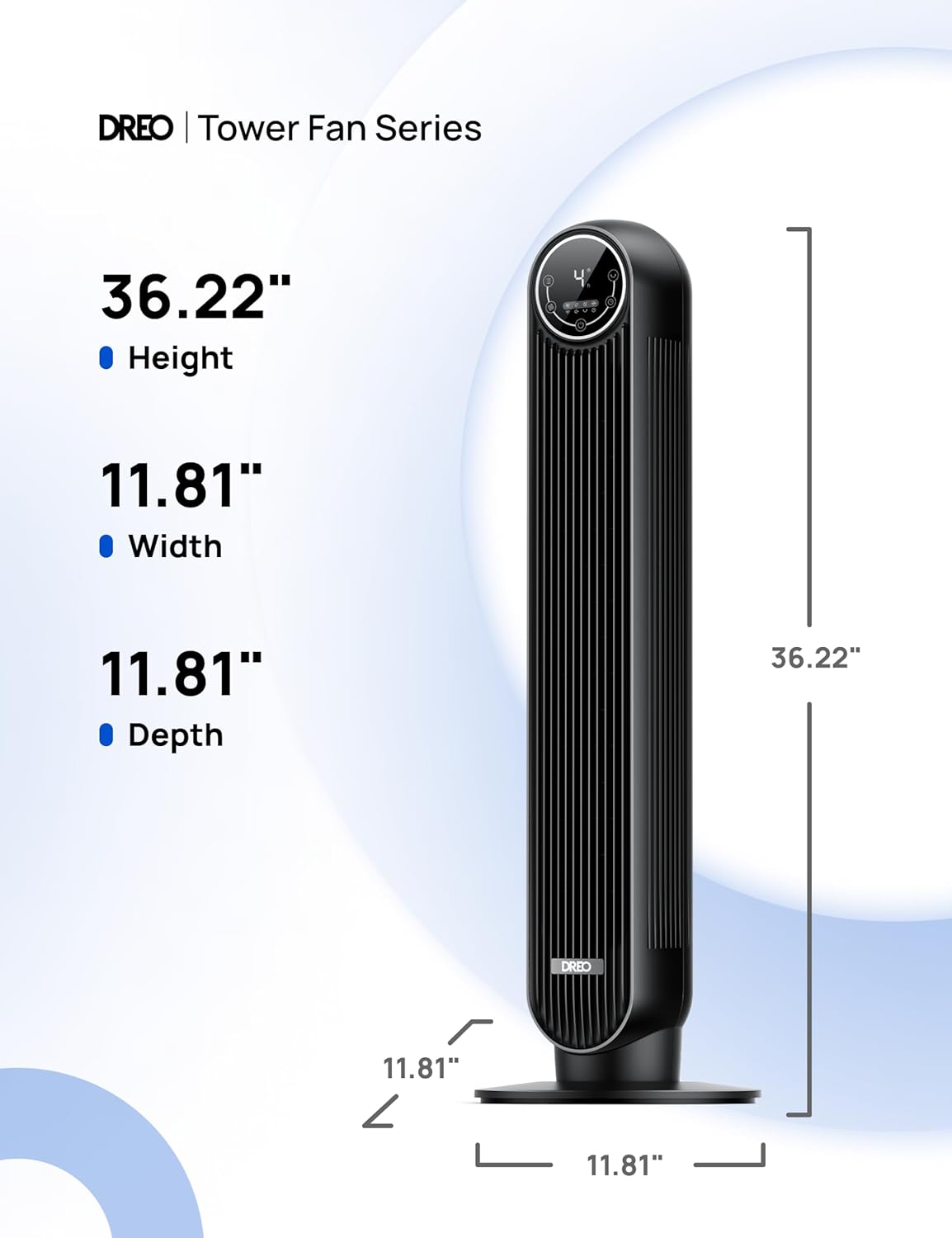
| Dimensions | ~36″ H x 11.81″ W x 11.81″ D |
| Weight | ~9 lbs |
| Noise Level | As low as 20dB |
| Motor Type | Upgraded brushless DC motor with TurboWind technology |
| Oscillation | 90° |
| Speed Levels | 8 |
| Modes | 4 (Normal, Natural, Sleep, Auto) |
| Timer | 8-hour |
| Remote | Included, with built-in storage compartment |
| Suitable Room Size | Bedrooms, offices, and living rooms (roughly up to 250–300 sq ft) |
| Warranty | 12-month manufacturer warranty (extendable by registering at dreo.com/warranty) |
| Pros | Whisper-quiet, strong airflow, easy to clean, bladeless safety design |
| Cons | No app or voice control on this model, corded (not battery/cordless) |
| Best For | Bedrooms, home offices, apartments, nurseries |
✅ View Current Discounts on Amazon
What Is the DREO Tower Fan?
The DREO tower fan is a bladeless, oscillating standing fan designed to replace both your noisy box fan and your wobbly pedestal fan in one slim unit. Instead of exposed blades, it uses an internal impeller and a calibrated airflow duct to push air out through a tall, narrow tower — a design that’s both safer and easier on the eyes.
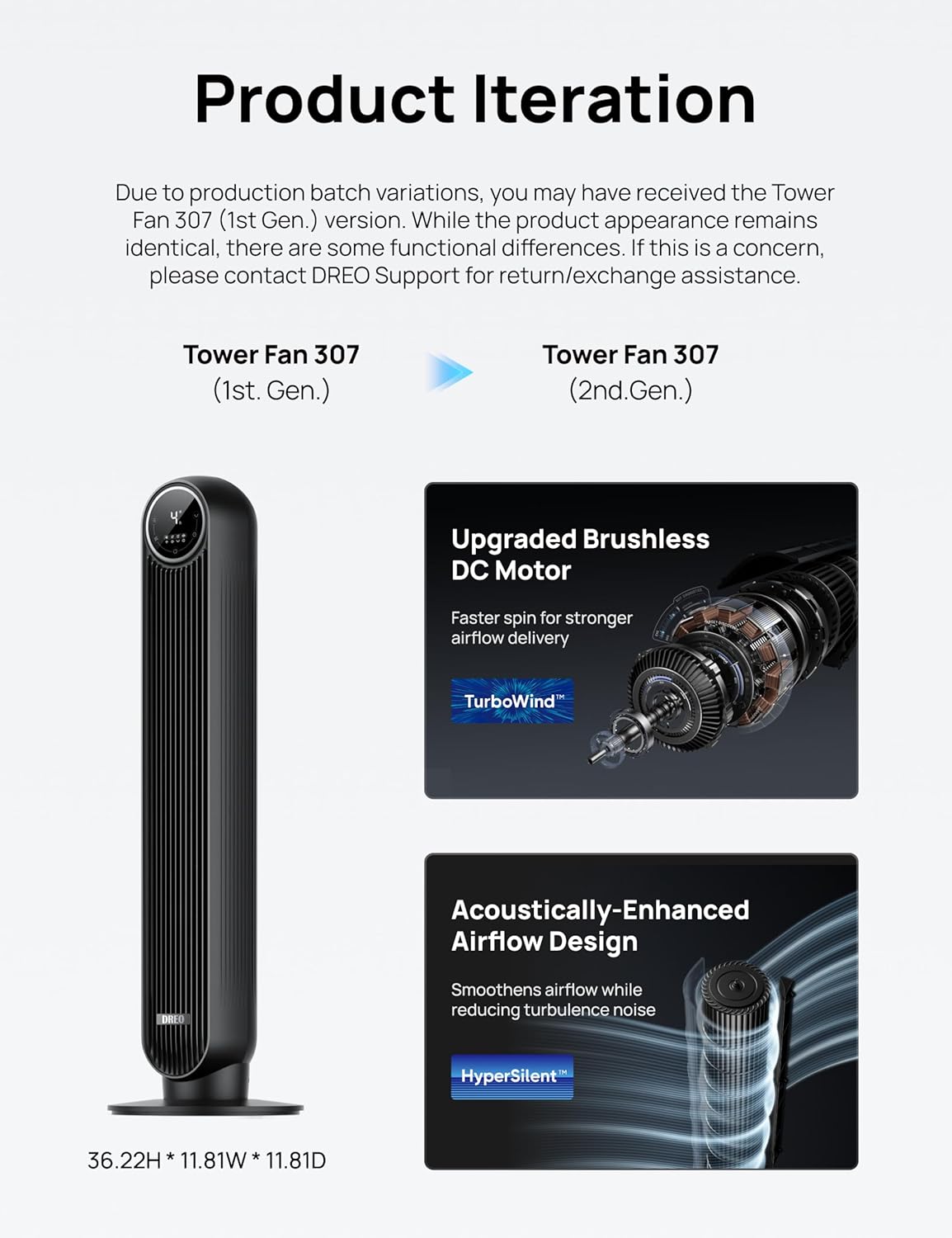
At its core is an upgraded brushless DC motor paired with what DREO calls TurboWind technology, which is engineered to deliver stronger airflow without a matching jump in noise. That combination is what separates this fan from the cheap tower fans you’ll find at a big-box store for half the price.
Who Should Buy It?
This fan is built for people who care about noise as much as raw cooling power. That includes:
- Light sleepers who need airflow without a droning motor
- Remote workers who want quiet background cooling during calls
- Parents looking for gentle white-noise-style airflow near a nursery
- Renters and apartment dwellers who can’t install a window AC
- Pet owners who want a bladeless design that’s safer around curious paws
Why It Stands Out
Most tower fans in this price range force a trade-off: you get either strong airflow or quiet operation, rarely both. The DREO tower fan is built specifically to close that gap, using its motor and duct design to push air at up to 28 ft/s while staying as quiet as 20dB on lower settings. Add in 8 distinct speeds, 4 modes, and a genuinely useful Auto mode, and you get a fan that adapts to the room instead of forcing you to adapt to it.
Design and Build Quality
At about 36 inches tall and 9 lbs, the DREO tower fan is slim enough to tuck into a corner without dominating the room. The matte black finish and rounded tower shape feel more like a piece of furniture than an appliance, which matters if it’s going to sit in your bedroom or living room long-term.
Build quality feels solid rather than flimsy, with a stable base and a top-mounted touch panel that’s simple to use even in the dark. If aesthetics matter as much as function in your home comfort purchases, our review of the Uthfy 38 Indoor Heater covers a similarly design-forward option for the colder months, so your setup looks intentional year-round.
Upgraded DC Motor Explained
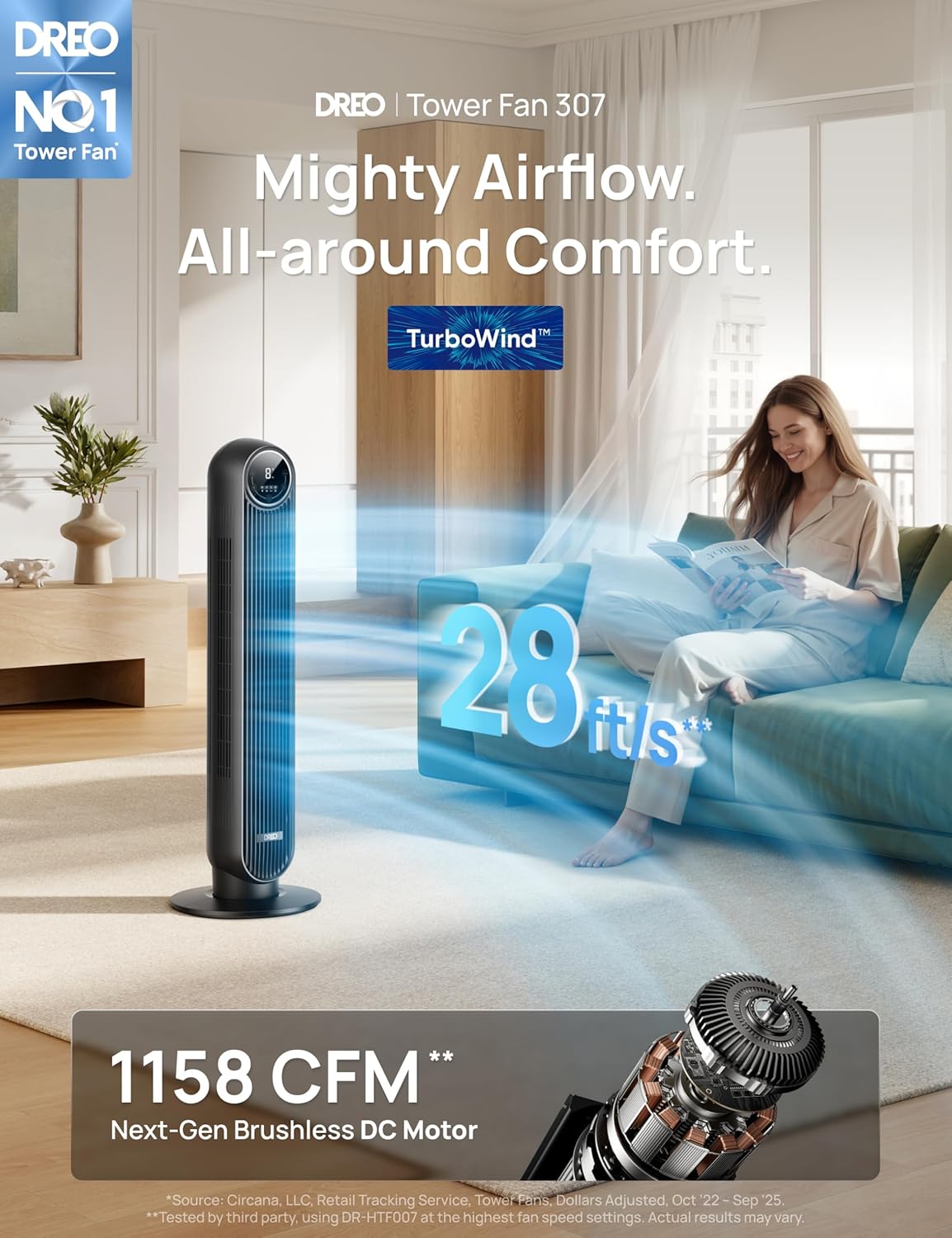
Most cheap tower fans use basic AC motors, which are simple but noisy and less efficient at lower speeds. DREO’s upgraded brushless DC motor works differently: it modulates power more precisely, which is why this fan can run at a genuine whisper on low settings instead of just a slightly quieter roar. Paired with TurboWind technology, the motor spins faster without the vibration and rattle you’d expect from a budget unit.
<a name=”air-velocity”></a>
28 ft/s Air Velocity
The headline number here is 28 ft/s of wind velocity, with an effective air throw of around 34 feet. In practical terms, that means the fan can comfortably reach across a bedroom or office rather than only cooling whoever sits directly in front of it. On higher speed settings, you’ll feel a genuinely strong breeze; on lower settings, it’s more of a steady, comfortable airflow that won’t scatter papers off your desk.
20dB Ultra-Quiet Operation
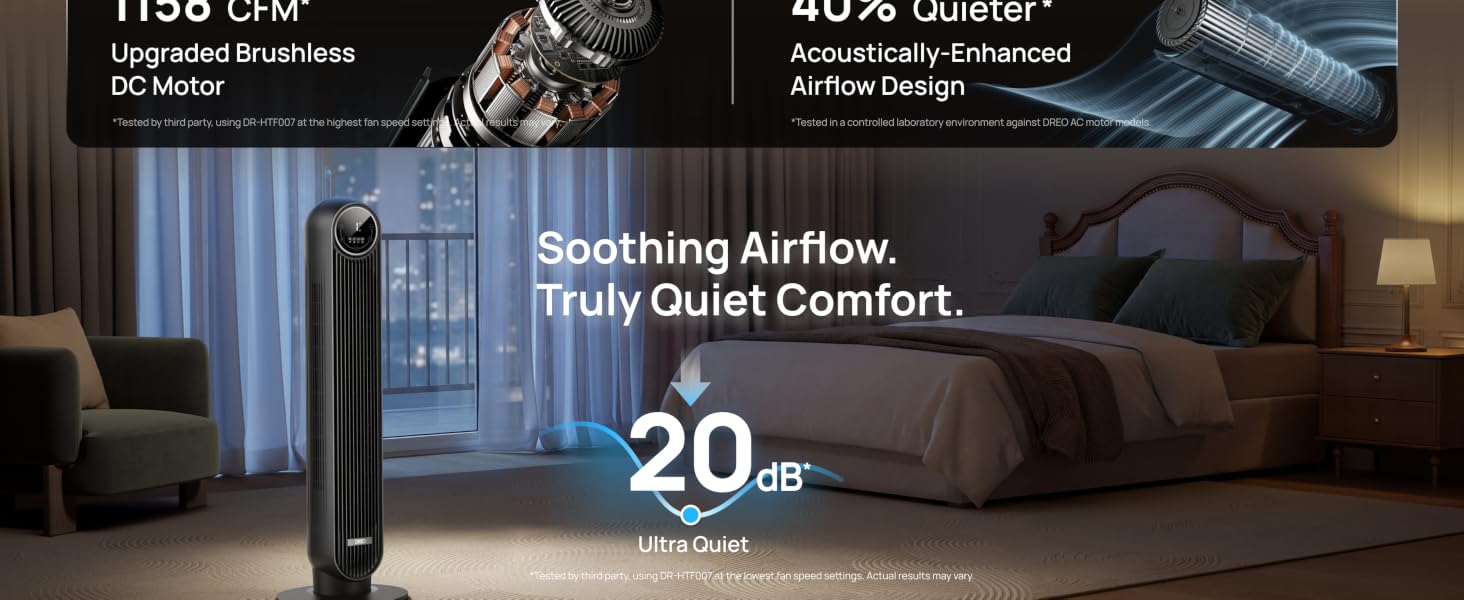
Twenty decibels is close to the sound of rustling leaves — quieter than a whispered conversation. DREO achieves this through an algorithmic impeller design that uses the Coanda effect, a principle where air clings to a curved surface to move more smoothly with less turbulence. Less turbulence means less noise, especially at lower speeds. Expect noise to rise somewhat at the top speed setting, which is normal for any fan pushing 28 ft/s of airflow, but even then it stays well within a comfortable range for shared spaces.
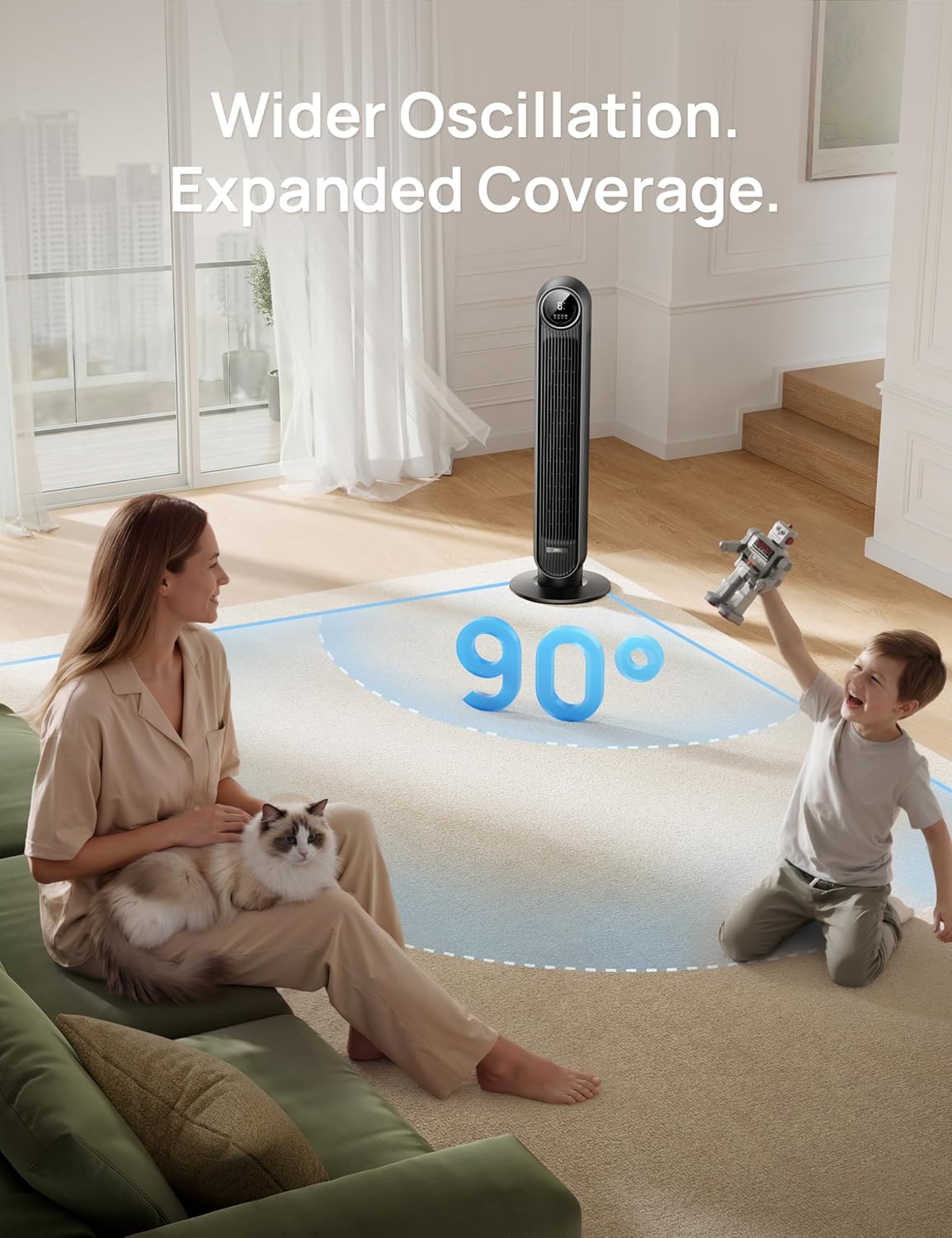
90° Oscillation Benefits
A fixed fan only cools whoever’s directly in its path. The 90° oscillation on this model sweeps air across a wider arc, which matters in rooms where you’re not always sitting in the exact same spot — a bedroom where you shift positions overnight, or an office where you move between a desk and a couch. It also helps prevent the “cold sports vs. hot spots” problem that comes with a stationary fan.
8 Speeds Explained
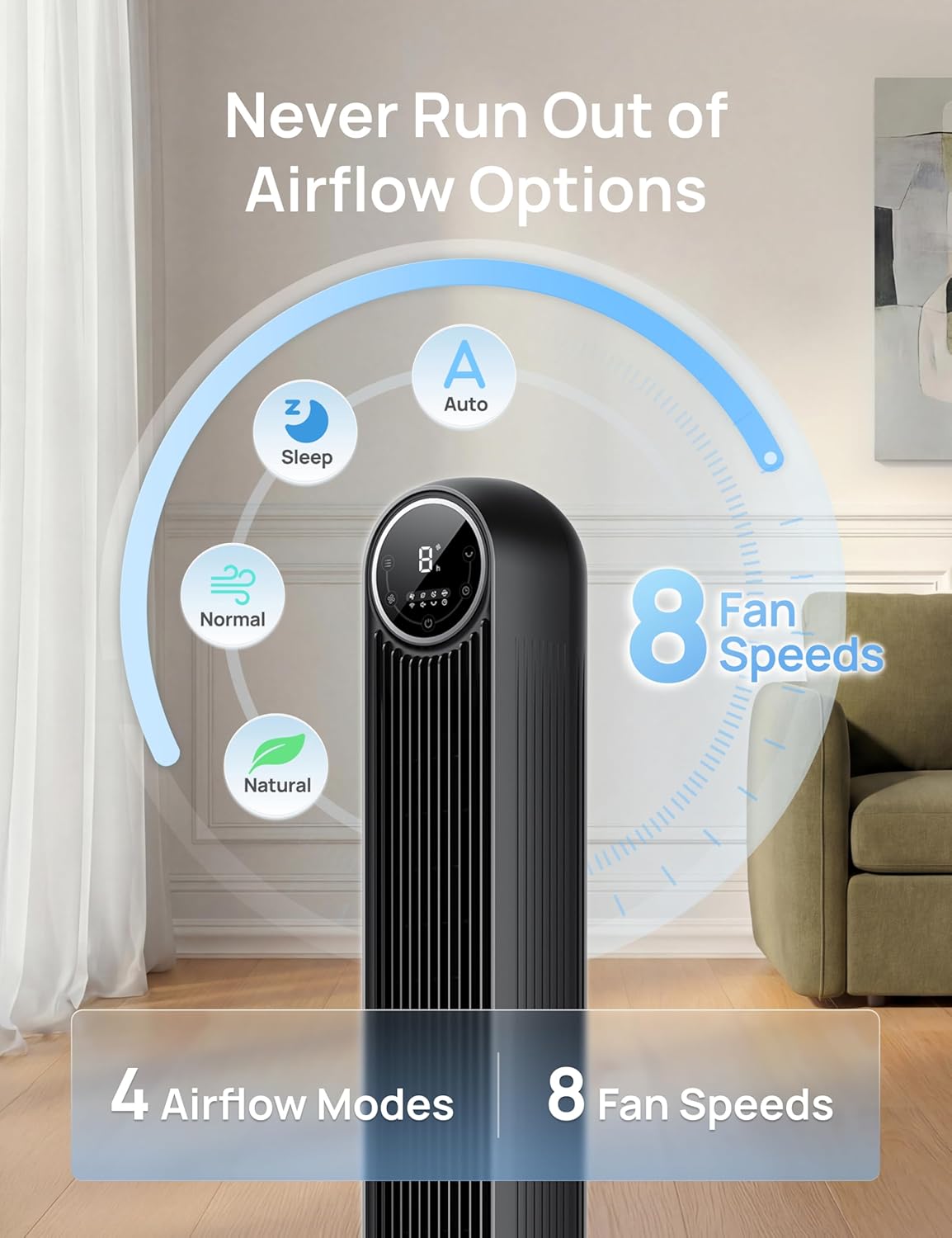
Eight distinct speed levels give you far more granular control than the typical 3-speed box fan. Low settings work well for background airflow while you sleep or work, while higher settings are better suited to hot summer afternoons or quickly cooling a stuffy room after it’s been closed up all day. Having 8 steps instead of 3 or 4 means you can fine-tune comfort instead of picking between “too weak” and “too strong.”
4 Operating Modes
- Normal Mode: Constant airflow at your chosen speed — best for daytime use.
- Natural Mode: Fluctuating airflow that mimics a natural breeze, which many people find more comfortable over long periods.
- Sleep Mode: Gradually reduces speed and dims the display for quiet, uninterrupted rest.
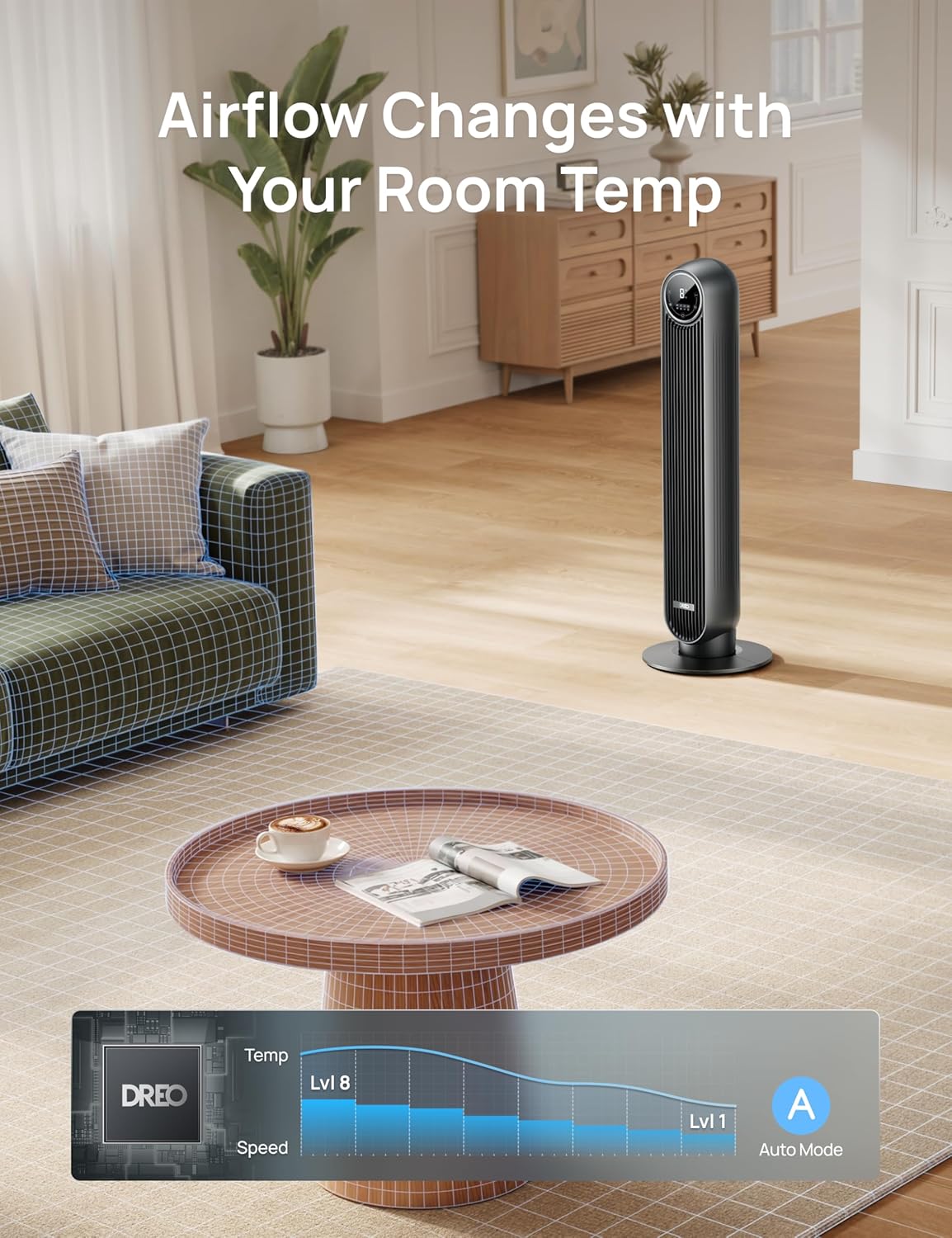
- Auto Mode: Adjusts fan speed based on ambient conditions, so you don’t have to keep adjusting it manually.
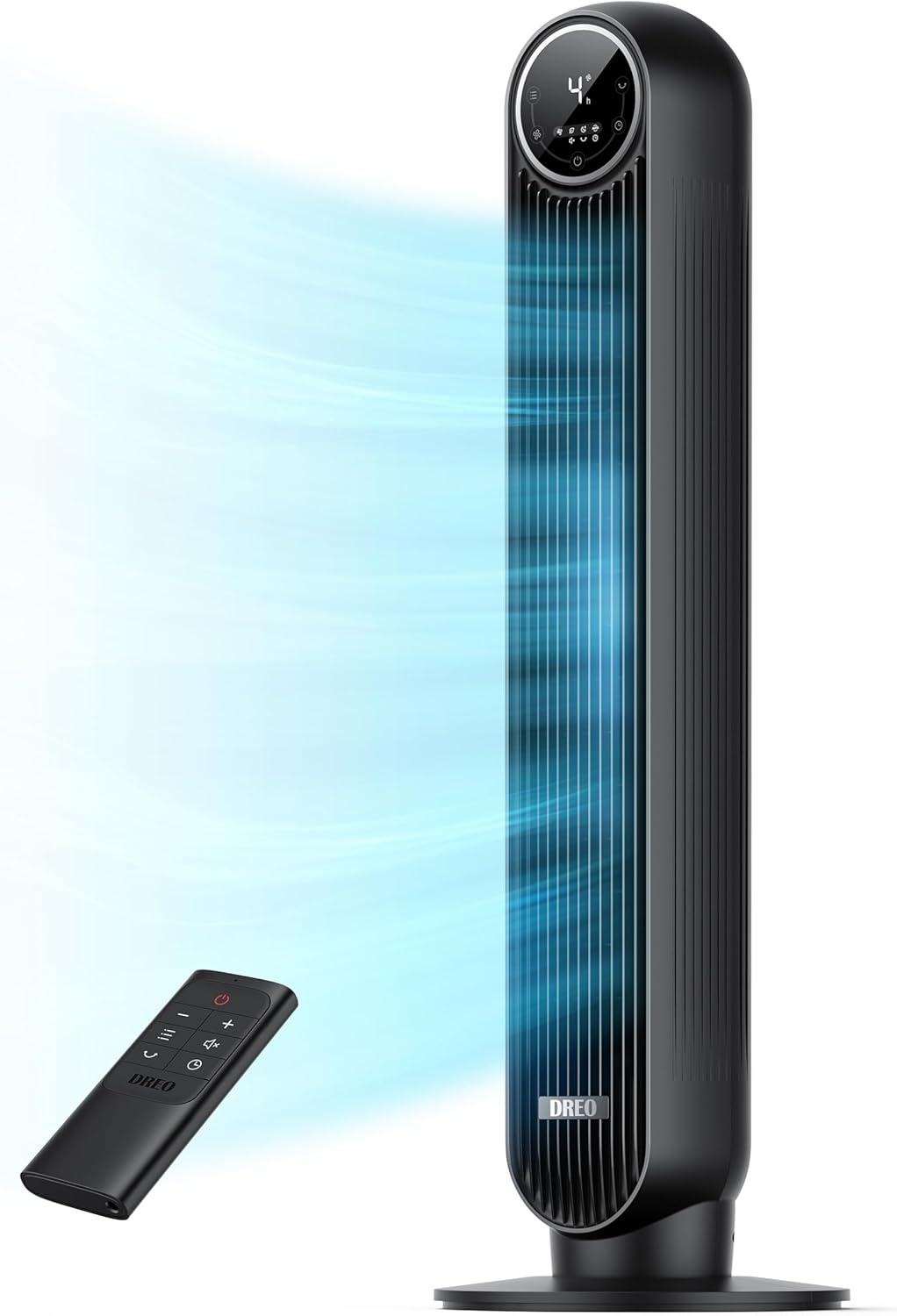
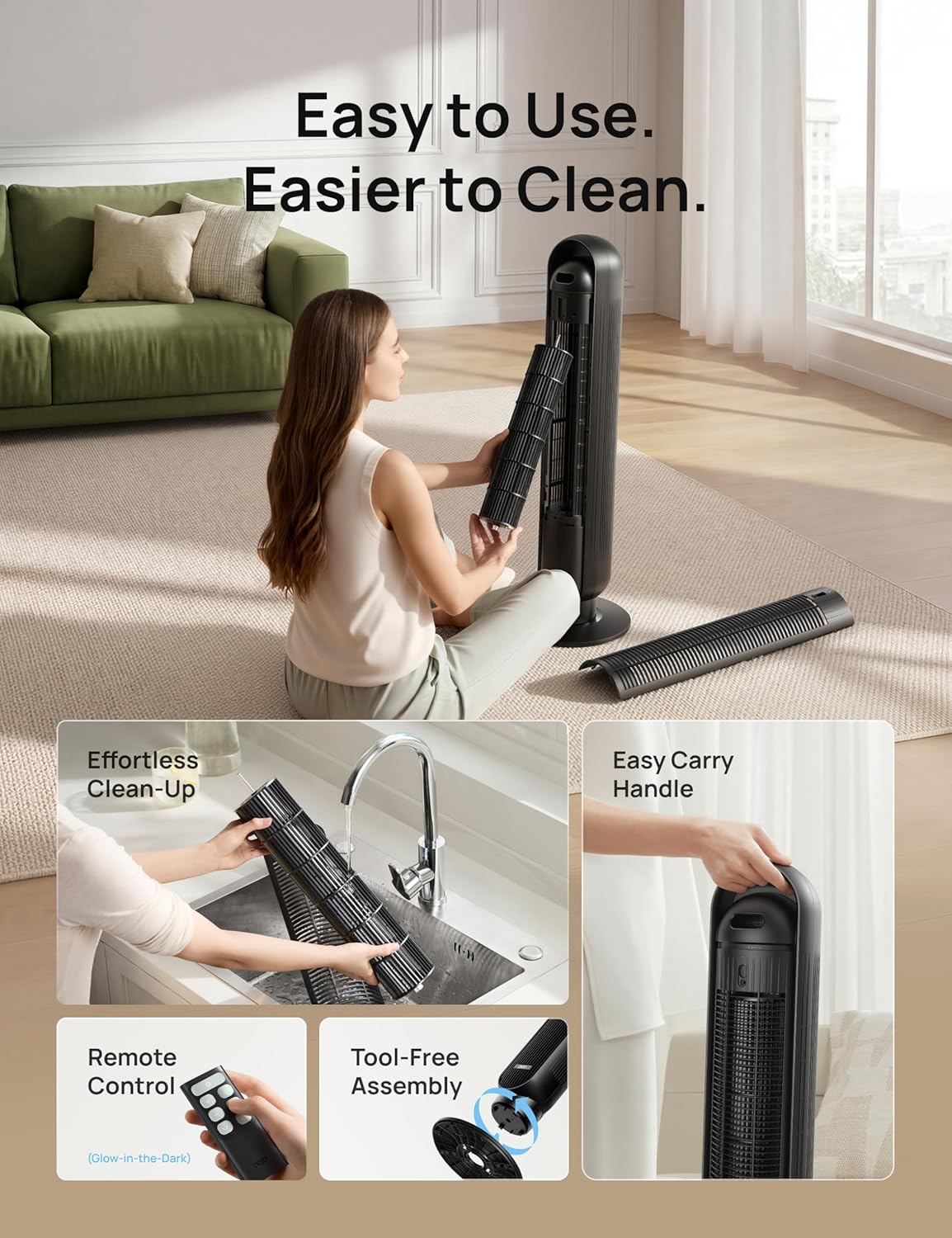
Remote Control Convenience
The included remote covers every function — speed, mode, oscillation, and the timer — without needing to get up. It also has a dedicated storage slot built into the back of the fan, which solves the classic “where did the remote go” problem. This model doesn’t include app or voice control, so if smart home integration matters to you specifically, double-check the listing for DREO’s WiFi-enabled tower fan variants before buying.
Energy Efficiency
Running at roughly 42 watts, this tower fan sips power compared to almost any air conditioner. Running it for 8 hours a night costs a small fraction of what an AC unit would over the same period, which makes it a smart choice for supplementing (or replacing) air conditioning on moderately warm nights. If you’re also comparing winter heating costs in the same room, our Dr. Infrared Heater review and Ballu Convection Heater breakdown use the same wattage-times-rate approach to estimate running costs.
Safety Features
The bladeless design is the headline safety feature here — there’s nothing for curious kids or pets to reach through the grille. Beyond that, the fan includes fingertip pinch-proof grilles, a fused plug, and built-in circuit protection, and it carries ETL safety certification. That combination makes it a reasonable pick for nurseries and family homes where a traditional blade fan might be a hard no.
Ease of Cleaning
Unlike sealed tower fans that trap dust inside, this model has a removable rear grille and impeller wheel, so you can actually get inside to clean it. This matters more than it sounds — dust buildup on an impeller is one of the most common reasons fans get noisier and weaker over time. A quick wipe-down every few weeks keeps performance consistent.
Bedroom, Office, Living Room & Apartment Performance
Bedroom: This is where the fan shines. Sleep Mode plus 20dB operation makes it genuinely easy to forget it’s running while you sleep.
Office: Quiet enough to run during video calls, with Auto mode keeping the temperature steady without you having to adjust settings mid-meeting.
Living Room: The 90° oscillation and stronger higher-speed settings make it capable of moving air across a larger shared space, though very large open-plan rooms will feel the limits of any single tower fan.
Apartment: No installation, no lease concerns, and light enough to move between rooms as needed — a natural fit for renters.
If you’re building a broader home wellness routine — better sleep, recovery, and comfort in the same room — our guide to the portable infrared sauna covers a complementary setup that pairs well with quiet, controlled airflow.
Cooling Performance During Summer
On genuinely hot days, it’s worth setting expectations correctly: a fan moves air, it doesn’t lower the actual room temperature the way an air conditioner does. What the DREO tower fan does well is create effective wind chill on your skin, which can make a room feel noticeably more comfortable even without changing the thermostat reading. It performs best in rooms with some airflow path (an open door, a slightly cracked window) rather than a fully sealed, superheated space.
Fan vs. Air Conditioner
A tower fan and a portable air conditioner solve different problems. The fan moves existing air and creates a cooling sensation through airflow; an AC actually removes heat and humidity from the room. For moderate summer nights or as a way to circulate air alongside central air conditioning, the DREO tower fan is excellent — and dramatically cheaper to run. For rooms that get genuinely hot and humid, or for anyone who needs the room temperature to actually drop, pairing it with (or upgrading to) real cooling makes more sense. We cover that exact scenario in our full DREO Portable Air Conditioner 515S review, which is a natural next step if a fan alone isn’t cutting it during peak summer heat.

Comparison Table
| DREO Tower Fan | Typical Box Fan | Traditional Pedestal Fan | Cheap Tower Fan | |
|---|---|---|---|---|
| Noise | As low as 20dB | 50–60+ dB | 40–55 dB | 45–55 dB |
| Power Consumption | ~42W | 60–100W | 50–75W | 40–60W |
| Airflow | 28 ft/s, 90° oscillation | Strong but fixed direction | Strong, adjustable angle | Moderate, often fixed |
| Safety | Bladeless, pinch-proof grille | Exposed blades | Exposed blades, tip-prone | Bladeless, thinner build |
| Remote | Included | Rarely included | Rarely included | Sometimes included |
| Oscillation | Yes, 90° | No | Yes, wider arc | Yes, limited range |
| Appearance | Sleek, modern | Utilitarian | Functional, bulkier | Basic, plasticky |
| Cleaning | Removable grille, easy | Simple but blades collect dust | Simple but blades collect dust | Often sealed, hard to clean |
| Bedroom Suitability | Excellent | Poor (too loud) | Fair | Fair to poor |
Pros and Cons
| Pros | Cons |
|---|---|
| Whisper-quiet at 20dB on low settings | No app or voice control on this model |
| Strong 28 ft/s airflow with 34-ft throw | Corded design limits placement flexibility |
| 8 speeds and 4 modes for fine control | Best suited to small-to-medium rooms, not large open spaces |
| Bladeless, pinch-proof, ETL-certified safety | Doesn’t lower room temperature like an AC |
| Removable grille for easy cleaning | — |
| Lightweight at 9 lbs, easy to reposition | — |
Buying Guide: What to Look for in a Tower Fan
Noise: If it’s running in a bedroom overnight, look for a dB rating in the 20s on low settings — anything over 40dB will be noticeable while you sleep.
Airflow: Higher ft/s ratings mean stronger cooling reach, but pair that with oscillation so the airflow actually spreads across the room.
Room size: Tower fans work best in bedrooms, offices, and mid-size living rooms. For anything approaching an open-plan layout, consider multiple fans or supplemental cooling.
Energy efficiency: Most tower fans use very little power compared to an AC — check the wattage rating if you plan to run it most of the day.
Remote control: A physical remote with a storage slot is a small feature that meaningfully improves daily convenience.
Oscillation: Wider oscillation angles cover more of the room but may feel less “directed” if you want airflow focused on one spot, like a desk.
Motor technology: Brushless DC motors run quieter and more efficiently than older AC motors — worth prioritizing if noise matters to you.
Timer: An auto shut-off timer is useful for overnight use and for energy savings.
Sleep mode: A true sleep mode gradually reduces speed and dims lights rather than just running at one constant setting all night.
Cleaning: A removable grille and accessible impeller make a real difference in long-term performance and hygiene.
Warranty: Registering your product for an extended warranty, where offered, is worth the five minutes it takes.
If your comfort needs also cover the colder months, our tower space heater guide applies the same buying criteria — noise, safety, and efficiency — to winter heating, and our guide to the DREO Space Heater covers how the same brand’s app ecosystem extends to year-round climate control.
✅ Buy Before Seasonal Demand Increases
Maintenance Tips
- Clean the grille and impeller every 2–3 weeks during heavy summer use to keep airflow strong and noise low.
- Wipe down the exterior with a soft, dry cloth; avoid chemical cleaners on the housing.
- Store upright during the off-season, ideally with a light cover to keep dust out.
- Common mistake to avoid: running the fan at max speed in a small, sealed room expecting AC-like cooling — pair it with a cracked window or door for the best airflow effect.
- Extend its lifespan by keeping it away from excess moisture and unplugging it before any cleaning.
Who Should Avoid It
- Anyone needing to genuinely lower a room’s temperature rather than improve airflow — look at a portable AC instead
- Buyers who specifically want app or voice control — check DREO’s WiFi-enabled tower fan models instead
- Very large, open-plan rooms where a single fan’s airflow won’t reach every corner
- Anyone who prefers a cordless or battery-powered fan for outdoor or patio use
Is It Worth the Money?
For its core job — quiet, controllable airflow in a bedroom, office, or apartment — yes. The combination of genuinely low noise, a strong 28 ft/s motor, and 8 usable speed levels puts it ahead of most fans at a similar price point. The main trade-off is the lack of smart home connectivity, which won’t matter to most buyers who just want a fan that works well and doesn’t wake anyone up.
Frequently Asked Questions
How quiet is the DREO tower fan?
It runs as low as 20dB on its lowest setting, which is close to the sound of rustling leaves.
Does the DREO tower fan have a remote?
Yes, it includes a remote control with a built-in storage compartment on the fan itself.
How many speeds does the DREO tower fan have?
It offers 8 distinct speed levels across 4 modes: Normal, Natural, Sleep, and Auto.
Is the DREO tower fan bladeless?
Yes, it uses an internal impeller and airflow duct instead of exposed blades, making it safer around kids and pets.
Does the DREO tower fan oscillate?
Yes, it oscillates 90° to spread airflow across a wider area of the room.
How much power does the DREO tower fan use?
It runs at approximately 42 watts, making it far more energy-efficient than an air conditioner.
Can the DREO tower fan cool a whole room?
It circulates air effectively across bedrooms, offices, and mid-size living rooms, but it doesn’t lower room temperature the way an air conditioner does.
Does the DREO tower fan have a timer?
Yes, it includes an 8-hour timer for auto shut-off, which is useful for overnight use.
Is the DREO tower fan good for a nursery?
Its bladeless design, pinch-proof grille, and quiet Sleep Mode make it a reasonable option, though always follow standard nursery safety guidelines around any appliance.
How do I clean the DREO tower fan?
Remove the rear grille and impeller wheel to clean dust buildup, and wipe the exterior with a dry cloth.
Does the DREO tower fan have app or voice control?
No, this specific model uses a remote and touch panel only. DREO does offer separate WiFi-enabled tower fan models with app and voice control.
What’s the difference between Normal, Natural, Sleep, and Auto modes?
Normal holds a constant speed, Natural varies airflow for a breeze-like feel, Sleep gradually lowers speed and dims the display, and Auto adjusts based on ambient conditions.
How tall is the DREO tower fan?
It stands approximately 36 inches tall with an 11.81-inch base footprint.
Is a tower fan better than a pedestal fan
Tower fans generally take up less floor space, oscillate more smoothly, and are safer around children, though pedestal fans can sometimes move slightly more air at max settings.
What is the warranty on the DREO tower fan?
It comes with a 12-month manufacturer warranty, and DREO offers a free extension if you register the product on their website.
Expert Verdict
The DREO tower fan earns its reputation as one of the quieter, better-controlled standing fans in its category. It won’t replace an air conditioner on the hottest days of the year, and it skips smart home connectivity, but for genuinely quiet airflow in a bedroom, office, or apartment, it delivers exactly what it promises without the compromises that come with cheaper tower fans.
If your priority is a fan you can actually sleep next to, this is a strong, honest recommendation. If you need real temperature control rather than airflow, pair it with (or step up to) a portable air conditioner instead.
✅ Check Today’s Price on Amazon