Disclosure: This guide contains affiliate links to product reviews on this site. If you purchase through one of those links, we may earn a commission at no additional cost to you.
If you’ve ever wiped down a shelf and had it dusty again within days, or caught a whiff of something unmistakably “pet” right as a guest walked in, you already know why so many pet owners go looking for the best air purifiers for pets. The honest answer is that there isn’t one single model that wins for every household. The right choice depends on your room size, how many pets you have, whether hair or odor bothers you more, and how much you’re willing to spend on filters over time.
This guide walks through everything that actually matters when choosing a pet air purifier — what HEPA filtration does and doesn’t do, how activated carbon handles odor, why room coverage numbers can be misleading, and how to weigh noise against performance. By the end, you should be able to match a type of purifier to your specific household, rather than just picking whatever has the most stars on Amazon.
Quick Answer: What Is the Best Air Purifier for Pets?
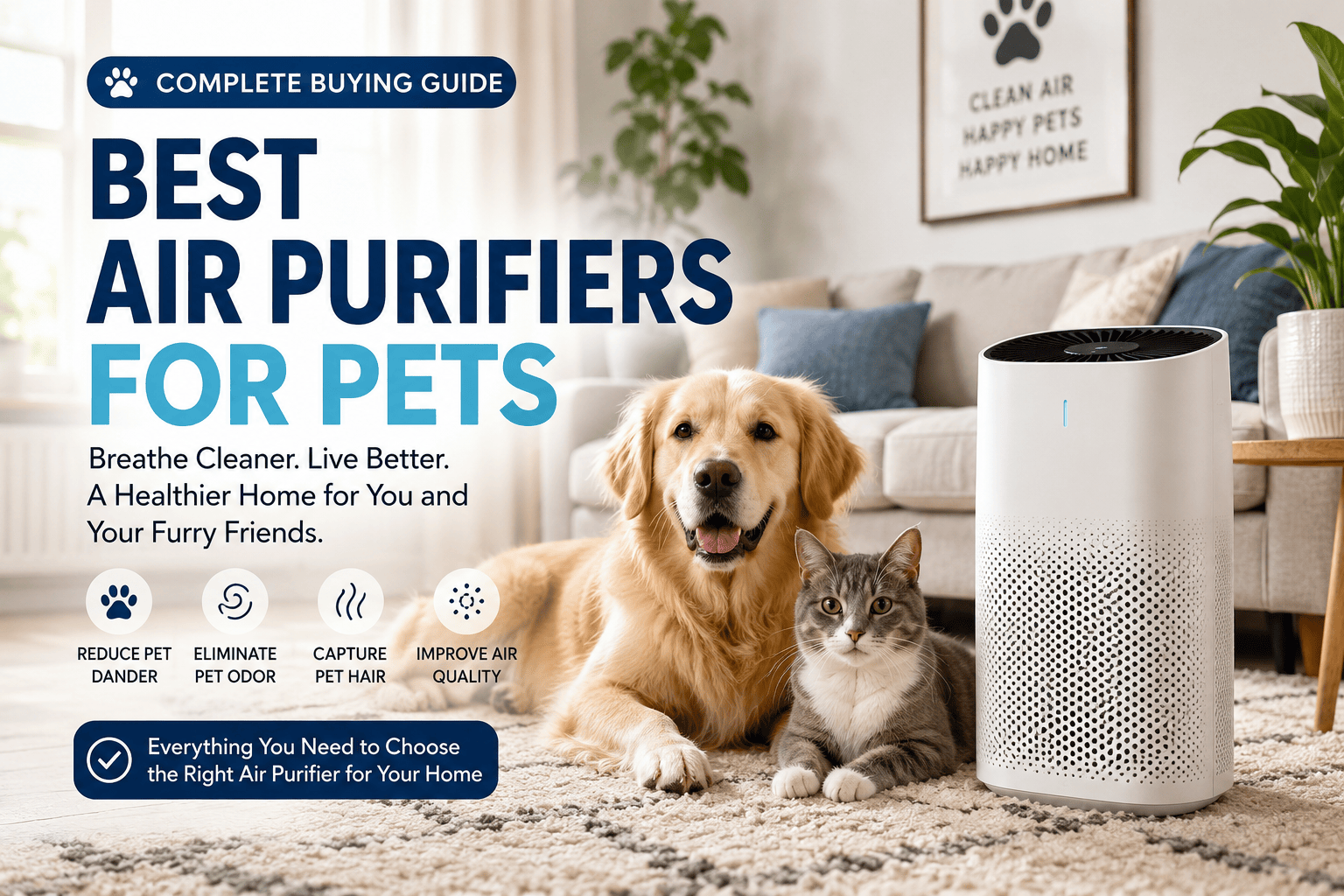
Choosing the best air purifiers for pets comes down to three key features: a true HEPA filtration system for dander and dust, a pre-filter to catch hair before it clogs the system, and activated carbon if odor is part of your problem. Beyond that, the “best” choice depends on a handful of specifics.
- Room size determines how much coverage and airflow you actually need.
- Pet type and number affect how much hair, dander, and odor the unit has to manage.
- Allergy sensitivity raises the importance of filtration grade and air turnover.
- Noise tolerance matters most for bedrooms or shared living spaces.
- Budget should account for filter replacement costs, not just the sticker price.
There’s no universal winner when searching for the best air purifiers for pets, and any guide that tells you otherwise is skipping the part where your home is different from the next reader’s home. The rest of this guide breaks down exactly how to weigh these factors for your own situation.
Who This Guide Is For
This guide is built for a wide range of pet owners, including:
- Dog owners dealing with shedding, dander, and general household odor
- Cat owners managing litter box smell, litter dust, and cat dander
- Multi-pet households facing a higher combined particle and odor load
- Allergy-conscious households where airborne dander and dust genuinely affect comfort
- Anyone dealing with persistent pet odor, whether from litter, bedding, or general “pet smell”
- Owners of heavy shedders, where hair-related filter clogging is a real, recurring problem
- Shoppers buying for a bedroom, where quiet operation matters as much as filtration
- Shoppers buying for a large living room or open floor plan, where coverage and airflow become the priority
If you fall into more than one of these categories, that’s normal, and it’s exactly why this guide treats buying factors separately rather than bundling everything into one blanket recommendation.
How Air Purifiers Help Pet Owners
Living with a cat or dog means living with a constant, low-level stream of particles moving through your home’s air, which is why researching the best air purifiers for pets starts with the basics. Understanding what those particles actually are makes it much easier to evaluate any specific purifier.
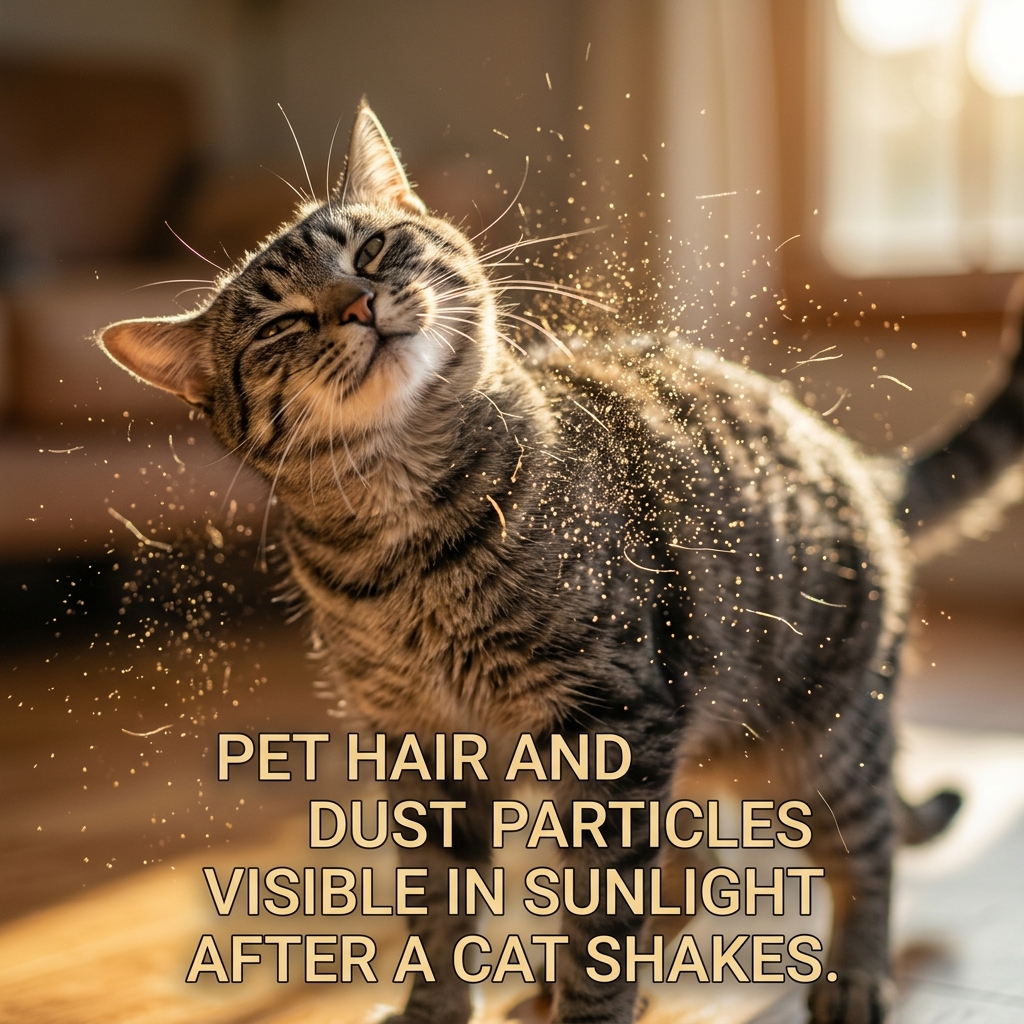
Pet dander is made up of microscopic flakes of skin, shed continuously by cats and dogs. It’s light enough to stay suspended in the air for hours, which is part of why it’s considered one of the most common indoor allergy triggers, according to the American Lung Association. Dander doesn’t settle quickly the way visible hair does, so filtration matters more here than vacuuming alone ever could.
Pet hair behaves differently. Larger fragments tend to settle onto furniture, floors, and clothing fairly quickly, while smaller, lighter pieces stay airborne longer and contribute to what collects on air purifier pre-filters.
Pet odor comes from a mix of skin oils, saliva, litter box waste, and general bacterial activity on fur and bedding. Odor molecules travel through the air independently of solid particles, which is why odor control requires a different filtration approach than dander or dust.
Allergens, dust, and pollen compound the pet-specific problem. Fur traps and redistributes household dust more than most people expect, and homes with pets often show visibly more dust buildup than pet-free homes, independent of general cleaning habits.
Here’s the important distinction: air purifiers can meaningfully reduce airborne dander, hair fragments, dust, and odor compounds. They cannot remove hair already embedded in carpet, cannot clean a litter box, and cannot replace grooming, vacuuming, or washing pet bedding. The EPA frames indoor air quality management as a combination of source control, ventilation, and filtration working together — not any single tool doing the whole job.
What Type of Filter Is Best for Pets?
Not all filtration is built the same way, and understanding each stage helps you evaluate any specific product rather than relying on marketing language alone.
HEPA Filter
A true HEPA filter is designed to capture at least 99.97 percent of particles at 0.3 microns, a standard associated with certified HEPA media. This size range covers the majority of pet dander, fine dust, and many common allergens. HEPA filtration is the backbone of almost any effective pet air purifier, but it’s worth noting that “HEPA-type” or “HEPA-style” language on a product listing doesn’t always meet the same certified standard as “True HEPA.” That distinction is worth checking before assuming a filter performs at the level the name implies.
Limitation: HEPA filtration captures solid particles. It does not neutralize odor.
Pre-filter
A pre-filter sits in front of the HEPA layer and is designed to catch larger particles — hair, fur clumps, bigger dust fragments — before they reach the finer filtration media underneath. This matters enormously in pet households, since hair is one of the fastest ways to clog a HEPA filter prematurely.
Washable pre-filters are particularly valuable for pet owners, since they let you rinse away accumulated hair regularly instead of replacing a disposable layer every few weeks.
Limitation: a pre-filter only catches what actually reaches the intake. It does nothing for hair already settled on furniture or carpet.
Activated Carbon
Activated carbon works differently from HEPA media. Instead of trapping solid particles, it adsorbs odor molecules and certain gaseous compounds onto its porous surface. This feature is essential in the best air purifiers for pets, as it is the component responsible for reducing litter box smell, wet-dog odor, and general “pet house” smell — jobs that HEPA filtration alone cannot do.
Limitation: carbon filters have a finite adsorption capacity and typically need replacement more frequently than HEPA media in heavy-odor households. Carbon also cannot address odor that’s soaked into carpet or fabric; it only affects what’s airborne.
Multi-Stage Filtration
Combining HEPA, a pre-filter, and activated carbon into one system makes practical sense for pet households specifically, because each stage handles a distinct part of the problem. A purifier with only one of these components will underperform on the tasks the other stages are built for, regardless of how strong that single component is.
For a deeper look at how these stages work together in a specific product, our pet air purifier review covering hair, dander, and odor performance breaks down a real-world filtration stack in more detail.
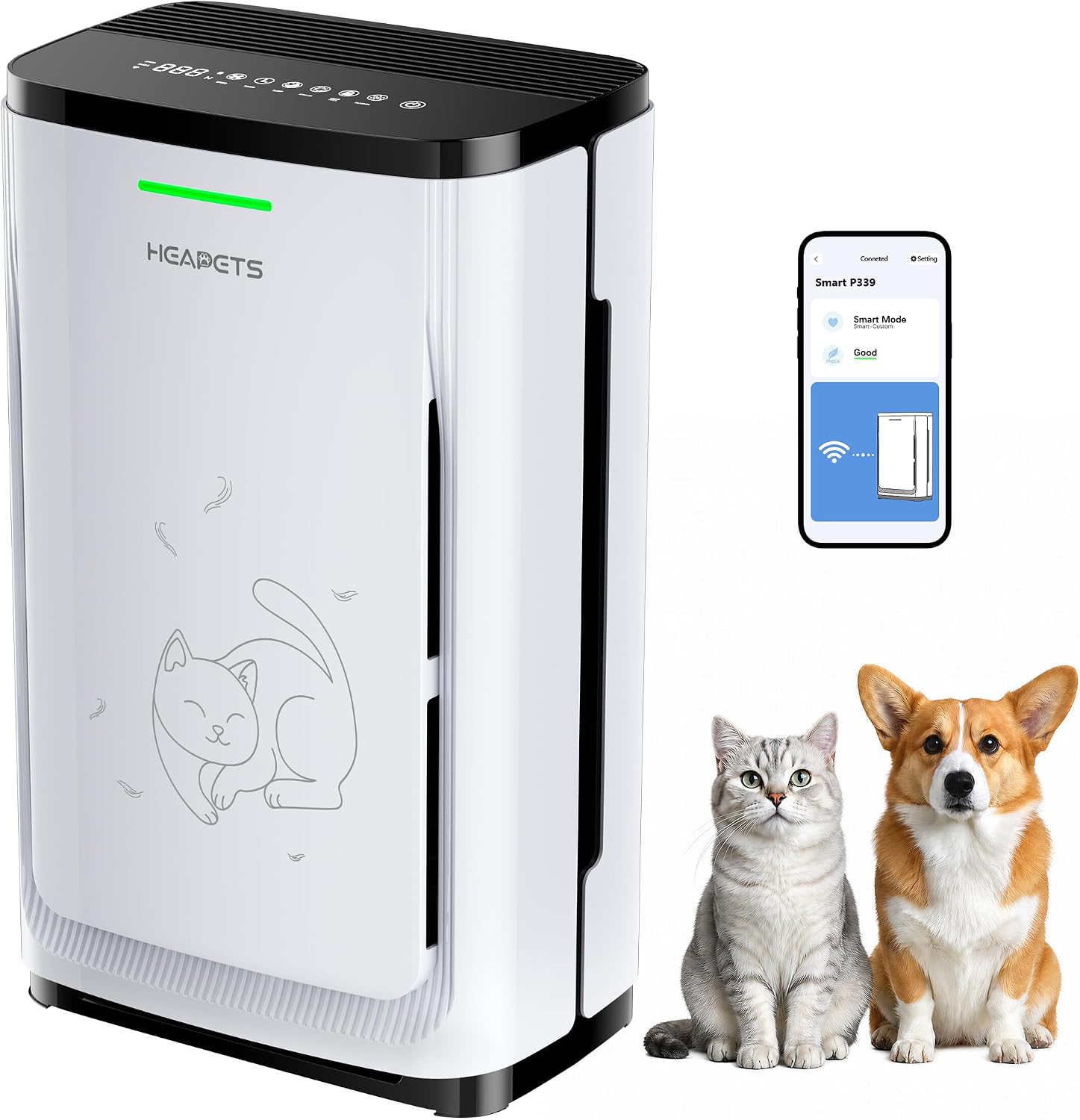
What to Look for in the Best Air Purifier for Pets
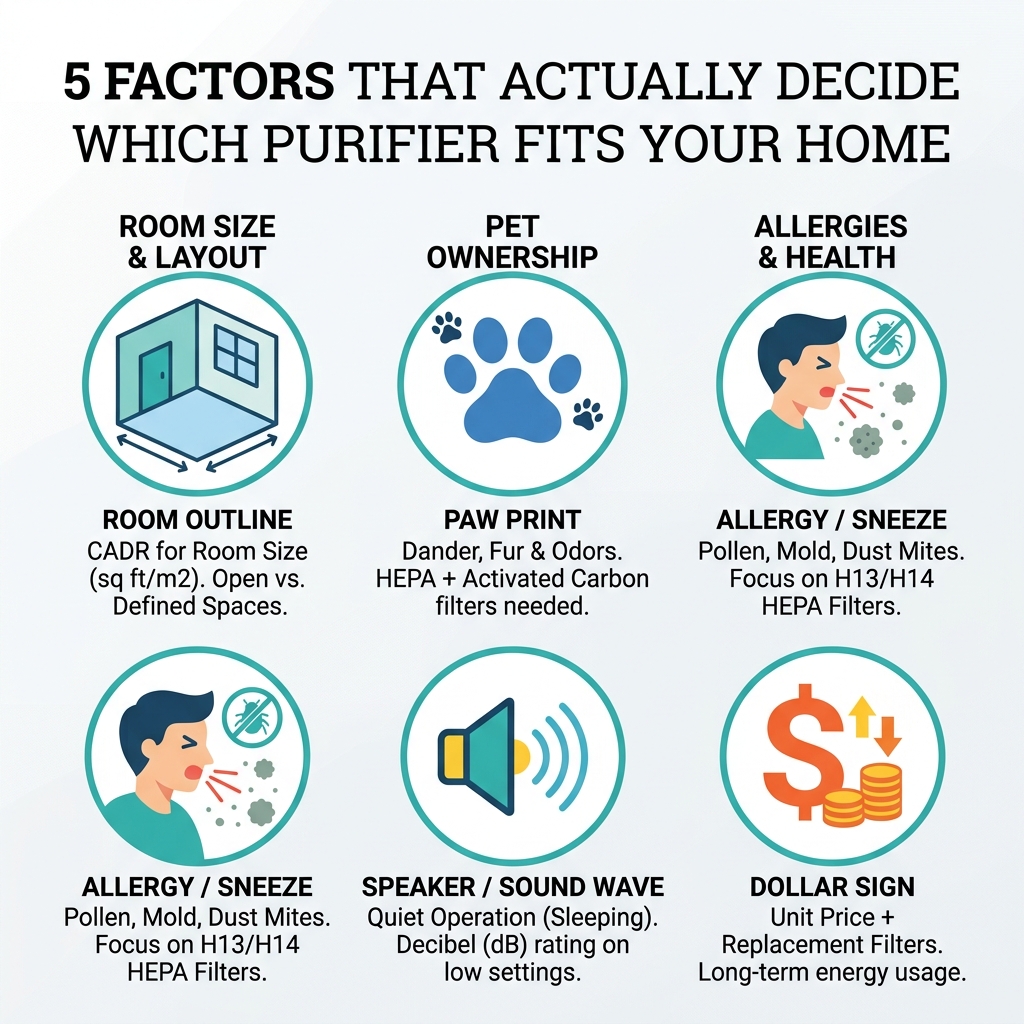
Beyond the filtration stages themselves, several practical factors determine whether a purifier actually performs well in a real pet household.
1. HEPA Filtration.
Look for certified True HEPA rather than vague “HEPA-style” language when researching the best air purifiers for pets. Pet owners care because this determines how effectively dander and fine dust actually get captured. A common mistake is assuming any filter labeled “HEPA” performs identically.
2. Pre-filter.
Prioritize washable designs if you have shedding pets. This directly affects how often you’ll need to replace the more expensive HEPA layer. A common mistake is ignoring the pre-filter entirely and only checking the main filter’s spec sheet.
3. Activated Carbon.
Confirm the unit includes genuine carbon media if odor is a concern, not just general “odor-reducing” language. Pet owners dealing with litter box smell or wet-dog odor should treat this as a non-negotiable feature. A common mistake is assuming HEPA filtration alone will handle smell.
4. CADR (Clean Air Delivery Rate).
This measures how much filtered air a unit actually delivers per minute, and it’s a more concrete performance indicator than square footage alone. Pet owners with heavier particle loads should look for CADR figures specifically rated for dust or smoke, since these are closer proxies for dander and hair than general marketing claims. A common mistake is comparing square-footage claims across brands without realizing they can be calculated differently.
5. Room Coverage.
Manufacturers list square footage coverage based on specific assumptions about air changes per hour, and this number can vary significantly in meaning from one brand to another. A common mistake is choosing a unit rated exactly for your room size rather than sizing up slightly.
6. Air Changes Per Hour.
This refers to how many times per hour the unit cycles the full volume of air in a room. Higher pollutant loads, like multiple shedding pets, benefit from more frequent air changes. A common mistake is not considering this metric at all, since it’s often buried deeper in specifications than the headline coverage number.
7. Noise Level.
Check the decibel rating at the fan speed you’d realistically use daily, not just the lowest setting. Pet owners running units overnight in bedrooms should prioritize this heavily. A common mistake is checking only the marketing headline “quiet operation” claim without confirming an actual decibel figure.
8. Filter Life.
Filters in pet households generally need replacement faster than in pet-free homes, due to higher particle loads. A common mistake is assuming published filter life estimates apply identically regardless of how many pets you have.
9. Replacement Filter Cost.
Factor this into total ownership cost, not just the upfront purchase price. A common mistake is choosing the cheapest unit without checking how much replacement filters cost over a year or two.
10. Energy Consumption.
Units running continuously, especially on higher fan speeds, contribute to ongoing electricity costs. A common mistake is ignoring this factor entirely when comparing otherwise similar models.
11. Smart Controls.
App control and remote monitoring add convenience for pet owners who are away from home and want to check conditions or adjust settings. A common mistake is paying extra for smart features you won’t actually use day to day.
12. Washable Pre-filter.
Worth calling out again specifically: this feature meaningfully reduces long-term maintenance cost in shedding-heavy homes. A common mistake is overlooking this detail in favor of headline filtration grade alone.
13. Fan Speed.
Multiple fan speed options let you balance noise and performance depending on the time of day or activity level in the home. A common mistake is assuming a unit only needs one operating speed.
14. Sleep Mode.
A dedicated quiet mode for overnight use matters for bedrooms specifically. A common mistake is assuming “low speed” and “sleep mode” perform identically; some units genuinely optimize sleep mode differently.
15. Air-Quality Sensors.
Real-time particulate monitoring, often via PM2.5 sensors, lets a unit respond automatically to spikes rather than running at a fixed speed all day. A common mistake is assuming these sensors also detect odor, which they generally do not — PM2.5 sensors measure particles, not smell.
Can Air Purifiers Remove Pet Hair and Dander?
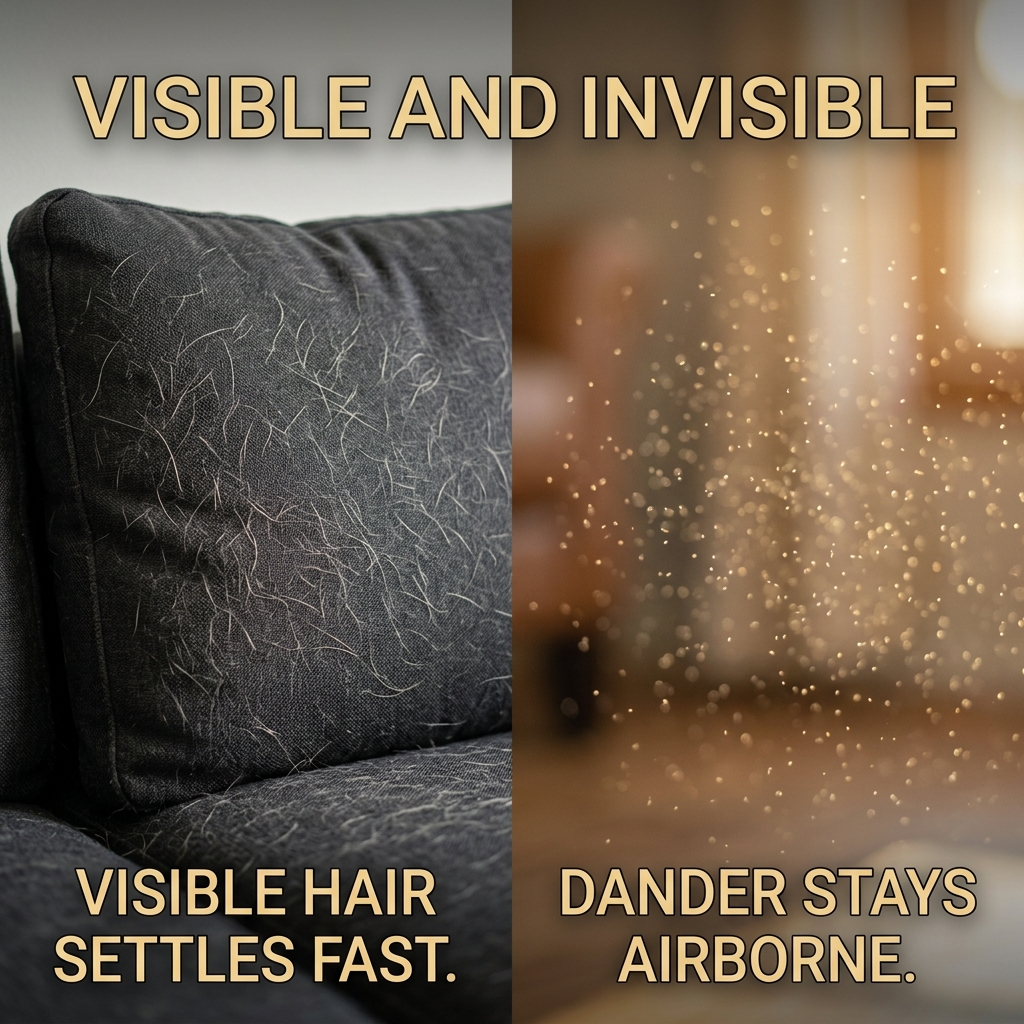
This deserves a nuanced answer, because “pet hair” and “pet dander” are often treated as the same problem when they behave very differently.
Visible pet hair — the fragments you see on the couch or floor — mostly settles quickly due to its weight and size. An air purifier’s pre-filter can capture hair that’s still floating in the air, but it cannot reach hair that has already landed on carpet, upholstery, or clothing.
Airborne microscopic particles, including pet dander, dust, and some pollen, behave very differently. These particles are light enough to stay suspended for extended periods, which is exactly the category HEPA filtration is designed to address.
Dander specifically refers to skin flakes, distinct from hair itself, and it’s one of the more persistent airborne allergens in pet households, according to guidance from the Asthma and Allergy Foundation of America (AAFA).
Dust and general allergens get compounded by pet ownership, since fur traps and redistributes particles throughout a home more than in pet-free households.
The clear takeaway: an air purifier is not a substitute for vacuuming, grooming, washing pet bedding, cleaning upholstery, or regular household cleaning. It addresses what’s currently airborne, not what’s already settled. The most effective approach uses both — consistent physical cleaning alongside continuous filtration — rather than relying on either one alone.
Do Air Purifiers Remove Pet Odor?
Every time he wants to keep his home fresh, choosing one of the best air purifiers for pets is essential: air purifiers can meaningfully reduce airborne pet odor, but only if they include genuine activated carbon or comparable odor-adsorbing media, and only within realistic limits.
Odor molecules and certain VOCs (volatile organic compounds) circulate through the air independently of solid particles. Activated carbon adsorbs these molecules as air passes through, which is why carbon-equipped purifiers tend to outperform HEPA-only units for smell specifically.
Ventilation plays a supporting role too. Periodically opening windows, when weather allows, helps exchange stale indoor air for fresh air in a way continuous filtration alone cannot fully replicate.
Source control remains essential regardless of filtration quality. Pet bedding absorbs and holds odor longer than most owners realize, and it needs regular washing. Litter boxes need consistent scooping and periodic full litter changes — no purifier compensates for a neglected box. Urine odors, particularly from accidents on carpet or fabric, require enzymatic cleaning products applied directly to the affected surface, since airborne filtration cannot reach odor trapped in a physical material. Wet-dog odors respond reasonably well to continuous carbon filtration, though regular bathing and grooming still matter.
The realistic expectation: even the best air purifiers for pets reduce the airborne component of pet odor meaningfully, especially with continuous operation, but they do not eliminate odor at its source and shouldn’t be marketed or expected to.
What Size Air Purifier Do You Need for a Home With Pets?
Room size is one of the most commonly misunderstood specifications on any air purifier listing. Manufacturers calculate square footage coverage based on specific assumptions about air changes per hour, and those assumptions aren’t standardized across brands.
A few factors affect how much coverage you actually need:
- Room dimensions and square footage are the starting point, but not the whole picture
- CADR gives a more concrete sense of how much filtered air the unit delivers, independent of the coverage number printed on the box
- Airflow determines how effectively that filtered air actually circulates through the room
- Air changes per hour matters more in pet-heavy households, since higher pollutant loads benefit from more frequent full-room air cycling
- Open-plan spaces dilute effective coverage, since air moves freely between connected areas like a combined kitchen and living room
- Bedrooms typically need less raw coverage but more emphasis on quiet operation
- Living rooms and large rooms usually need higher CADR and coverage ratings, especially in multi-pet households
- Multiple rooms generally cannot be served effectively by a single unit; consider dedicated units per room or whole-home filtration instead
Room-Size Decision Table
| Room Type | Approximate Size | Priority |
|---|---|---|
| Bedroom | Under 300 sq ft | Quiet operation, moderate CADR |
| Home office | 300–500 sq ft | Balanced filtration and noise |
| Standard living room | 500–1,000 sq ft | Higher CADR, HEPA + carbon |
| Open-concept living space | 1,000–2,000 sq ft | High CADR, strong airflow |
| Large or multi-pet home | 2,000+ sq ft | Large-capacity unit or multiple units |
| Whole home | Multiple rooms/floors | HVAC filtration or several dedicated units |
For a closer look at how a large-room-rated purifier performs in practice, our best cat air purifier for large homes review covers a model built specifically for open floor plans.
Matching a Purifier to Your Household
Different pet households have genuinely different priorities, and it helps to think in terms of what you’re actually solving for rather than chasing the highest spec sheet across the board.
| Pet Household Type | What to Prioritize |
|---|---|
| One small pet | HEPA filtration + washable pre-filter |
| Multiple pets | Higher CADR + larger filter capacity |
| Heavy shedders | Strong pre-filter + solid airflow |
| Strong pet odors | HEPA + substantial activated carbon |
| Allergy-sensitive household | HEPA + high air turnover |
| Bedroom use | Quiet operation + dedicated sleep mode |
| Large living room | High CADR + verified room coverage |
| Whole-home needs | HVAC filtration or multiple dedicated units |
This table is meant as a starting framework, not a rigid rulebook — plenty of households fall into more than one category at once, which is normal and simply means weighing two priorities together.
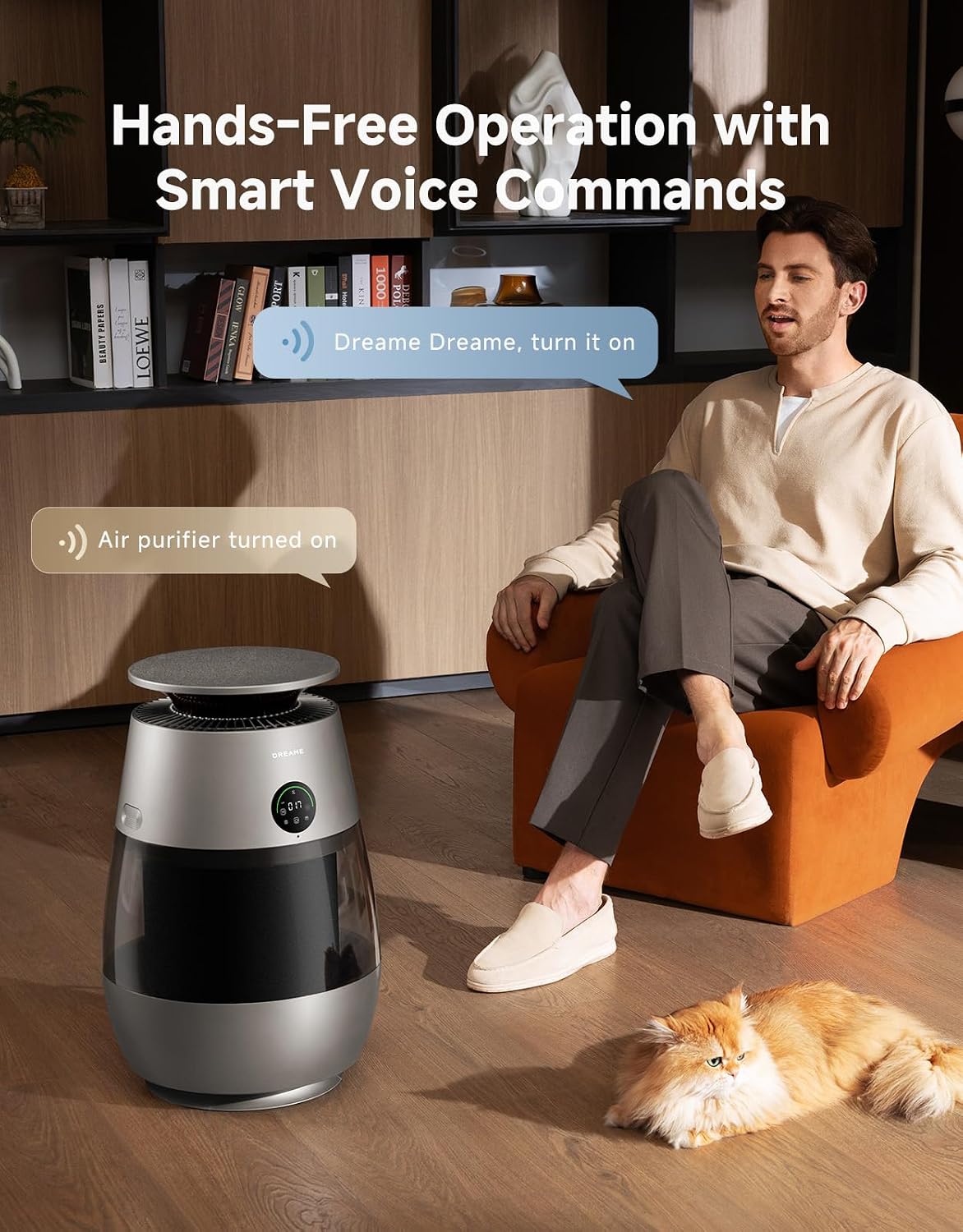
Best Air Purifiers for Pets: Top Picks
The following recommendations reflect specific use cases based on the listed features and design priorities of each model, rather than a single universal “best overall” claim. Specifications should be verified on current listings before purchasing, since pricing and availability change.
Best for Dedicated Pet Hair Detection
For households specifically dealing with heavy shedding, a purifier with sensors tuned to detect floating pet hair — rather than general dust alone — offers a real practical advantage. Our LEVOIT Vital Pet Pro review covers a model built around this exact feature, including its auto-clean pre-filter and high-carbon odor filtration.
Who should buy it: multi-pet households with heavy shedding breeds who want the unit to respond specifically to hair activity rather than general particulate spikes. Who should skip it: buyers who don’t need dedicated hair sensors and would rather prioritize raw room coverage instead.
Best for Large Rooms and Open Floor Plans
Households with bigger living spaces need a unit built for wider coverage rather than a compact, bedroom-focused design. Our large-home cat air purifier review covers a 7-stage filtration model rated for larger square footage, with anion purification as an added particle-control layer.
Who should buy it: pet owners in open-concept homes or larger rooms who need coverage beyond what a standard-size purifier offers. Who should skip it: anyone in a smaller room, where the larger footprint and higher price wouldn’t be necessary.
Best for Quiet, Smart Operation in Apartments
For apartment dwellers or light sleepers, a unit that combines a genuinely quiet sleep mode with smart app and voice control tends to fit daily life better than a bulkier, large-capacity unit. Our DREO pet odor purifier review covers a model built around exactly this combination.
Who should buy it: apartment owners and single-pet households who want smart controls and low nighttime noise. Who should skip it: multi-pet households in large, open spaces, where its mid-size coverage may fall short.
Best for Long-Term, Low-Maintenance Ownership
If ongoing filter replacement is your biggest concern, a unit with a manufacturer-rated long-life filter can meaningfully reduce that recurring cost and hassle. Our Dreame AP10 review covers a model with a multi-year filter life claim, along with an honest look at how that claim should be interpreted.
Who should buy it: buyers who want to set up a large-room purifier and not think about filter replacement for an extended stretch of time. Who should skip it: anyone prioritizing the lowest upfront cost, since long-life filter systems typically carry a higher initial price.
Best for Pet Odor as the Primary Concern
Households where litter box smell or general pet odor is the dominant complaint should prioritize a unit with a clearly defined activated carbon component. Our pet odor and pet hair, dander review and our pet air purifier for pet odors review both walk through odor-specific filtration in detail, including realistic limits around urine odor and litter box smell.
Who should buy it: cat and dog owners whose main frustration is lingering smell rather than visible hair or allergy symptoms. Who should skip it: buyers whose primary concern is dust or dander rather than odor, who may get more value prioritizing HEPA grade and coverage instead.
Which Air Purifier Is Right for You?
Use this framework to narrow down your decision quickly:
Choose a high-CADR model if you have multiple pets generating a heavier combined particle and odor load.
- Prioritize activated carbon if odor — litter box smell, wet-dog odor, general pet smell — is your main complaint rather than visible hair or dust.
- Prioritize low noise and sleep mode if the unit will run overnight in a bedroom or shared living space.
- Prioritize a strong, washable pre-filter if you have heavy shedding breeds and want to reduce how often the main HEPA filter needs replacement.
Consider multiple units if your home has separated rooms that a single purifier can’t realistically cover from one location.
Consider HVAC-integrated filtration if you want whole-home air quality management rather than room-by-room coverage, since a portable unit is generally most effective in the specific room it’s placed in.
Avoid overpaying for smart features if you won’t actually use app control or voice commands day to day — put that budget toward filtration grade or coverage instead.
Final Verdict: Which Air Purifier Is Best for Pets?
There’s no single air purifier that qualifies as the best air purifiers for pets across every household, and any guide claiming otherwise is oversimplifying a decision that genuinely depends on your specific situation. What matters is matching the right combination of filtration, coverage, and features to your actual problem.
- If dander and general allergens are your priority, focus first on certified HEPA filtration and adequate air changes per hour.
- If pet hair and shedding are the bigger issue, prioritize a strong, washable pre-filter and solid airflow over filtration grade alone.
- If odor is your main complaint — litter box smell, wet-dog smell, general pet odor — activated carbon becomes the feature that matters most, more than HEPA grade by itself.
Before buying, compare room size against verified coverage, weigh noise level against where you’ll place the unit, and factor in filter replacement costs over a year or two rather than judging purely on upfront price. A purifier that’s slightly more expensive but has a washable pre-filter or a longer filter life may cost less over time than a cheaper unit with frequent, costly replacements.
Whatever specific model you land on, remember that even the best air purifiers for pets work alongside cleaning, grooming, and litter maintenance — not instead of them. For more home comfort guidance that pairs well with cleaner indoor air, our winter home comfort and efficiency guide covers additional appliances worth considering during colder months when windows stay shut. You can also browse our full range of home comfort reviews at Emrald Lifestyle.
Frequently Asked Questions
Are air purifiers good for homes with pets?
Yes, generally. They help reduce airborne dander, hair fragments, dust, and odor, which supports a cleaner-feeling home alongside regular cleaning, grooming, and litter maintenance.
Do air purifiers remove pet dander?
Yes. True HEPA filtration, particularly at H13 grade or higher, is specifically designed to capture fine particles in the size range associated with pet dander.
Can an air purifier remove pet hair?
While even the best air purifiers for pets can capture floating hair still circulating in the air—especially models equipped with a strong pre-filter—they cannot remove hair that has already settled on carpet, furniture, or clothing, meaning vacuuming and grooming remain necessary for overall cleanup.
Do air purifiers help with pet odors?
Yes, when the unit includes genuine activated carbon filtration. HEPA filtration alone addresses particles, not smell, so odor-focused shoppers should confirm a carbon component specifically.
Is HEPA better for pet dander?
Yes, HEPA is the filtration type specifically designed for fine particle capture, which includes dander. No filtration type outperforms certified HEPA for this specific job.
Do I need activated carbon for pet smells?
If odor is a genuine concern, yes. HEPA filtration does not neutralize smell, so a unit without carbon or comparable odor-adsorbing media will underperform on odor control regardless of its HEPA grade.
What CADR should I look for with pets?
There’s no single number that fits every room, since CADR needs scale with room size and pollutant load. As a general approach, match or slightly exceed the CADR recommendation for your actual room size, and lean toward the higher end if you have multiple pets or heavy shedders.
Should I run an air purifier all day with pets?
Continuous operation, often on auto mode where available, tends to produce more consistent results than running the unit only when odor or dust becomes noticeable, since pet particles and odor accumulate steadily throughout the day.
How often should pet air purifier filters be replaced?
This varies by unit and household, but pet air purifier filters commonly need replacement every 6 to 8 months, sometimes sooner in multi-pet or heavy-shedding homes. Washable pre-filters should be checked and cleaned more frequently, often weekly in shedding-heavy households.
Where should I place an air purifier in a home with pets?
Central placement in the room your pet spends the most time works best, with a few feet of clearance for airflow. Positioning it near, but not directly against, a litter box can help with odor and dust, while corners, blocked spaces, and areas pets can knock over should be avoided.