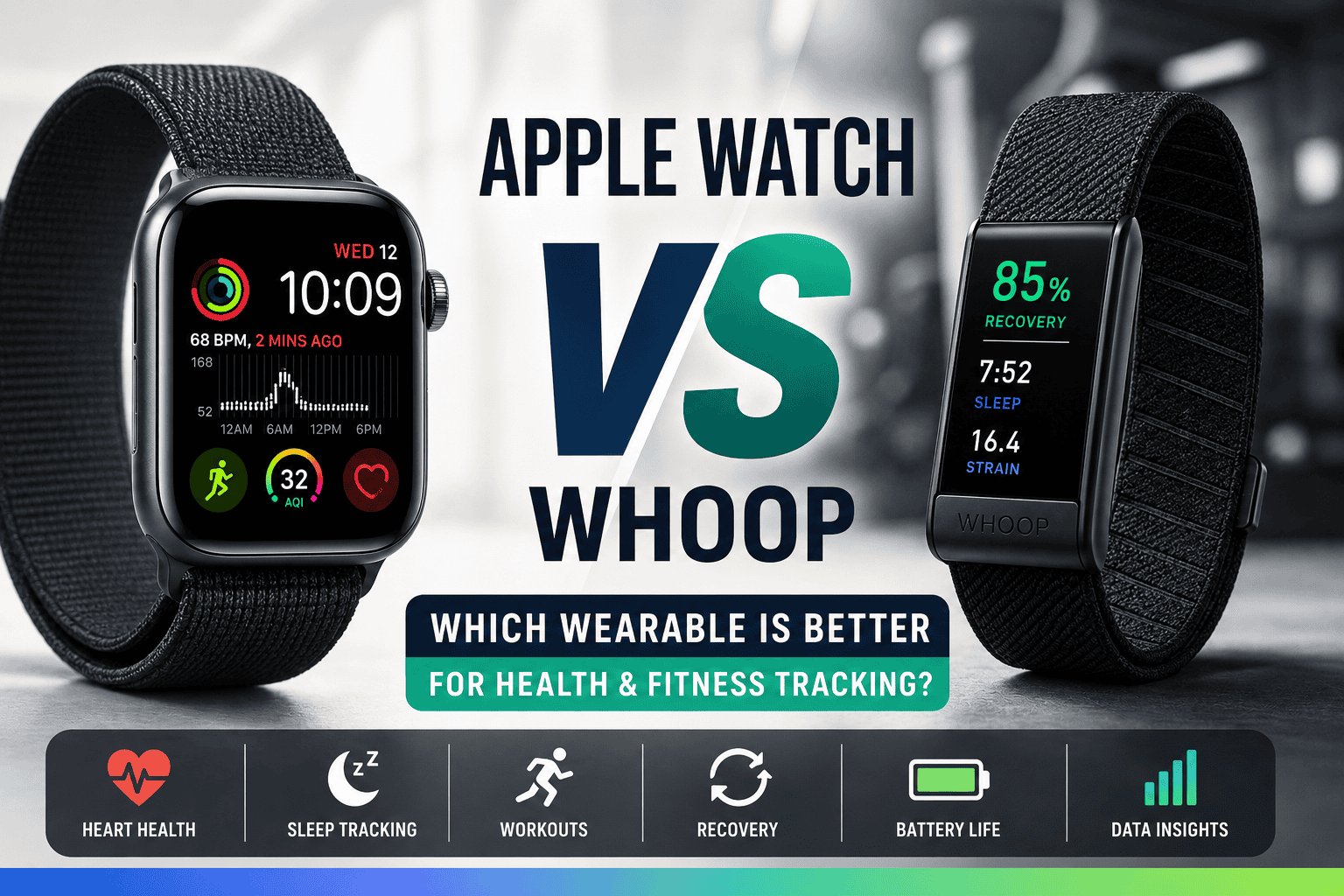
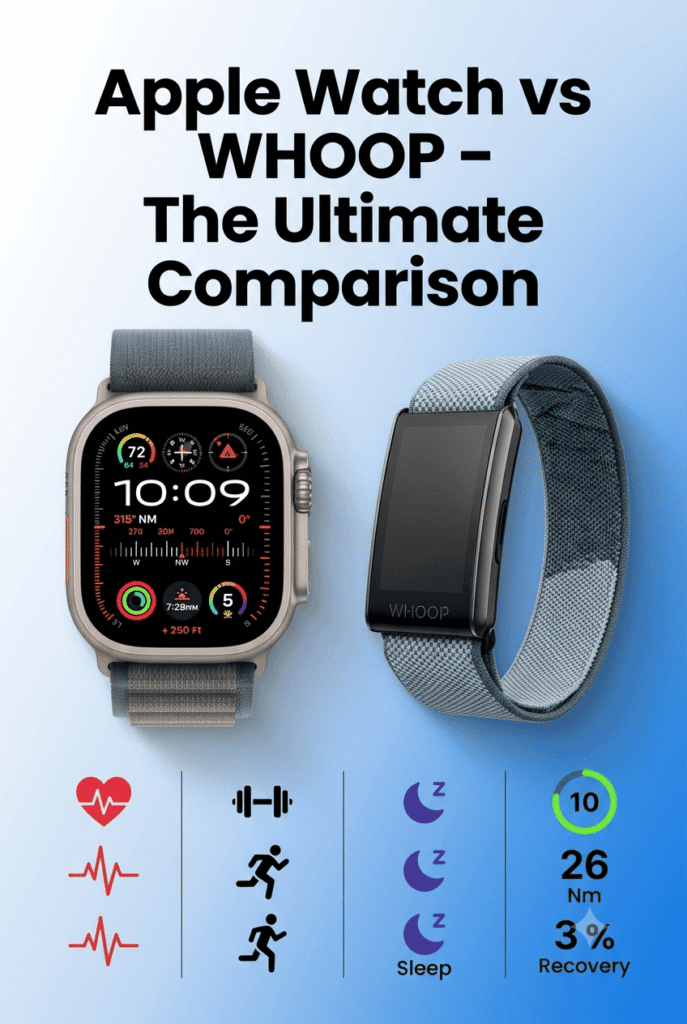
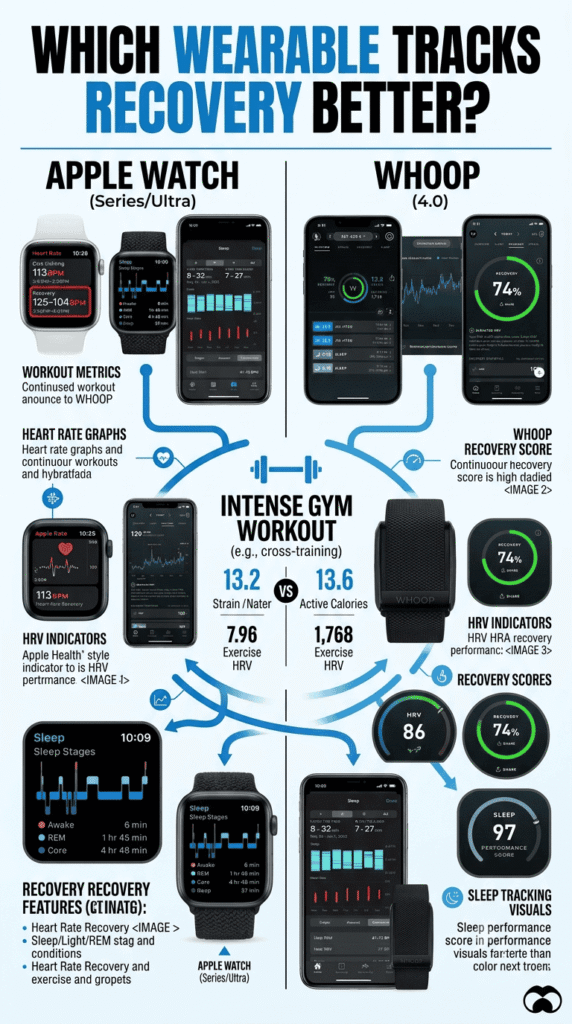
You’ve been staring at this decision for a week. Apple Watch or WHOOP. Two devices that look nothing alike, cost money in completely different ways, and attract completely different kinds of users — yet both promise to help you train smarter, sleep better, and understand your health. The Apple Watch vs WHOOP debate comes up constantly in fitness communities, coaching circles, and Reddit threads, and for good reason. Apple Watch is the world’s most popular smartwatch. WHOOP is arguably the world’s most sophisticated recovery wearable. Comparing them feels like comparing a Swiss Army knife to a surgical scalpel. One does everything. One does one thing — and does it exceptionally.
This guide is your practical buying decision. We’ll break down every major category — design, sleep tracking, recovery data, heart rate accuracy, battery life, subscription costs, and long-term value — with clear recommendations based on who you actually are and what you actually need.
By the end, you’ll know exactly which wearable belongs on your wrist.
Featured Snippet: Apple Watch vs WHOOP — Quick Answer
Apple Watch wins for iPhone users who want a full smartwatch with strong health features, ECG monitoring, and zero recurring fees. WHOOP wins for athletes and performance-focused users who want the deepest HRV-based recovery coaching available in a consumer device. Both excel at sleep tracking. WHOOP has no display; Apple Watch requires daily charging. Neither is universally “better” — the right choice depends on your specific goals.
Quick Comparison Table
| Feature | Apple Watch Series 11 | WHOOP 5.0 |
|---|---|---|
| Price | ~$350–400 (one-time) | Subscription-based |
| Subscription | None (Fitness+ optional) | Required (~$18–30/month) |
| Battery Life | ~18–36 hours | ~4–5 days |
| Charging | Magnetic, daily | On-wrist pack, continuous data |
| Display | LTPO OLED touchscreen | None |
| GPS | ✅ Built-in | ❌ None |
| Workout Tracking | ✅ 80+ activity types | ✅ Strain-based |
| Sleep Tracking | ✅ Good + Sleep Apnea Notification | ✅ Excellent + Sleep Coach |
| Recovery Score | ❌ Basic (3rd-party apps) | ✅ Daily HRV-based score |
| HRV Monitoring | ✅ Basic | ✅ Best-in-class |
| Heart Rate | ✅ Continuous | ✅ Continuous (6-LED) |
| ECG | ✅ FDA-cleared | ❌ |
| Blood Oxygen (SpO2) | ✅ | ✅ |
| Skin Temperature | ✅ | ✅ |
| Stress Tracking | ✅ Mindfulness / retrospective | ✅ Indirect (HRV-based) |
| Women’s Health | ✅ Cycle tracking + temp | ✅ Cycle + recovery correlation |
| Smart Notifications | ✅ Full iPhone integration | ❌ None |
| Music Storage | ✅ Offline | ❌ |
| Calls | ✅ (LTE models) | ❌ |
| Payments | ✅ Apple Pay | ❌ |
| Water Resistance | WR50 (50m) | IP68 |
| Crash Detection | ✅ | ❌ |
| Fall Detection | ✅ | ❌ |
| Emergency SOS | ✅ | ❌ |
| iPhone Required | ✅ | ❌ (iOS + Android) |
| Best For | iPhone users, everyday health | Athletes, recovery optimization |
| Overall Winner By Category | Smartwatch features, ECG, safety | Recovery, HRV, sleep coaching |
What Is Apple Watch?
Apple Watch launched in April 2015 — and changed the smartwatch category permanently. What started as a notification delivery device for iPhone users has evolved into one of the most clinically significant consumer health tools ever built.
By Series 11 (the current generation as of 2026), Apple Watch incorporates an impressive sensor array: optical heart rate, ECG, SpO2, skin temperature, crash detection, fall detection, and — critically — FDA-cleared Sleep Apnea Notification capability on supported models. The health credentials have become so substantial that Apple Watch is increasingly discussed in clinical contexts.
The Apple Watch runs watchOS — the most mature smartwatch operating system available — giving it access to thousands of third-party apps, seamless iPhone integration, and a biometric data hub through Apple Health.
Current lineup:
| Model | Key Selling Point | Approx. Price |
|---|---|---|
| Apple Watch SE (2nd Gen) | Best budget Apple Watch | ~$200–250 |
| Apple Watch Series 11 | Best all-around | ~$350–400 |
| Apple Watch Ultra 2 | Best for endurance athletes | ~$700–800 |
Apple Watch health technology:
- Optical HR with a four-cluster LED array
- Third-generation temperature sensor (wrist-based)
- Electrical heart rate sensor enabling ECG
- Accelerometer and gyroscope for fall/crash detection
- watchOS Sleep for automatic sleep stage detection
- Third-party app ecosystem enabling deeper fitness analytics
Apple Watch is exclusively an iPhone companion. There is no Apple Watch for Android. If you don’t own an iPhone, Apple Watch is not an option.
What Is WHOOP?
WHOOP was founded in 2012 by Will Ahmed, a Harvard varsity squash athlete who was frustrated that elite athletes had almost no tools for measuring physiological recovery. The insight was simple but powerful: training is only as effective as the recovery between sessions.
WHOOP 5.0 is the latest hardware iteration, refining the already-strong 4.0 sensor platform with an improved six-LED PPG array, expanded biometric sensing, and enhanced WHOOP Coach AI capabilities.
How WHOOP works:
WHOOP runs 24/7 on your wrist, bicep, forearm, or calf. It collects continuous biometric data and synthesizes it into two core daily scores:
- Recovery Score (0–100%): Built from overnight HRV, resting heart rate, sleep performance, and respiratory rate — calibrated to your personal baseline, not population averages
- Strain Score (0–21): The cumulative cardiovascular load your body has accumulated throughout the day
Alongside these scores, the Sleep Coach provides forward-looking bedtime recommendations based on your recovery goal for tomorrow. The Journal lets you log daily behaviors — alcohol, caffeine, supplements, stress, travel — and shows you statistically how each one affects your recovery over time.
The WHOOP membership model means you subscribe and receive the hardware as part of your plan. There’s no display, no GPS, no smart notifications. WHOOP is deliberately stripped down to eliminate distractions and maximize biometric data precision.
WHOOP is compatible with both iPhone and Android — an important point for the Apple Watch vs WHOOP comparison.
Apple Watch vs WHOOP Design and Comfort
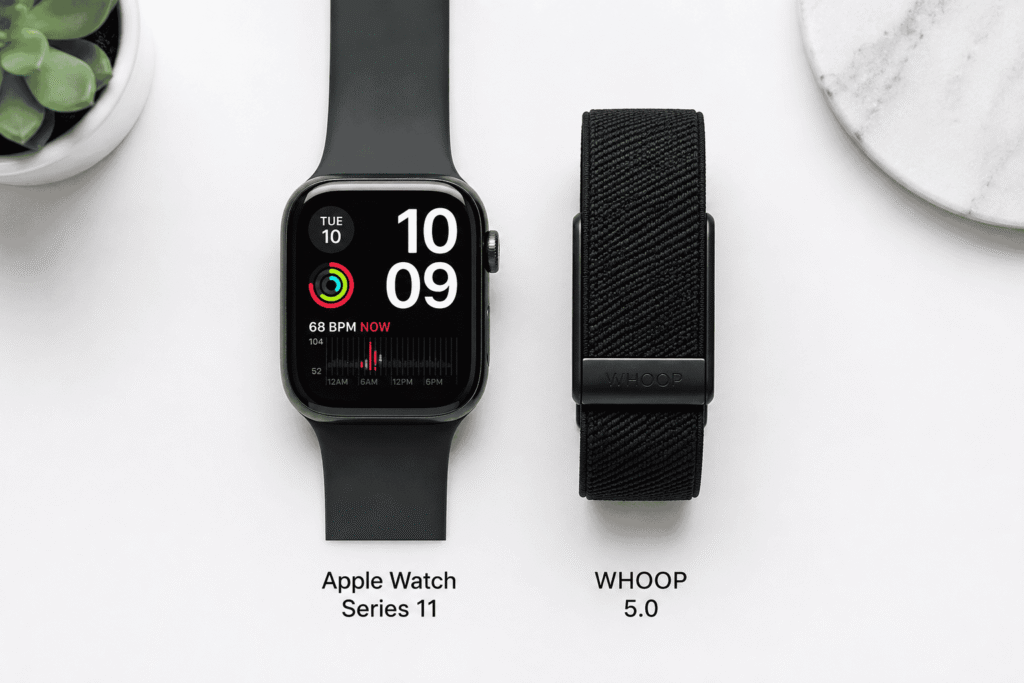
Apple Watch is a premium aluminum, stainless steel, or titanium rectangle on a variety of interchangeable bands. It’s recognizably a watch. It looks good at the gym, in a meeting, and at dinner. The Series 11 is thinner and lighter than any previous Apple Watch, with a larger display in the same footprint.
WHOOP is a slim, screenless band that barely registers under a shirt sleeve. It can be worn on the wrist, bicep, forearm, or calf via accessory bands — a flexibility no Apple Watch offers. Many users genuinely forget they’re wearing it.
For overnight sleep wear — critical for recovery tracking — WHOOP is easier for most people. No screen, no raised edge, minimal bulk. Apple Watch’s flat case is manageable but noticeably present. Apple Watch Ultra 2’s larger case is explicitly not designed for sleep tracking comfort.
Winner: WHOOP for 24/7 biometric comfort. As Apple Watch is for everyday aesthetic appeal.
Apple Watch vs WHOOP Display
We all know that Apple Watch has one of the most beautiful displays in consumer electronics. The always-on LTPO OLED on Series 11 — large, crisp, and bright — shows your activity rings, heart rate, notifications, watch face complications, and navigation at a glance.
WHOOP has no display. Zero. You read all your data through the app on your phone. This is either a feature or a limitation depending on who you are.
For athletes who want fewer digital distractions during training, WHOOP’s absence of a screen means no temptation to check notifications mid-workout. For everyday users who want to glance at their wrist for steps, heart rate, messages, or the time — Apple Watch is the only choice.
Winner: Apple Watch — unconditionally, if a display matters to you.
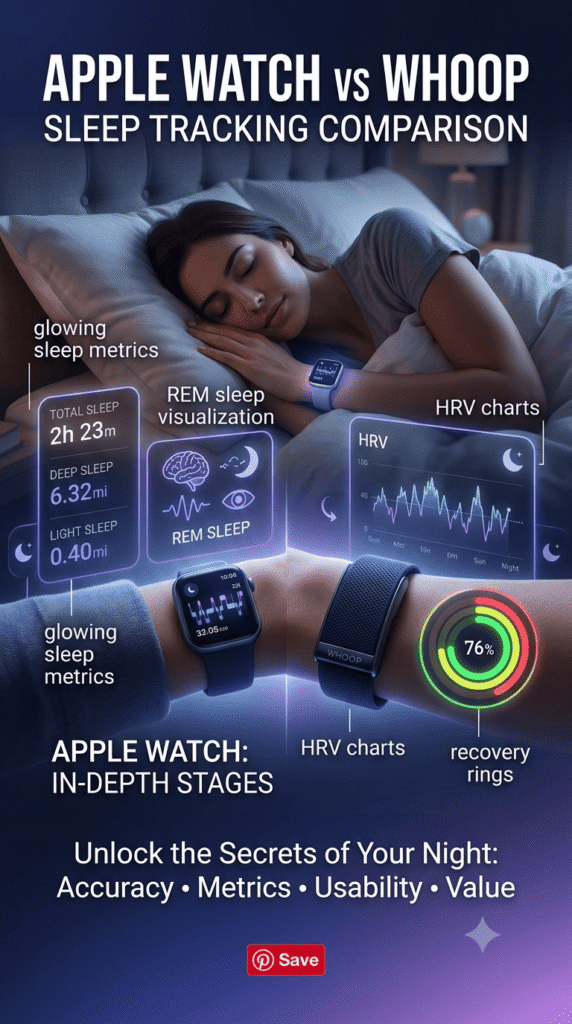
Apple Watch vs WHOOP Sleep Tracking
Sleep tracking is one of the most important categories in this Apple Watch vs WHOOP comparison — and one where both devices have improved substantially in recent years.
WHOOP Sleep Tracking
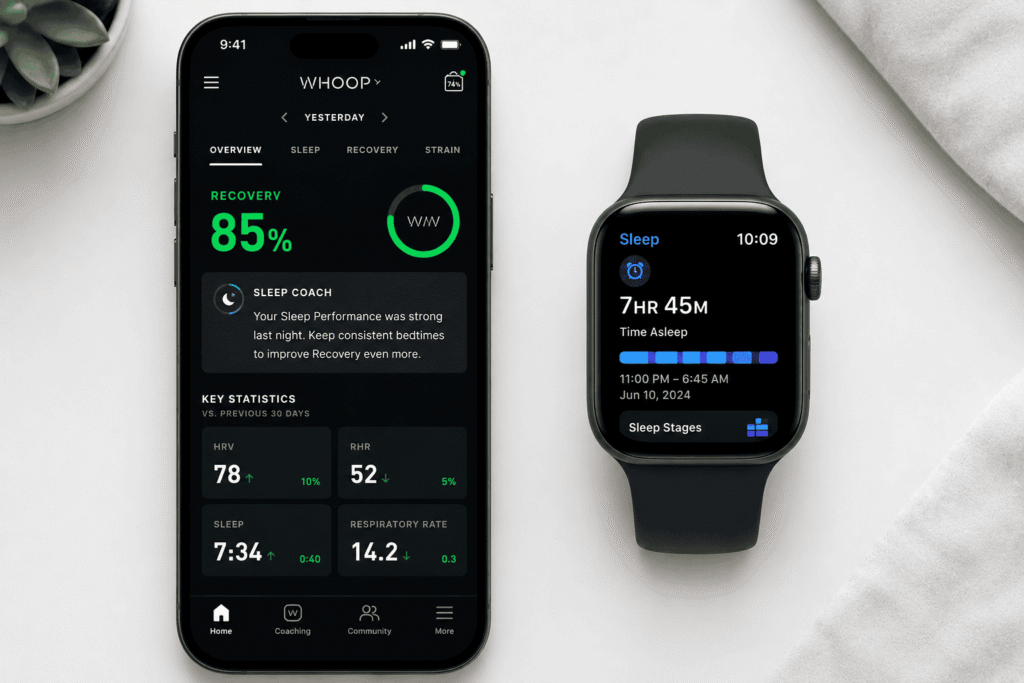
WHOOP measures sleep continuously using its full sensor array. It tracks all four sleep stages — light, deep, REM, and awake time — and synthesizes them into a Sleep Performance Score.
The real differentiator is the Sleep Coach. Each evening, WHOOP tells you what time to go to sleep based on your recovery goal for tomorrow. Want to peak for tomorrow’s hard interval session? WHOOP calculates the exact bedtime that maximizes your chances of a green Recovery Score. Want to simply maintain? Here’s your minimum. Want to extend and accelerate recovery from a depleted state? Here’s what you need.
That forward-looking coaching is genuinely unusual — and genuinely useful for athletes. Most sleep trackers look backward and report what happened. WHOOP plans ahead.
WHOOP’s on-wrist charging ensures zero overnight data gaps — you never remove it to charge.
Apple Watch Sleep Tracking
Apple Watch Series 11 tracks sleep stages (REM, core, deep, awake), provides a sleep score, monitors respiratory rate, and delivers overnight SpO2 monitoring. Sleep Apnea Notifications — available on supported Apple Watch Series 11 models — flag irregular breathing patterns that may warrant medical evaluation. This is a wellness notification, not a clinical diagnosis, but it’s a meaningful consumer health feature.
The limitation: Apple Watch requires daily charging, and most users charge overnight. Sleeping with Apple Watch means charging during waking hours instead — a behavioral change that trips up many new users.
Apple Watch’s sleep data connects seamlessly with Apple Health, enabling third-party apps like Oura, AutoSleep, and Pillow to provide additional sleep analysis within the same ecosystem.
Sleep Tracking Verdict
WHOOP wins for sleep coaching depth and continuous overnight data. Apple Watch wins for Sleep Apnea Notification capability and iPhone ecosystem integration. For users who can solve the charging timing issue, Apple Watch delivers solid sleep data. For users who prioritize sleep optimization as a primary goal, WHOOP’s Sleep Coach is a more powerful tool.
Apple Watch vs WHOOP Recovery Tracking
This is WHOOP’s defining category — and where the Apple Watch vs WHOOP gap is most pronounced.
WHOOP Recovery Score
Every morning, WHOOP delivers a Recovery Score from 0 to 100, color-coded:
- Green (67–100%): Your body has recovered well. Push hard.
- Yellow (34–66%): Proceed thoughtfully. Be mindful of accumulated fatigue.
- Red (0–33%): Rest or active recovery. Don’t force it.
This score is built from your overnight HRV (measured at 100+ Hz throughout the night), resting heart rate, sleep quality, and respiratory rate — and critically, it’s calibrated entirely against your own personal baseline, not a population average. Your 80% recovery means something specific to you based on 30+ days of your own data.
For athletes who train with periodization — building load then tapering — this daily precision is genuinely useful. Knowing your body is running at 40% recovery before deciding whether to hit a heavy deadlift session or take a rest day is information you can’t get from intuition alone.
Apple Watch Recovery Tracking
The Watch doesn’t provide a native recovery score. Apple Health collects HR, HRV, sleep, and activity data that third-party apps can access to generate readiness metrics. AutoSleep and HRV4Training are popular options that use Apple Watch data to calculate recovery-adjacent scores.
The challenge: the quality of recovery data from Apple Watch is directly limited by charging timing. If your watch is charging overnight, you’re missing the most important biometric window of the day.
Winner: WHOOP — by a significant margin for daily recovery coaching precision.
Apple Watch vs WHOOP Heart Rate Accuracy
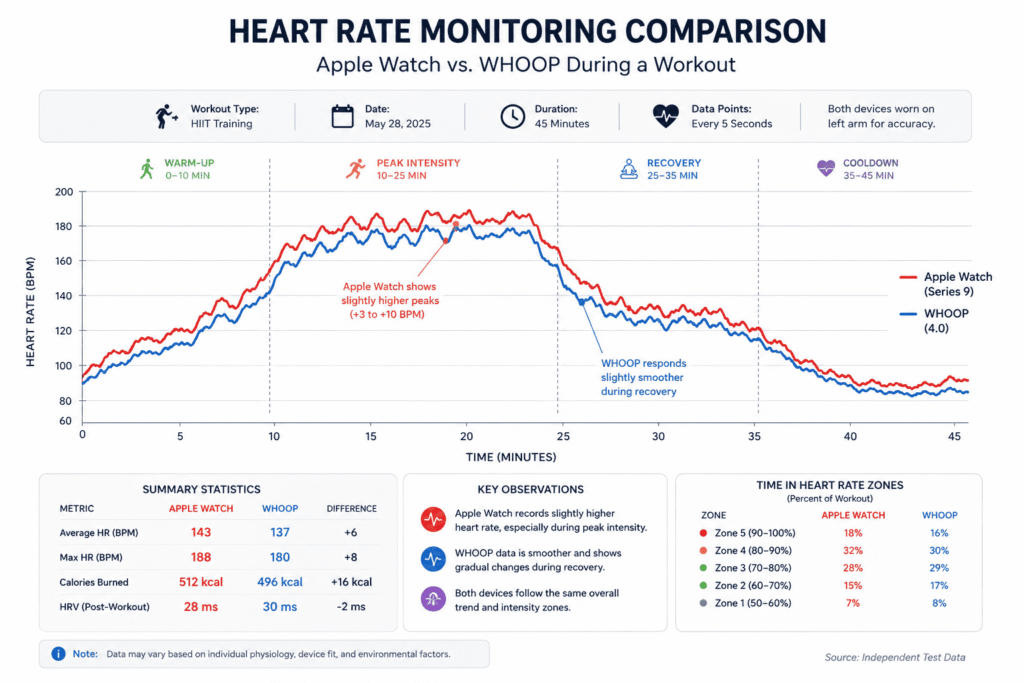
Both devices use optical photoplethysmography (PPG) for continuous wrist-based heart rate monitoring. Both struggle during high-intensity intervals and heavy lifting — standard limitations of optical wrist-based HR across all consumer devices.
WHOOP’s six-LED array samples continuously at high frequency, giving it a precision advantage for resting and overnight HR. Several independent assessments of consumer wearable accuracy suggest WHOOP’s resting HR and overnight monitoring is more consistent than Apple Watch’s — which takes periodic measurements rather than continuous readings during lower-intensity periods.
For workout-based heart rate, Apple Watch performs strongly during steady-state activities (running, cycling). Both devices lose accuracy during heavy barbell movements and rapid wrist-motion exercises. For precision HR during high-intensity training, a chest strap remains the gold standard.
Apple Watch adds an important dimension WHOOP lacks entirely: ECG. The electrical heart sensor on Apple Watch Series 11 can generate a medical-grade single-lead electrocardiogram, detecting atrial fibrillation (AFib) with FDA clearance. WHOOP has no ECG capability.
Winner: WHOOP for continuous resting and overnight HR precision. Apple Watch for ECG and broader heart health monitoring.
Apple Watch vs WHOOP HRV Monitoring
HRV — heart rate variability — is the core input into WHOOP’s recovery system and one of the most validated biometric markers for physiological readiness. The American Heart Association recognizes HRV as a meaningful indicator of autonomic nervous system health.
WHOOP HRV: Measured continuously throughout the night using high-frequency sampling. The morning RMSSD (root mean square of successive differences) value represents a true overnight average — not a spot measurement. This is then compared against your rolling personal baseline to generate a meaningful daily number. After 30+ days of wear, WHOOP’s HRV data becomes one of the most personally calibrated recovery signals available in any consumer device.
Apple Watch HRV: Apple Watch records HRV during breathing exercises via the Mindfulness app and during brief periods of rest. It logs HRV data to Apple Health, where third-party apps can access it for trend tracking. The measurements are less continuous and less frequent than WHOOP’s overnight approach — producing directionally useful HRV trends but less granular daily precision.
Winner: WHOOP for HRV precision. The Apple Watch for HRV trend awareness within the Apple Health ecosystem.
Apple Watch vs WHOOP Workout Tracking
Apple Watch Workout Tracking
The Apple Watch’s workout tracking is among the most comprehensive of any smartwatch. Over 80 activity types are supported natively — running, cycling, swimming, yoga, HIIT, core training, Pilates, rowing, dance, and more. Each workout type has optimized metrics:
- Running: GPS pace, cadence, route map, splits, heart rate zones, VO2 Max estimate (third-party apps), indoor/outdoor tracking
- Cycling: GPS route, power (with compatible accessories), speed, elevation, heart rate zones
- Swimming: Pool and open-water tracking, stroke detection, SWOLF, lap counting
- Strength: Manual or automatic rep counting, set tracking (accuracy varies)
- HIIT and Functional Fitness: Zone-based tracking, calorie estimation
Apple Watch Activity Rings — Move, Exercise, Stand — provide simple, motivating daily targets that most users find genuinely engaging over time.
WHOOP Workout Tracking
WHOOP automatically detects activities and logs them as Strain events. You can also manually initiate a workout in the app. WHOOP records heart rate zone data throughout the session and calculates a Strain contribution for each workout.
What WHOOP uniquely provides is the connection between your training session and the next morning’s recovery. A heavy lifting session that produced a Strain of 16/21 and drops your next-day Recovery Score to 35% is precisely the kind of data that prevents overtraining. That post-session recovery context is WHOOP’s most distinctive workout feature.
What WHOOP doesn’t provide: GPS, route maps, pace, stroke count, rep detection, or real-time metric display during exercise.
Winner: Apple Watch for workout variety and in-session guidance. WHOOP for post-workout recovery correlation.
Apple Watch vs WHOOP Running
Running is a clear Apple Watch advantage.
Apple Watch tracks GPS routes accurately, provides real-time pace, cadence, distance, split alerts, heart rate zones, and elevation. Series 11’s GPS — while not multi-band — delivers reliable route accuracy for road and light trail running. Apple Watch Ultra 2 adds dual-frequency GPS for superior accuracy in complex terrain.
The Apple Watch Ultra 2 is the most capable Apple Watch for serious runners — 60-hour battery in low-power GPS mode, precision dual-frequency GPS, and the Action Button for one-press workout control.
WHOOP tracks running as cardiovascular strain without GPS or pace data, unless you run with your phone for connected GPS. For runners who want any form of route data without carrying a phone, WHOOP alone is insufficient.
Where WHOOP adds value for runners: the next morning. Seeing exactly how a 16-mile long run affected your HRV and Recovery Score — and receiving a coaching recommendation to take two easy days before your next hard effort — is training intelligence that Apple Watch alone doesn’t provide.
Winner: Apple Watch for active run tracking. WHOOP for run recovery analytics.
Apple Watch vs WHOOP Strength Training
Neither device is purpose-built for the weight room. But they serve strength athletes differently.
Apple Watch’s Strength Training mode logs reps automatically on some exercises (accuracy is variable, especially for compound movements). Heart rate zone tracking during lifting provides some effort context. Apple Fitness+ offers guided strength workouts that sync with the watch.
WHOOP doesn’t track reps, sets, or individual exercises. But WHOOP’s recovery data after heavy lifting sessions is uniquely informative. A hard squat and deadlift session that barely registers as high-intensity on a heart rate monitor can produce measurable HRV suppression the following morning — WHOOP catches this in a way that Apple Watch alone does not.
For bodybuilders and powerlifters who train with high volume and frequency, WHOOP’s morning Recovery Score can genuinely prevent the overreach that leads to injury or plateau.
Winner: Slight edge to Apple Watch for in-session strength tracking. WHOOP for post-session recovery monitoring.
Apple Watch vs WHOOP Calories Burned
Both devices estimate calorie burn from heart rate data, movement, and demographic inputs. Both overestimate active calories to varying degrees under certain conditions — a known limitation across all consumer wearables.
Apple Watch’s calorie estimates tend to run higher than most competitors, including WHOOP. Published comparisons have noted Apple Watch can significantly overcount calories during certain activities — particularly those that elevate heart rate via stress, caffeine, or temperature rather than genuine exercise.
WHOOP’s calorie estimates are more conservative and are built into the Strain framework — showing calories burned within a physiological training load context rather than as a standalone target.
The honest advice: Don’t use either device for precise dietary calorie management. Use calorie data for directional trend tracking, not as a dietary mathematics tool.
Winner: Neither — both provide estimates, not measurements. Use trends, not daily totals.
Apple Watch vs WHOOP Stress Monitoring
Apple Watch’s Mindfulness app includes Reflect and Breathe sessions that detect stress-adjacent states through elevated heart rate and HRV patterns. The State of Mind feature allows quick mood logging. These tools are better described as stress management prompts than stress monitoring systems.
WHOOP monitors stress indirectly through HRV trends, resting heart rate patterns, and the Journal feature. Sustained HRV suppression over multiple days — without a corresponding training load explanation — often signals accumulated psychological stress. The Journal then helps you identify which life factors are driving that pattern.
Neither device offers real-time electrodermal activity (EDA) sensing — which is the most direct physiological stress measure available in consumer wearables (Fitbit Sense 2 has this). Both WHOOP and Apple Watch approach stress from the HRV and heart rate side.
Winner: Near-tie, different approaches. Apple Watch for real-time mindfulness prompts. WHOOP for long-term stress impact on recovery.
Apple Watch vs WHOOP GPS
Apple Watch has GPS. WHOOP does not.
GPS on Apple Watch is active during outdoor workouts — running, cycling, hiking, paddle sports. Route maps, real-time pace, and distance data all depend on GPS.
WHOOP can pair with your iPhone’s GPS via the app during workouts, providing route data if you carry your phone. Phone-free GPS is impossible with WHOOP.
For any athlete who regularly trains outdoors without a phone, this is a significant limitation of WHOOP.
Winner: Apple Watch.
Apple Watch vs WHOOP Smart Features
Apple Watch’s smart feature set is the most developed of any smartwatch:
- Calls and messages: Full two-way calling and messaging on LTE models (no phone required)
- Apple Pay: Contactless NFC payments from the watch
- Apple Maps navigation: Turn-by-turn directions on your wrist
- Siri: Voice assistant with full Apple ecosystem access
- App Store: Thousands of watchOS apps
- Music: Offline Spotify, Apple Music playback via Bluetooth headphones
- Crash Detection: Automatic emergency contact notification if a severe crash is detected
- Fall Detection: Same for sudden falls, particularly relevant for older adults
- Emergency SOS: Global satellite emergency SOS (Ultra 2)
WHOOP has none of these features. No notifications. No payments. Also No calls. and No navigation. This is a deliberate design philosophy: WHOOP is a health monitor, not a computer on your wrist. The absence of distraction is the point.
For users who spend long hours phone-free and need wrist-based smart features, WHOOP is the wrong device.
Winner: Apple Watch — comprehensively.
Apple Watch vs WHOOP Battery Life and Charging
Battery life is one of the most consequential practical differences in the WHOOP band vs Apple Watch comparison.
Apple Watch Series 11: ~18 hours typical use; ~36 hours in Low Power Mode. The improved battery in Series 11 is a meaningful step up from previous generations, but daily charging is still the norm. The magnetic charger is fast and convenient — a full charge takes ~75 minutes.
Apple Watch Ultra 2: Up to 60 hours typical use; up to 36 hours in high-GPS mode. A genuine multi-day wearable for adventure athletes.
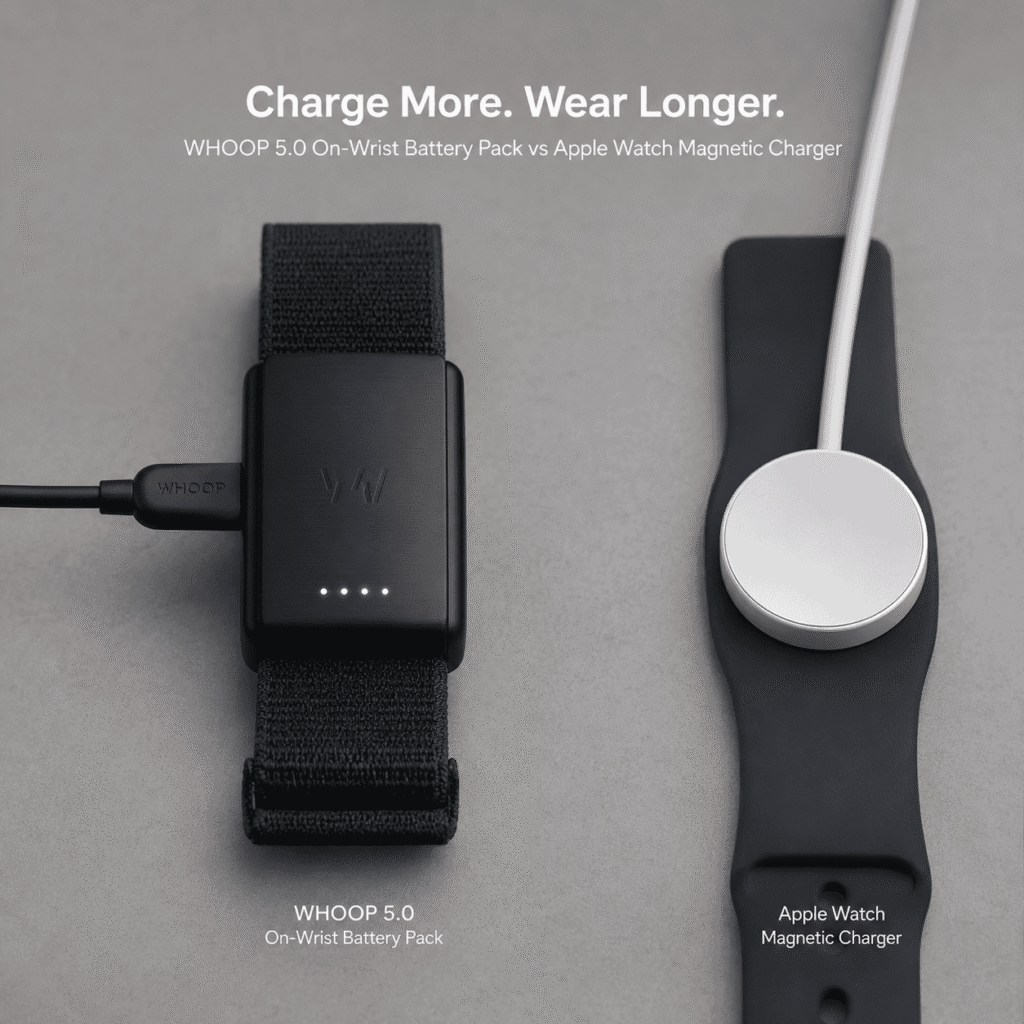
WHOOP 5.0: Approximately 4–5 days per charge. The key differentiator is WHOOP’s on-wrist charging system — an external battery pack clips onto the sensor module while you’re still wearing it. You charge the pack separately, then slide it on during your morning coffee, commute, or workout. Your biometric stream never breaks. No overnight data gaps. No missed sleep nights because you forgot to charge.
For continuous health monitoring — especially sleep tracking — WHOOP’s charging architecture is a genuine strategic advantage.
Winner: WHOOP for charging continuity and multi-day battery. Apple Watch Ultra 2 for best-in-Apple-Watch battery.
Apple Watch vs WHOOP App and Software
Apple Health and the Apple Watch Ecosystem
The Apple Watch feeds data into Apple Health — the most mature consumer health data hub in existence. Apple Health aggregates biometrics from hundreds of compatible apps, enabling a unified view of steps, sleep, workouts, heart rate, respiratory rate, and more — all in one place on your iPhone.
The Apple Watch App Store provides deep customization: AutoSleep for advanced sleep analysis, HRV4Training for recovery coaching, Strava for running, Peloton for guided workouts, TrainingPeaks for structured plans. No WHOOP alternative delivers this third-party breadth.
For athletes already embedded in app ecosystems — Garmin Connect for training history, MyFitnessPal for nutrition, Oura for ring-based recovery — Apple Health serves as the connective tissue that synthesizes everything.
The WHOOP App
The WHOOP app is purpose-built for recovery analytics. Your morning opens with your Recovery Score, sleep breakdown, HRV reading, and recommended strain range for the day. Dive deeper and you get:
- HRV trend charts over 30, 60, and 90 days
- Sleep stage timelines with respiratory rate overlaid
- Journal behavior correlation — showing statistically how alcohol, caffeine, stress, and other variables affect your recovery
- WHOOP Coach AI recommendations in plain language
After 60–90 days, the WHOOP app stops feeling like a tracker and starts feeling like a coach that knows you specifically. The Journal correlations become personal — not generic advice about sleep hygiene, but specific data about your body’s response to your habits.
Winner: Apple Watch for ecosystem breadth and third-party integration. WHOOP for personalized recovery coaching depth.
Apple Watch vs WHOOP Subscription Costs
Apple Watch: One-time hardware purchase. No mandatory subscription. Apple Fitness+ ($9.99/month) is entirely optional — it adds guided workout videos but nothing health-monitoring related.
WHOOP: Subscription-based model. The wearable hardware is included with your membership. Current pricing tiers:
| WHOOP Plan | Approx. Cost |
|---|---|
| Monthly | ~$30/month |
| 12-month | ~$25/month (~$300/year) |
| 24-month | ~$18/month (~$432 upfront) |
Always verify current pricing at whoop.com — rates have changed across hardware generations.
Long-Term Cost Comparison
| Timeframe | WHOOP (Annual Plan) | Apple Watch Series 11 | Apple Watch Ultra 2 |
|---|---|---|---|
| Year 1 | ~$300 | ~$350–400 | ~$700–800 |
| Year 2 | ~$600 | Same device | Same device |
| Year 3 | ~$900 | Potential upgrade (~$700–800 total) | Same device |
By Year 3, WHOOP’s subscription accumulates to approximately the same cost as an Apple Watch Series 11 purchased once. Beyond Year 3, WHOOP becomes progressively more expensive. Factor this into your decision honestly.
Winner: Apple Watch for total cost of ownership. WHOOP’s subscription is justified only if you engage with the data daily.
Apple Watch vs WHOOP Long-Term Value
Apple Watch delivers consistent value year-over-year through watchOS software updates, new health features, and a device that remains useful across all life contexts — not just fitness. The watch face works in meetings, the ECG works after your run, the Apple Pay works at the grocery store. Generalist value compounds over time.
WHOOP delivers specialist value proportional to your engagement. An athlete who makes daily training decisions based on their Recovery Score gets real, measurable ROI — improved performance, reduced injury, smarter recovery. Someone who checks their score sporadically and never changes behavior based on it pays monthly for data they don’t act on.
Winner: Apple Watch for generalist long-term value. WHOOP for athletes who make data-driven training decisions daily.
Apple Watch vs WHOOP Privacy
Both Apple and WHOOP publish detailed privacy policies. Key considerations:
Apple: Apple Health data is stored on-device and optionally in iCloud (encrypted). It also has consistently positioned health data privacy as a core brand value. Apple does not sell health data to advertisers.
WHOOP: Uses HIPAA-aligned data practices. WHOOP data is stored in encrypted cloud infrastructure. Aggregated, anonymized data may be used for research. Individual health data is not sold. Review WHOOP’s current privacy policy for specifics.
General guidance: Both companies maintain significantly better health data practices than many smaller wearable brands. For users handling particularly sensitive health data, verify each platform’s current policy before committing.
Winner: Tie — both maintain strong health data privacy positions.
Apple Watch vs WHOOP Women’s Health
Both platforms have invested meaningfully in women’s health features.
Apple Watch: Cycle Tracking in Apple Health logs period dates, symptoms, flow, and temperature. Wrist temperature sensors on Series 11 flag potential ovulation windows by detecting temperature shifts associated with the luteal phase. Retrospective Ovulation Estimates are generated based on temperature pattern changes.
WHOOP: Correlates menstrual cycle phases with Recovery Score, HRV, and sleep quality. Female athletes can see precisely how their body’s physiological readiness shifts across the follicular and luteal phases — and plan training intensity accordingly. WHOOP also monitors skin temperature, adding sensitivity to hormonal cycle changes.
For women athletes, WHOOP’s direct connection between cycle phase and training readiness data is practically powerful. Apple Watch’s temperature-based ovulation detection is more general wellness-oriented.
Women interested in smart ring alternatives for health tracking should also see our guide to the best smart ring for women.
Winner: Near-tie. WHOOP edges ahead for cycle-performance correlation. Apple Watch edges ahead for overall cycle tracking accessibility.
Apple Watch vs WHOOP vs Garmin
Adding Garmin opens a third strong option — particularly for endurance athletes.
| Feature | Apple Watch Series 11 | WHOOP 5.0 | Garmin Forerunner 965 |
|---|---|---|---|
| Recovery Score | Basic (3rd-party) | ✅ Advanced | ✅ Body Battery |
| GPS | ✅ | ❌ | ✅ Multi-band |
| Battery | ~18 hours | ~4–5 days | ~23 days |
| Subscription | None | Required | None |
| HRV Depth | Basic | ✅ Best-in-class | ✅ HRV Status |
| Sleep Coaching | Moderate | ✅ Excellent | ✅ Good |
| Smart Features | ✅ Full | None | Moderate |
| ECG | ✅ | ❌ | ❌ |
| Best For | iPhone users | Athletes, recovery | Runners, endurance |
Garmin is the best choice for GPS-focused endurance athletes who want solid recovery data without a subscription. WHOOP is the deepest recovery tool. Apple Watch is the best smartwatch for iPhone users.
See our full WHOOP vs Garmin comparison for an in-depth breakdown.
Apple Watch vs WHOOP vs Oura Ring
| Feature | Apple Watch Series 11 | WHOOP 5.0 | Oura Ring Gen 4 |
|---|---|---|---|
| Form Factor | Watch | Wrist band | Finger ring |
| Display | ✅ Large OLED | None | None |
| Recovery Score | Basic | ✅ HRV-based daily | ✅ Readiness Score |
| Sleep Coaching | Moderate | ✅ Excellent | ✅ Excellent |
| HRV Precision | Basic | ✅ Best | ✅ Excellent |
| Subscription | None | ~$18–30/mo | ~$6/mo |
| GPS | ✅ | ❌ | ❌ |
| Smart Features | ✅ Full | None | None |
| Overnight Comfort | Moderate | Good | ✅ Excellent |
| Best For | iPhone smartwatch users | Athletes, training load | Sleep, wellness, biohackers |
For a detailed comparison between WHOOP and Oura, see our full WHOOP vs Oura breakdown. Our guide to the best Oura Ring alternatives is also worth exploring.
WHOOP vs Fitbit vs Apple Watch
| Feature | WHOOP 5.0 | Fitbit Charge 6 | Apple Watch Series 11 |
|---|---|---|---|
| Recovery Score | ✅ Advanced | Basic (Premium) | Basic (3rd-party) |
| Sleep Tracking | ✅ Excellent | ✅ Good | ✅ Good |
| GPS | ❌ | ✅ Built-in | ✅ Built-in |
| Subscription | Required (~$18–30/mo) | Optional ($9.99/mo) | None |
| Display | None | ✅ Color | ✅ OLED |
| Smart Features | None | ✅ Google Pay, Maps | ✅ Full |
| ECG | ❌ | ✅ | ✅ |
| Battery | ~4–5 days | ~7 days | ~18 hours |
| Best For | Athletes, recovery | Budget everyday users | iPhone power users |
Fitbit Charge 6 serves a different audience than either WHOOP or Apple Watch — everyday users who want GPS, Google Pay, and solid health tracking under $200 without mandatory subscription. See our WHOOP vs Fitbit comparison for more detail.
Who Should Buy What
| User Type | Best Device | Runner-Up |
|---|---|---|
| Beginners | Apple Watch Series 11 | Fitbit Charge 6 |
| Competitive athletes | WHOOP 5.0 | Garmin Forerunner 965 |
| Marathon runners | Apple Watch Ultra 2 | Garmin Forerunner 965 |
| Cyclists | Garmin Forerunner 965 | Apple Watch Ultra 2 |
| CrossFit athletes | WHOOP 5.0 | Apple Watch |
| Strength athletes | WHOOP 5.0 | Apple Watch |
| Biohackers | WHOOP 5.0 | Oura Ring Gen 4 |
| Sleep optimization | WHOOP 5.0 | Oura Ring Gen 4 |
| Weight loss | Apple Watch | Fitbit Charge 6 |
| Women | Apple Watch | Oura Ring Gen 4 |
| Heart health monitoring | Apple Watch (ECG) | WHOOP (HRV) |
| Older adults | Apple Watch (fall detection) | Garmin Venu 3 |
| Busy professionals | Apple Watch | Oura Ring Gen 4 |
| Students (budget) | Fitbit Charge 6 | Amazfit Balance |
| iPhone users | Apple Watch Series 11 | WHOOP 5.0 |
| Android users | WHOOP 5.0 | Garmin |
| Recovery optimization | WHOOP 5.0 | Oura Ring Gen 4 |
Amazon Product Recommendations
Verify current prices and availability before purchasing — prices fluctuate.
1. Apple Watch Series 11
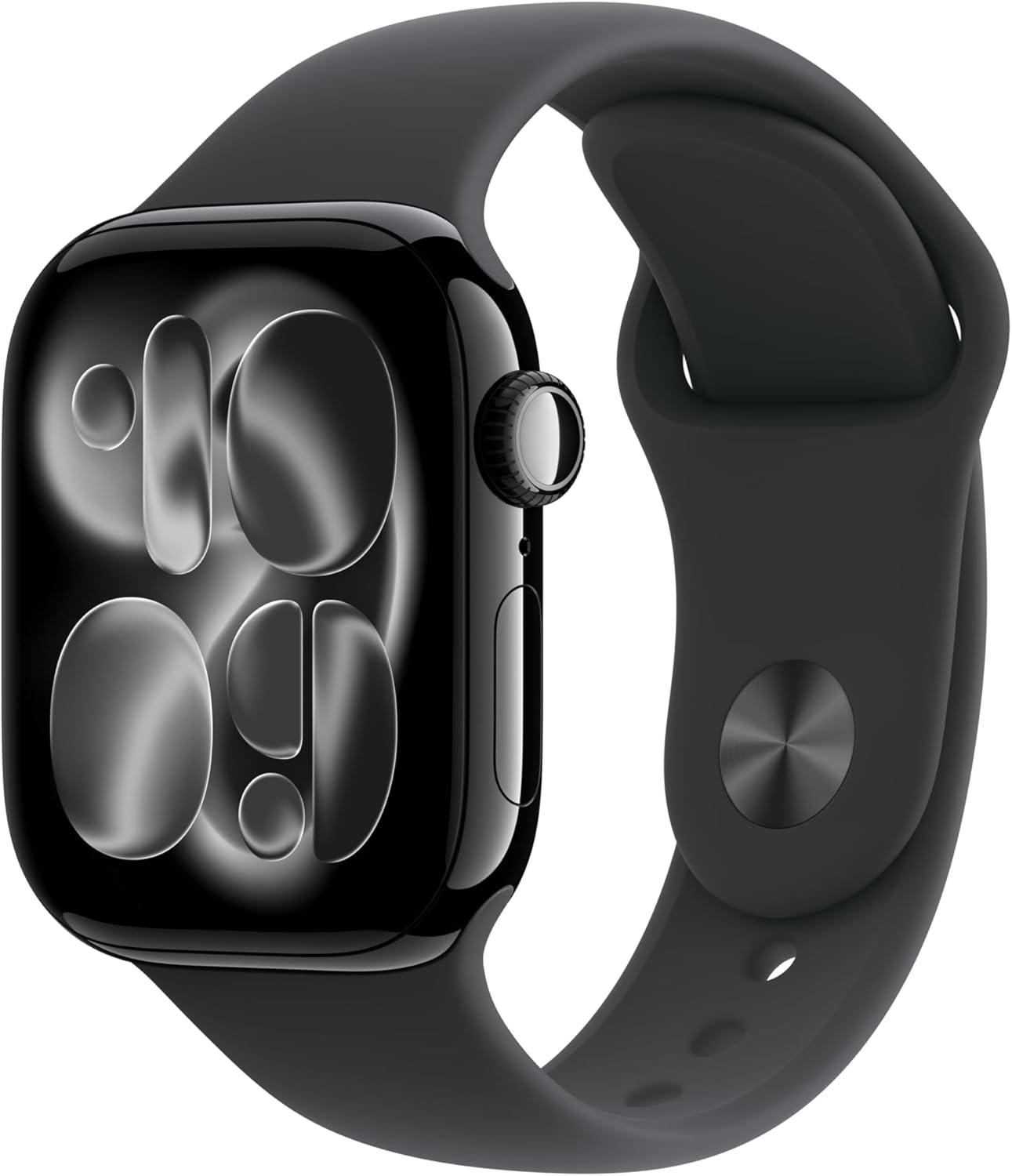
Best for: iPhone users who want the complete smartwatch experience with strong health features
The best all-around Apple Watch for most users. Series 11 improves on every previous generation — thinner case, brighter display, better battery, improved temperature sensor, and Sleep Apnea Notification support.
- Key features: LTPO OLED, GPS, ECG, SpO2, crash detection, fall detection, sleep stages, Apple Pay, Apple Health integration
- Pros: Best smartwatch ecosystem; ECG and Safety features; deep iPhone integration; Sleep Apnea Notification; no subscription
- Cons: Daily charging required; iPhone-only; less HRV depth than WHOOP
- Best for: iPhone users who want health tracking plus full smartwatch functionality
- Approx. price: ~$350–400
2. Apple Watch Ultra 2
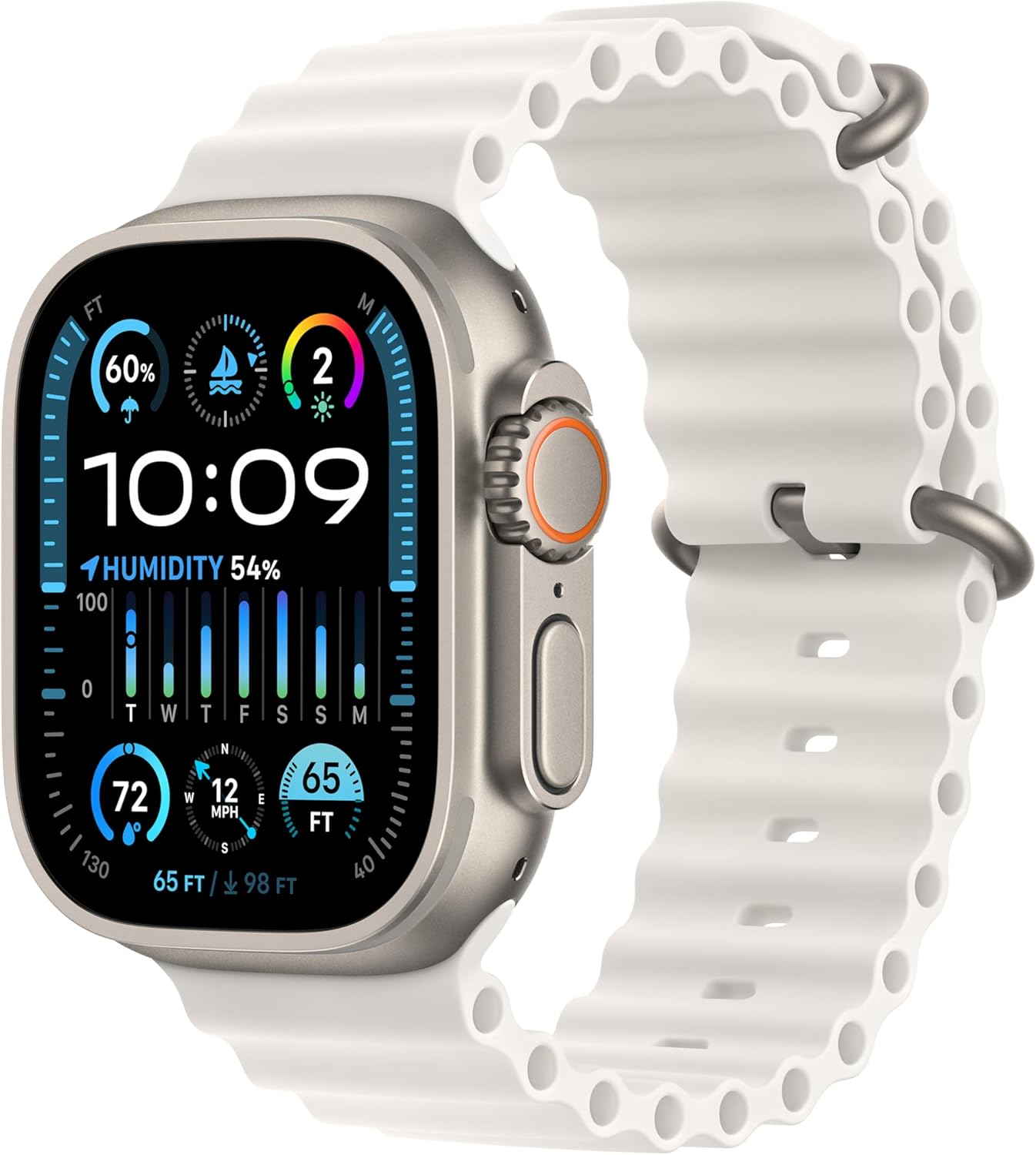
Best for: Endurance athletes and adventure users who need maximum battery, GPS precision, and rugged build
The Ultra 2 is Apple’s most capable watch ever — 60-hour typical battery, dual-frequency GPS, titanium case, Action Button, and global satellite Emergency SOS.
- Key features: 60-hour battery, dual-frequency GPS, titanium, Action Button, satellite SOS
- Pros: Best Apple Watch battery; precision GPS; rugged; cellular; no subscription
- Cons: Heaviest and most expensive Apple Watch; larger case may not suit all wrists
- Best for: Marathon runners, trail athletes, and adventurers who want the best Apple Watch for endurance
- Approx. price: ~$700–800
3. WHOOP 5.0 Fitness Tracker
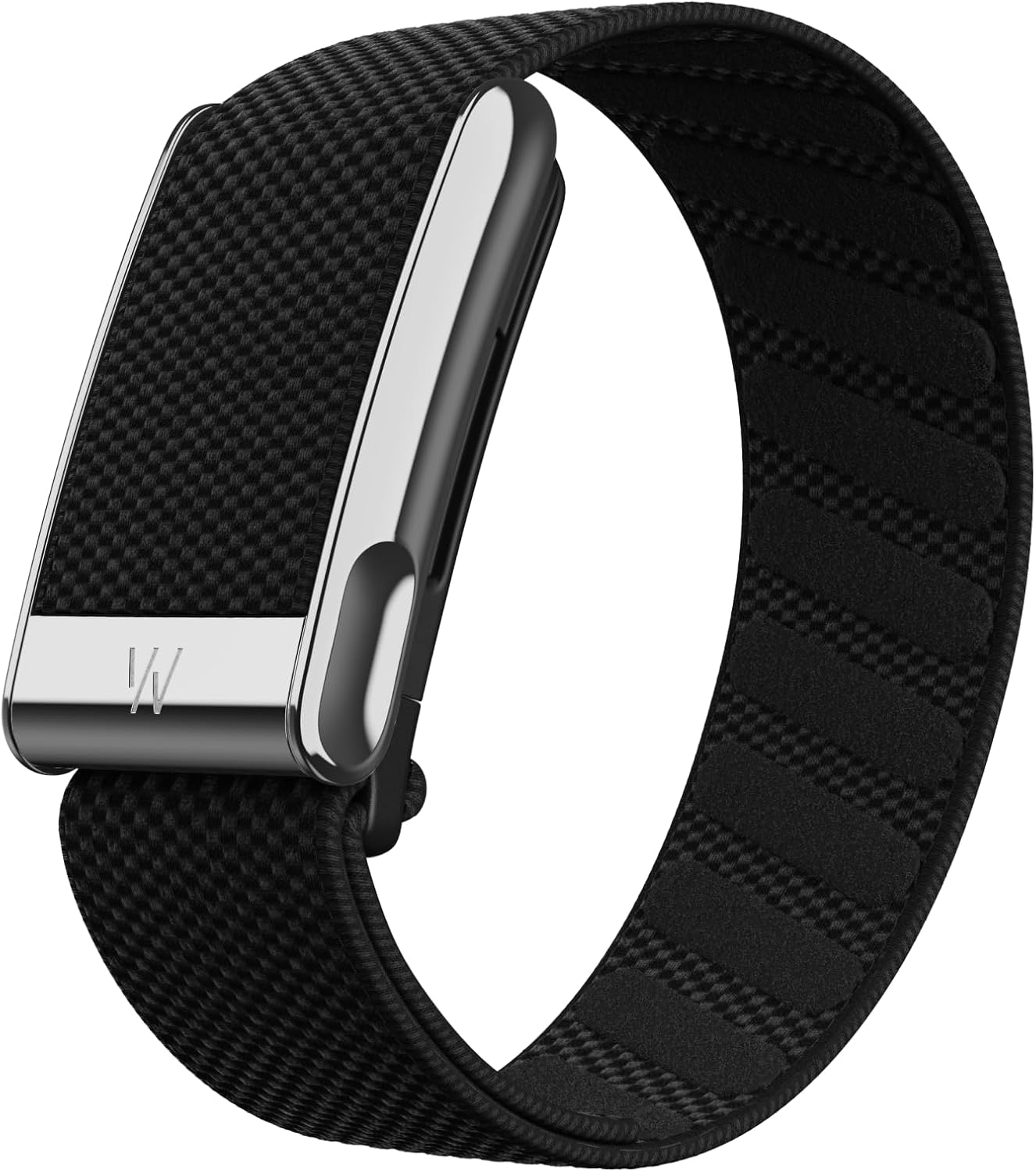
Best for: Athletes, recovery-focused users, and serious biohackers who engage with data daily
WHOOP 5.0 delivers the most sophisticated HRV-based recovery coaching in consumer wearables. No display. No GPS. And No distractions. Just the data that matters — and coaching that tells you what to do with it.
- Key features: Recovery Score, Strain Score, Sleep Coach, Journal behavior correlation, WHOOP Coach AI, on-wrist charging, IP68
- Pros: Best daily HRV recovery scoring; on-wrist charging (zero data gaps); behavioral coaching after 60+ days; AI recommendations
- Cons: Subscription required (~$18–30/month); no display; no GPS; 30+ days to personalize
- Best for: Athletes who make training decisions based on recovery data
- Approx. price: Subscription-based — check Amazon for current hardware pricing + verify membership rates at whoop.com
4. Garmin Forerunner 965
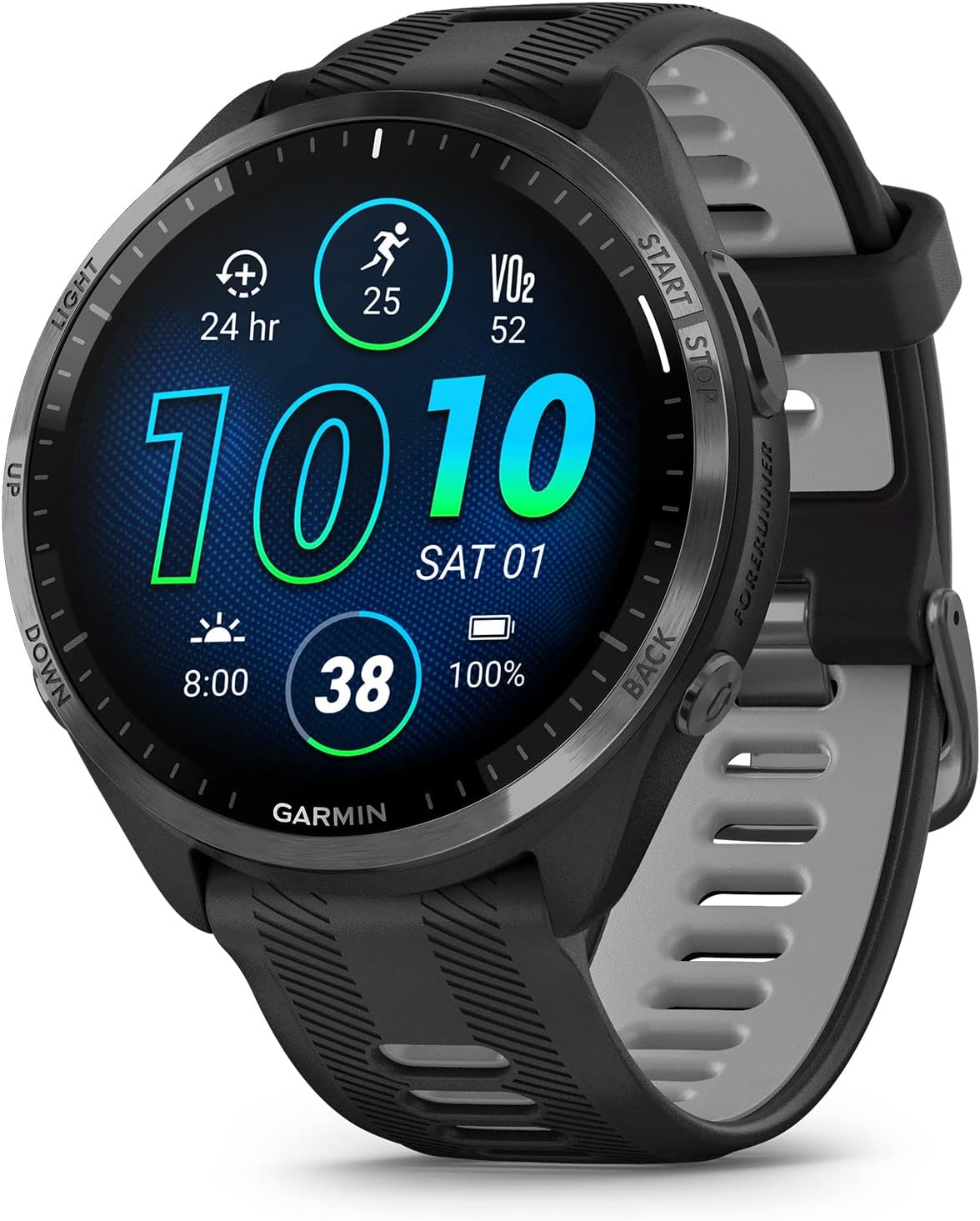
Best for: Runners, triathletes, and endurance athletes who want elite GPS and solid recovery features — no subscription
Multi-band GPS, Body Battery, HRV Status, Daily Suggested Workouts, offline topo maps, and a 23-day battery with no recurring fees.
- Pros: No subscription; best multi-band GPS; 23-day battery; race predictor; Body Battery
- Cons: Less HRV depth than WHOOP; overnight charging creates data gaps; high upfront cost
- Approx. price: ~$500–600
5. Garmin Fenix 8
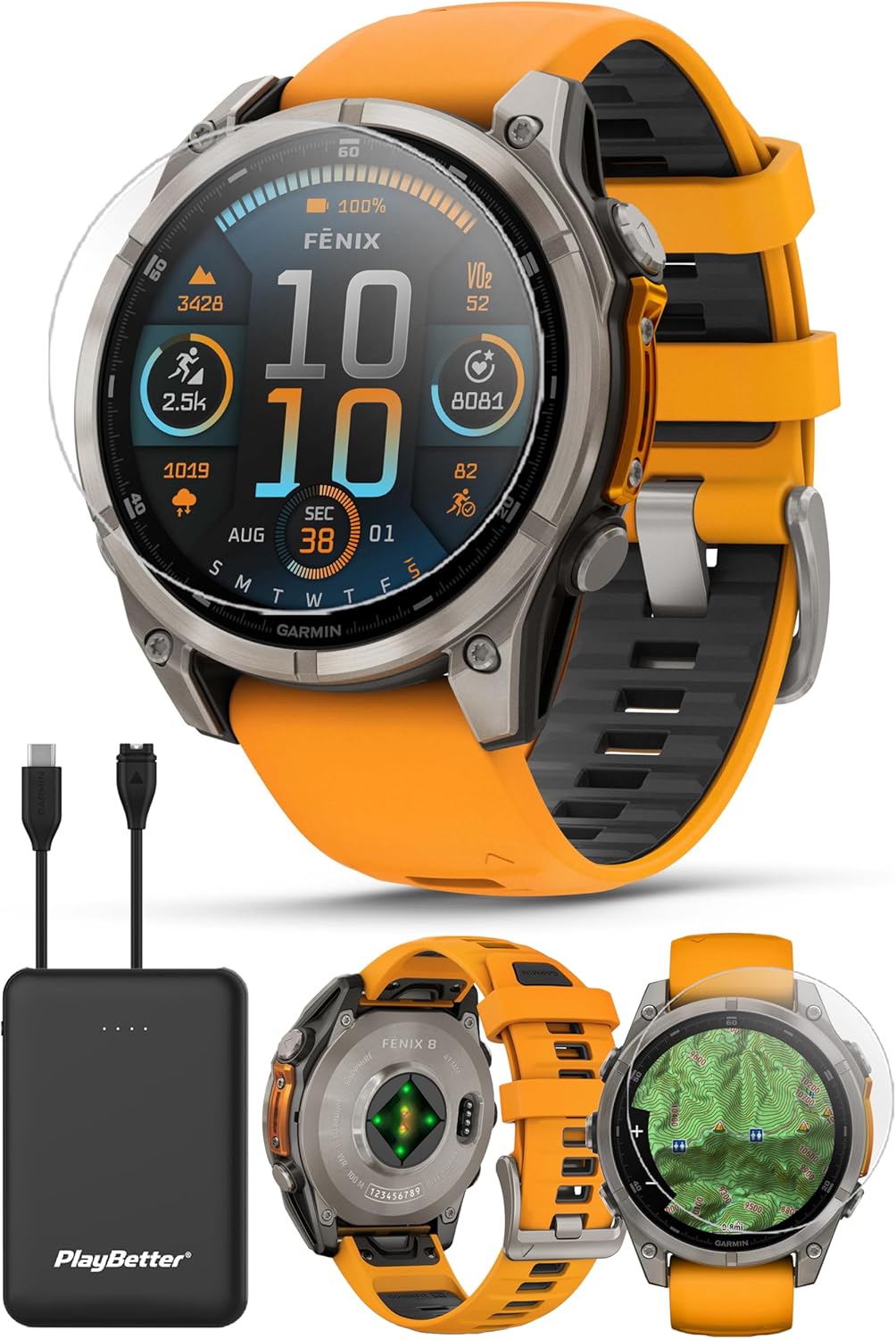
Best for: Elite adventure athletes who need maximum durability, offline maps, and the longest GPS battery available
MIL-SPEC durability, LED flashlight, dive computer, offline topo maps, and 57-hour GPS battery.
- Pros: MIL-SPEC; 57-hour GPS battery; offline maps; no subscription; dive mode
- Cons: Heaviest, most expensive Garmin; overkill for road-only training
- Approx. price: ~$600–900
6. Oura Ring Gen 4
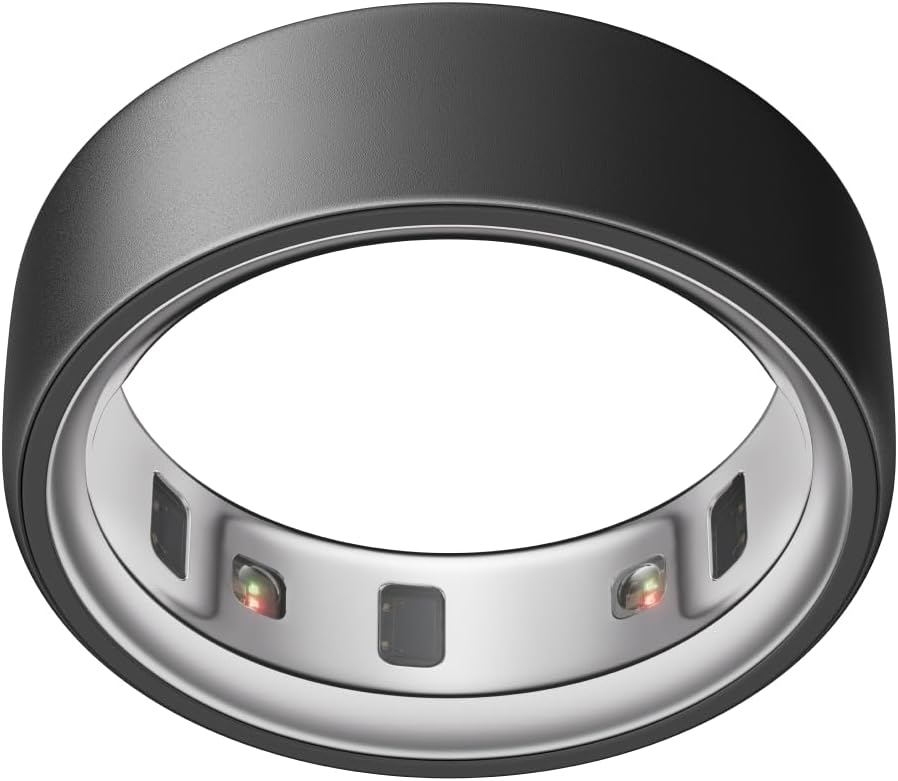
Best for: Sleep-focused users, women, biohackers, and anyone prioritizing comfort in a discreet recovery tracker
The most refined smart ring available — finger-based HR for more accurate overnight biometrics, excellent sleep coaching, and temperature-based cycle tracking at the lowest subscription cost among recovery-focused wearables.
- Pros: Best sleep tracking comfort; finger-based biometric accuracy; $6/month subscription; excellent Readiness Score; temperature cycle detection
- Cons: Ring sizing is permanent; no GPS or display; subscription required for full features
- Approx. price: ~$300–350 + ~$6/month
See our full WHOOP vs Oura comparison and our Garmin vs Oura breakdown.
7. Fitbit Charge 6
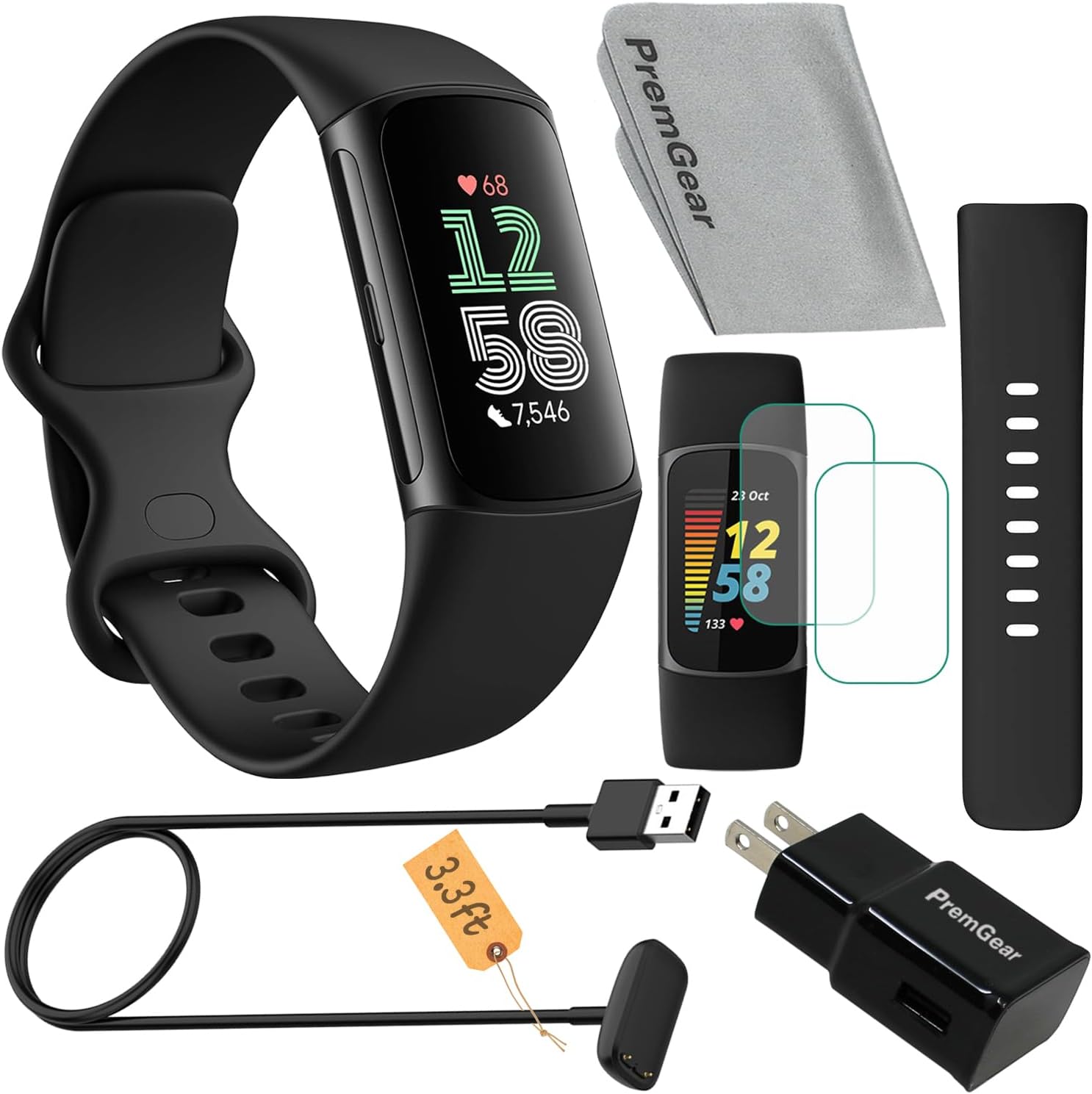
Best for: Budget-conscious everyday users who want GPS, ECG, Google integration, and solid health tracking under $200
The most capable affordable fitness tracker with built-in GPS, ECG, Google Pay, and no mandatory subscription.
- Pros: Most affordable device with GPS + ECG; Google ecosystem; 7-day battery; no required subscription
- Cons: Less recovery depth than WHOOP; limited HRV precision; Fitbit’s long-term Google direction
- Approx. price: ~$130–160
See our WHOOP vs Fitbit guide for full comparison details.
Buying Guide
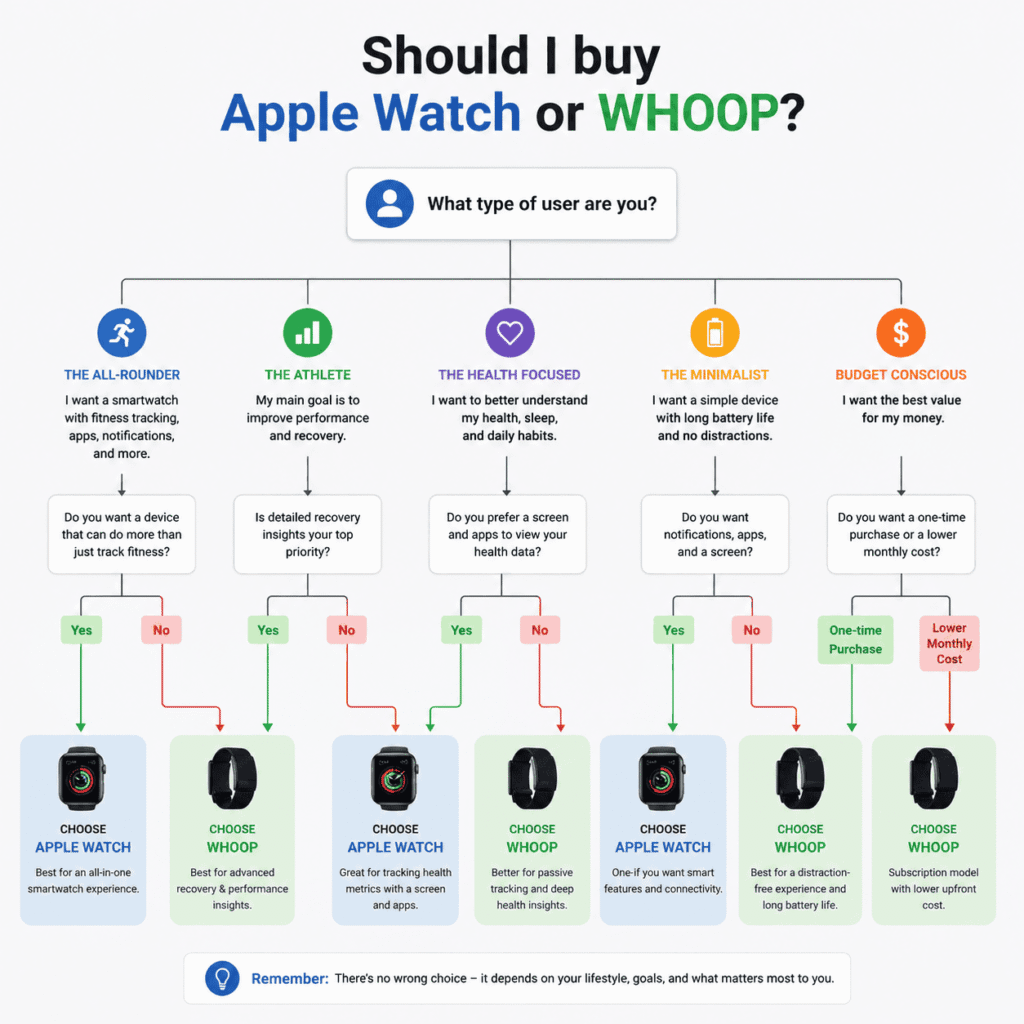
Step 1: Decide Your Primary Goal
| Primary Goal | Best Choice |
|---|---|
| Daily smartwatch functionality | Apple Watch Series 11 |
| Recovery optimization | WHOOP 5.0 |
| Sleep coaching | WHOOP 5.0 |
| GPS running | Apple Watch Ultra 2 or Garmin |
| Heart health (ECG) | Apple Watch Series 11 |
| No subscription | Apple Watch or Garmin |
| Budget | Fitbit Charge 6 |
Step 2: Are You an iPhone User?
Yes → Apple Watch is a natural fit and adds ecosystem value across all life contexts. No → WHOOP works with Android; Garmin works with both. Apple Watch does not.
Step 3: Calculate Your 3-Year Cost
WHOOP at 3 years (annual plan): ~$900 in subscriptions (+ no hardware cost) Apple Watch Series 11: ~$350–400 upfront (no recurring fees) Apple Watch Ultra 2: ~$700–800 upfront (no recurring fees)
Step 4: Can You Solve the Apple Watch Charging Problem?
Apple Watch’s ~18-hour battery works for most users who charge during a morning shower, commute, or desk time. If you can’t commit to daytime charging, you’ll have overnight data gaps that undermine sleep and recovery monitoring.
Step 5: Will You Engage With the Data?
WHOOP only delivers its value if you check your Recovery Score daily and act on it. Passive users pay monthly for data they ignore. Apple Watch delivers value even to passive users through notifications, Apple Pay, and basic health awareness.
Pros and Cons Summary
Apple Watch Series 11
| ✅ Pros | ❌ Cons |
|---|---|
| Best smartwatch ecosystem available | Daily charging required |
| ECG with FDA clearance | iPhone only — no Android |
| Crash and fall detection, Emergency SOS | Less HRV depth than WHOOP |
| Sleep Apnea Notification | Basic recovery scoring without 3rd-party apps |
| No mandatory subscription | Recovery coaching less sophisticated |
| Apple Pay, Maps, Siri, calls, music | |
| Crash detection for cyclist and drivers | |
| watchOS third-party app ecosystem |
WHOOP 5.0
| ✅ Pros | ❌ Cons |
|---|---|
| Best-in-class HRV and Recovery Scoring | Subscription required (~$18–30/month) |
| Daily personalized Sleep Coach | No display — requires phone |
| On-wrist charging (zero data gaps) | No GPS |
| Journal behavioral correlation (60+ days) | No smart features |
| AI coaching adapts to your patterns | 30+ days to personalize |
| IP68 waterproof | Not useful without daily engagement |
| Works with iOS and Android | Higher long-term total cost |
| Alternative wear sites (bicep, calf) |
FAQ Section
Do I need WHOOP if I have an Apple Watch?
Not necessarily — but they serve different purposes. Apple Watch is a smartwatch with strong health features. WHOOP is a dedicated recovery system. If your Apple Watch meets your health tracking needs and you’re not a serious athlete making daily training decisions based on recovery data, you don’t need WHOOP. If you find yourself wanting deeper HRV coaching, a forward-looking Sleep Coach, and personalized behavioral correlations — WHOOP adds something Apple Watch doesn’t provide natively.
What does WHOOP do that the Apple Watch doesn’t?
WHOOP provides: a daily HRV-calibrated Recovery Score built against your personal baseline; a Sleep Coach that tells you what time to sleep tonight based on tomorrow’s goals; a Journal feature that statistically connects lifestyle behaviors to your biometric patterns over time; and on-wrist charging that ensures zero overnight data gaps. None of these exist as native Apple Watch features. Third-party apps can approximate some of them — but without WHOOP’s continuous sensing and coaching integration.
Is WHOOP better than a smartwatch?
WHOOP is better than a smartwatch for recovery and sleep coaching. Smartwatches are better than WHOOP for GPS, notifications, payments, music, calls, and general daily functionality. They are different tools. “Better” depends entirely on what you want from a wearable.
Is WHOOP worth it vs Apple Watch?
For athletes who engage with recovery data daily — absolutely. For casual users or those who primarily want a smartwatch — Apple Watch delivers more consistent daily value at a lower long-term cost. The break-even math matters: WHOOP’s subscription accumulates to ~$300–360/year indefinitely. Apple Watch is a one-time purchase that retains broad value regardless of how often you check your health metrics.
What is the downside of WHOOP?
The primary downsides of WHOOP are: the mandatory subscription that makes it significantly more expensive over time; the absence of any display (requiring your phone for all data views); no GPS; no smart features; and a 30+ day personalization period before the data becomes truly meaningful. For users who want a versatile everyday device, WHOOP’s deliberate single-purpose design can feel limiting.
Will Apple release a WHOOP alternative?
Apple has consistently moved toward deeper health monitoring with each watchOS and Apple Watch generation. The addition of temperature sensing, Sleep Apnea Notification, and ECG suggests Apple is interested in clinically meaningful health metrics. However, Apple’s product strategy has historically prioritized broad accessibility over deep specialization — which is what makes WHOOP distinct. Whether Apple builds a WHOOP-equivalent recovery system into watchOS in future generations remains to be seen. As of 2026, the recovery coaching depth gap between WHOOP and Apple Watch remains significant.
Do cardiologists recommend Apple Watch?
Some cardiologists have referenced Apple Watch’s ECG capability favorably in clinical contexts — particularly for detecting AFib in patients who might not otherwise receive timely cardiac monitoring. Several published studies have examined Apple Watch’s ECG accuracy in detecting atrial fibrillation and irregular rhythm. The American Heart Association has noted that consumer wearables can play a role in heart health awareness. Apple Watch’s ECG and irregular rhythm notifications are FDA-cleared — a meaningful clinical distinction. That said, no cardiologist would recommend Apple Watch as a replacement for clinical cardiac monitoring. It’s a complement to — not a substitute for — medical care. If you have cardiac concerns, consult your physician.
Which wearable has the most accurate heart rate tracking?
For resting and overnight HR: WHOOP’s high-frequency continuous sampling and Oura Ring’s finger-based positioning both outperform wrist-based smartwatches. For workout-based HR in most steady-state activities: Apple Watch, Garmin, and Polar all perform well. And for highest-intensity activities (heavy lifting, HIIT intervals): no optical wrist device is fully reliable — a chest strap (Garmin HRM-Pro Plus, Polar H10) remains the gold standard.
Is Apple Watch or WHOOP better for sleep?
WHOOP wins for sleep coaching — its Sleep Coach provides forward-looking bedtime recommendations that Apple Watch doesn’t offer natively. Oura Ring rivals WHOOP for sleep accuracy with the comfort advantage of ring-based wear. Apple Watch’s Sleep Apnea Notification feature is a meaningful safety capability. If sleep optimization is your primary goal, WHOOP or Oura Ring outperform Apple Watch. If you want sleep data integrated with a smartwatch you’re already wearing, Apple Watch with AutoSleep or a similar third-party app is sufficient.
Can WHOOP replace an Apple Watch?
For iPhone users: WHOOP cannot replace Apple Watch’s smartwatch functionality. WHOOP has no display, no notifications, no Apple Pay, no Siri, no GPS, no calls, no apps. For pure health and recovery monitoring, WHOOP is the deeper tool. Most iPhone users who wear WHOOP also keep their Apple Watch — using WHOOP on one wrist or the bicep, and Apple Watch on the other wrist. The combination covers every base.
Which wearable is better for marathon runners?
For active training and race day: Apple Watch Ultra 2 or Garmin Forerunner 965 — both offer dual-frequency or multi-band GPS, real-time pace coaching, heart rate zones, and race predictor tools. For post-run recovery management — understanding whether you’re ready for your next hard session: WHOOP 5.0 provides insights that neither Apple Watch nor Garmin match natively. Many elite marathon runners use both: a GPS watch for training and WHOOP for recovery.
Final Verdict
After comparing Apple Watch and WHOOP across every meaningful category, the answer isn’t one device for everyone. It’s the right device for your specific situation.
Best overall for iPhone users:
Apple Watch Series 11 — the most complete everyday health and smartwatch experience, with ECG, no subscription, and seamless iOS integration.
Best for recovery-focused athletes:
WHOOP 5.0 — nothing in the consumer wearable market matches its HRV-based daily Recovery Score, Sleep Coach, and behavioral coaching depth. If you train hard and want to know whether your body is ready to push again, WHOOP is the tool.
Best for endurance athletes:
Apple Watch Ultra 2 for GPS and safety features; Garmin Forerunner 965 for no subscription and multi-band GPS precision. Our WHOOP vs Garmin comparison covers that head-to-head in detail.
Best for sleep optimization:
WHOOP 5.0 — particularly for athletes who want their sleep coaching integrated with training data. Oura Ring Gen 4 is the alternative for maximum comfort and the lowest subscription cost.
Best for budget buyers:
Fitbit Charge 6 at ~$130–160 with no mandatory subscription, built-in GPS, and solid health tracking.
Best for Android users:
WHOOP works with Android. Apple Watch does not. Android users comparing these two effectively have one choice.
The Apple Watch vs WHOOP comparison ultimately comes down to this: are you building a smartwatch experience, or building a performance monitoring system? Both devices are excellent at their respective purposes. The wrong answer is treating them as interchangeable.
Check current pricing on Amazon for both devices, read verified user reviews specific to your use case, and choose the wearable that matches how you actually train, live, and recover.
For a broader look at the entire wearable landscape — including all the devices covered in this comparison — see our complete wearable fitness tracker comparison, our best recovery trackers guide, and our best sleep trackers roundup.