
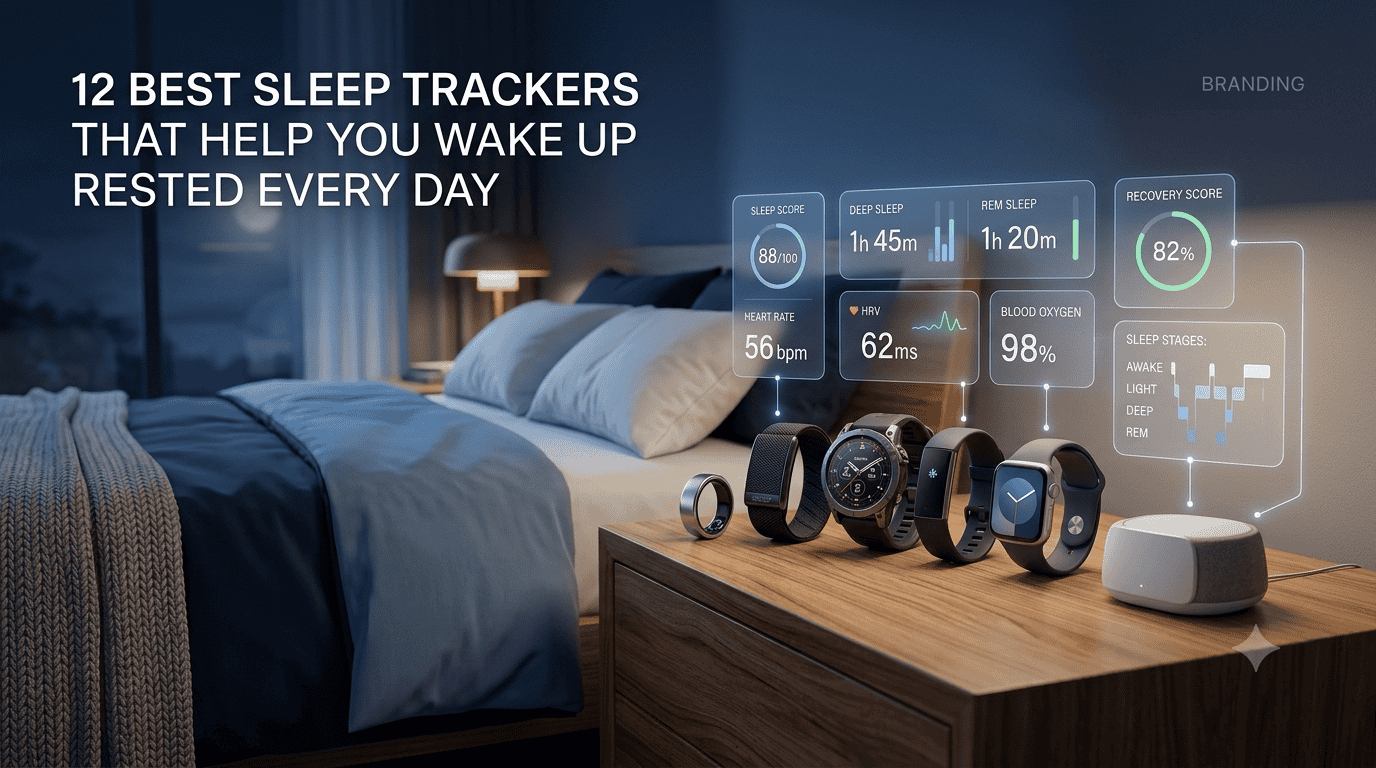
The recovery tracking story: You know the feeling. You spent eight hours in bed. Your alarm goes off. And you’re exhausted. That’s the problem with sleep: the number of hours doesn’t tell you nearly enough. Poor sleep quality — too little deep sleep, fragmented REM cycles, elevated overnight heart rate — leaves you just as depleted as no sleep at all. This is why the Best Sleep Trackers focus on what’s actually happening while you’re asleep, giving insight to the majority of people who otherwise have no idea.
That frustration is exactly why sleep trackers have exploded in popularity. But here’s what most buying guides don’t tell you: the best sleep trackers aren’t just pedometers for your bed. The top devices track sleep stages, heart rate variability, skin temperature, blood oxygen, and respiratory rate — and turn all of that into morning insights that can genuinely change how you sleep.
The hard part is finding the right one. Smart rings, fitness watches, wrist bands, bedside analyzers — the options multiply every year, and the marketing all sounds the same.
This guide cuts through it. We ranked the 12 best sleep trackers currently available on Amazon, comparing sleep accuracy, comfort, battery life, subscription costs, and real-world usefulness. You’ll know exactly which one belongs on your wrist — or finger, or nightstand — by the time you finish reading.
How Sleep Trackers Work
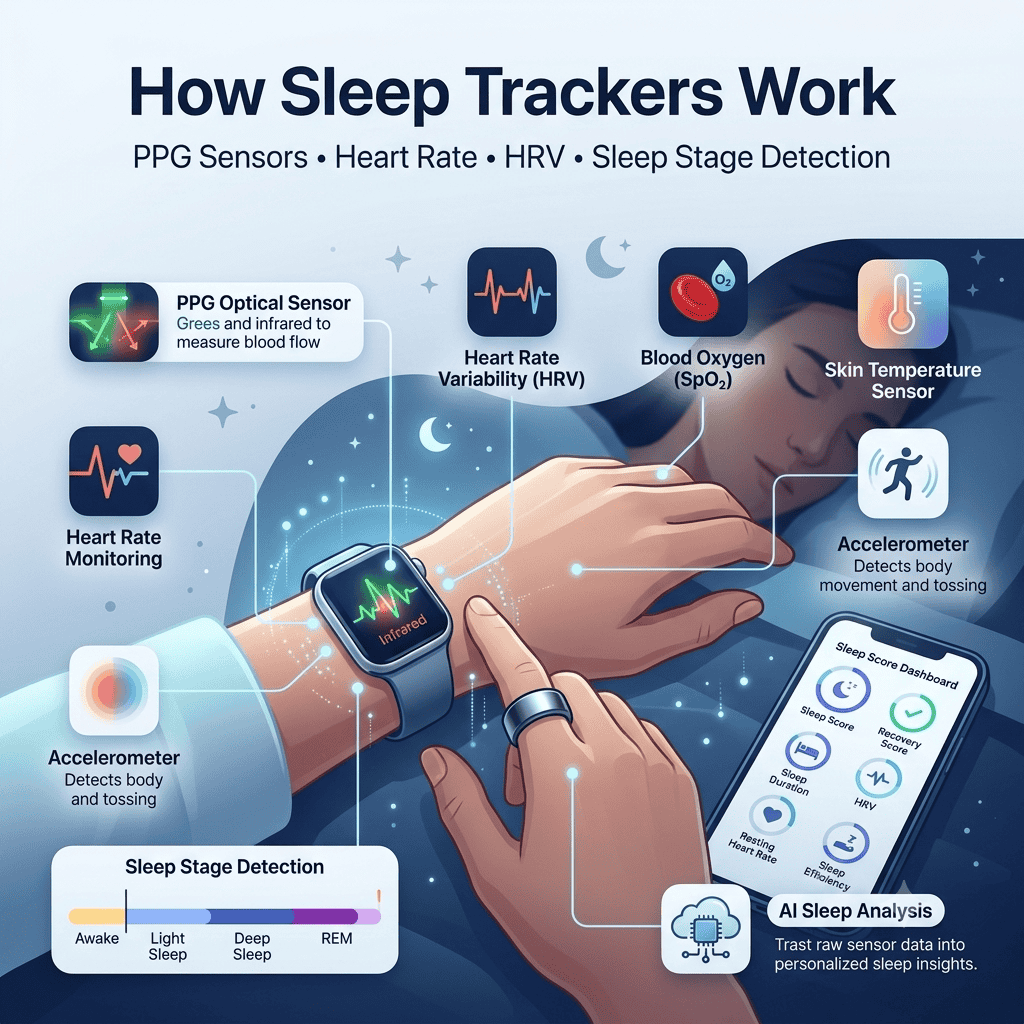
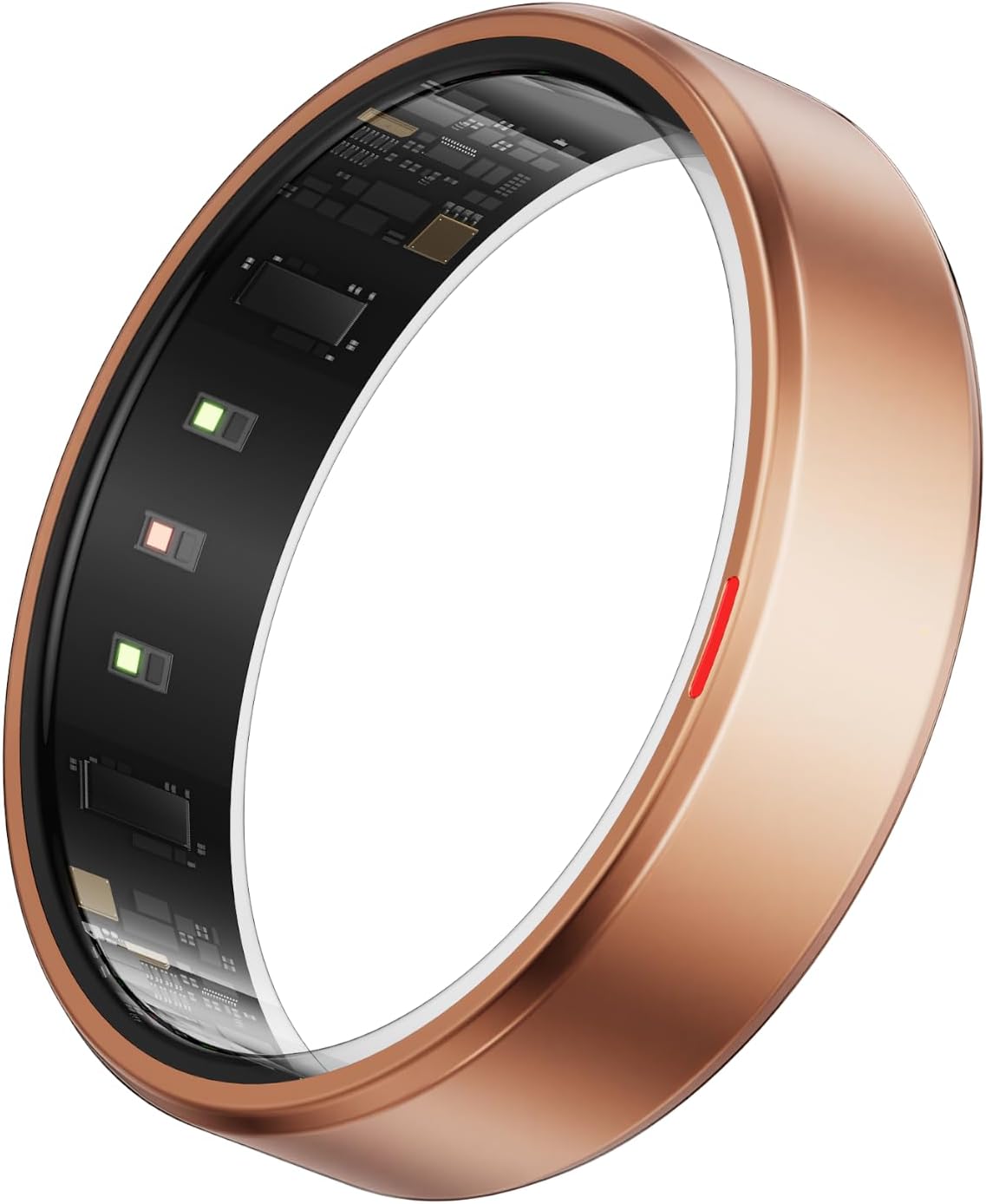
Most sleep trackers use a technology called photoplethysmography (PPG) — optical sensors that shine light (usually green LEDs) into your skin and measure blood flow changes. From those changes, the device infers your heart rate and HRV patterns moment to moment throughout the night.
Combined with accelerometer data that detects movement, the device classifies your sleep into stages:
- Light sleep: A transitional state between wakefulness and deeper sleep
- Deep sleep (slow-wave): The physically restorative stage — muscle repair, immune function, and growth hormone release happen here
- REM sleep: The mentally restorative stage — memory consolidation, emotional processing, and cognitive recovery
- Awake periods: Brief wakings that may or may not be remembered
Some trackers add skin temperature sensors, respiratory rate monitoring, and blood oxygen (SpO2) sensing to increase accuracy. The more physiological data points a device collects overnight, the better its sleep stage estimates tend to be.
Important note: No consumer sleep tracker produces clinically diagnostic data. Polysomnography — the gold standard sleep study conducted in a clinical setting — is the only method that can accurately diagnose sleep disorders. Consumer devices estimate sleep metrics and should be used for wellness awareness, not medical diagnosis. If you have concerns about sleep quality or suspect a sleep disorder, consult a physician.
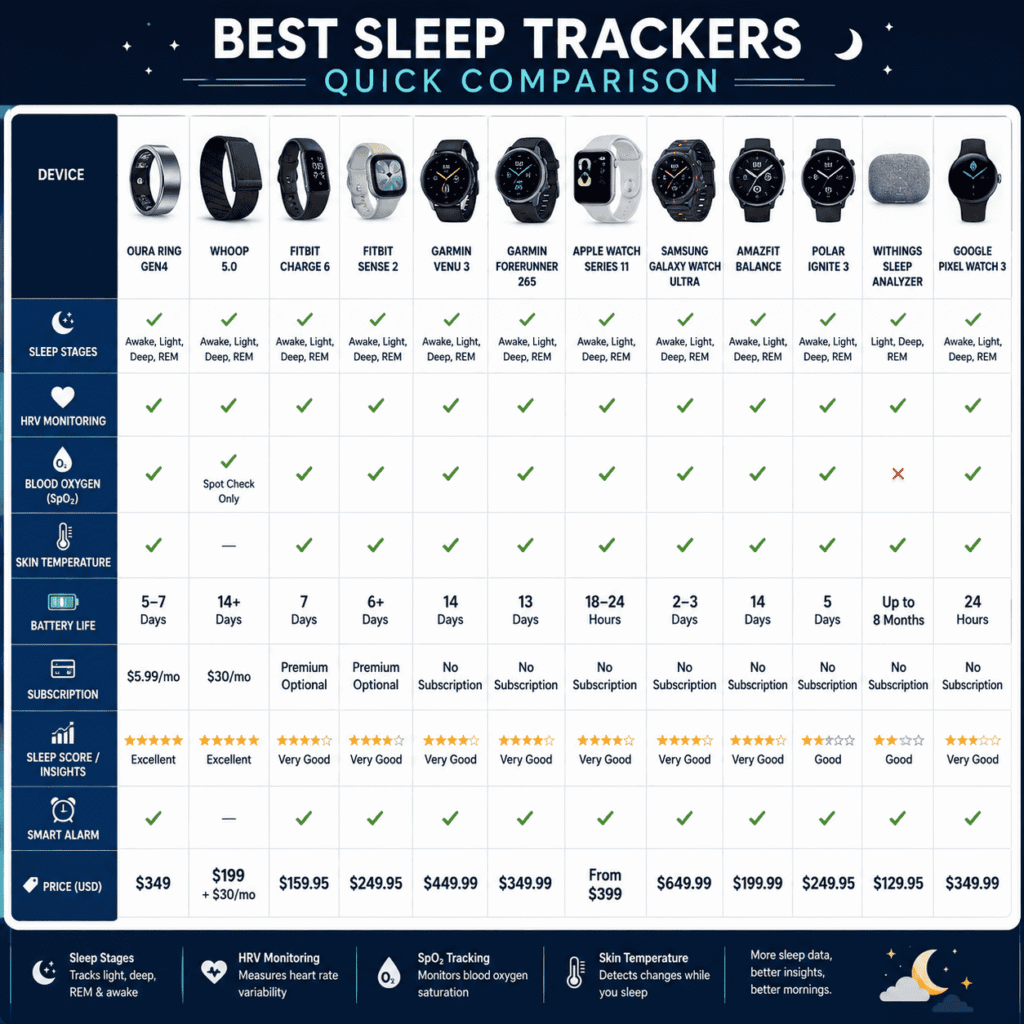
Quick Comparison Table
| Device | Sleep Stages | HRV | Temp Sensor | SpO2 | Battery | Subscription | Price |
|---|---|---|---|---|---|---|---|
| Oura Ring Gen 4 | ✅ Excellent | ✅ | ✅ | ✅ | 5–8 days | ~$6/mo | ~$300–350 |
| WHOOP 5.0 | ✅ Excellent | ✅ | ✅ | ✅ | ~4–5 days | ~$18–30/mo | Subscription |
| Fitbit Charge 6 | ✅ Good | ✅ Basic | ✅ | ✅ | ~7 days | Optional $9.99/mo | ~$130–160 |
| Fitbit Sense 2 | ✅ Good | ✅ Basic | ✅ | ✅ | ~6 days | Optional $9.99/mo | ~$200–250 |
| Garmin Venu 3 | ✅ Good | ✅ | ✅ | ✅ | ~14 days | None | ~$300–350 |
| Garmin Forerunner 265 | ✅ Good | ✅ | ✅ | ✅ | ~13 days | None | ~$300–350 |
| Apple Watch Series 11 | ✅ Moderate | ✅ Basic | ✅ | ✅ | ~18+ hours | None | ~$350–400 |
| Samsung Galaxy Watch Ultra | ✅ Good | ✅ | ✅ | ✅ | ~60 hours (watch) | None | ~$600–650 |
| Amazfit Balance | ✅ Good | ✅ Basic | ✅ | ✅ | ~14 days | None | ~$100–150 |
| Polar Ignite 3 | ✅ Good | ✅ | ❌ | ✅ | ~5 days | None | ~$200–250 |
| Withings Sleep Analyzer | ✅ Excellent | ✅ | ❌ | ✅ | N/A (plug-in) | None | ~$100–130 |
| Google Pixel Watch 3 | ✅ Good | ✅ | ✅ | ✅ | ~24 hours | None | ~$300–350 |
Image placeholder: best-sleep-trackers-2026-quick-comparison.jpg | Alt: “”
Editor’s Picks at a Glance
| Category | Pick |
|---|---|
| Editor’s Choice | Oura Ring Gen 4 |
| Best Overall | WHOOP 5.0 |
| Best Value | Garmin Venu 3 |
| Best Budget | Amazfit Balance |
| Best Smart Ring | Oura Ring Gen 4 |
| Best Subscription-Free | Garmin Venu 3 |
| Best for Athletes | WHOOP 5.0 |
| Best for Sleep Apnea Awareness | Withings Sleep Analyzer |
| Best for iPhone Users | Apple Watch Series 11 |
| Best Bedside Tracker | Withings Sleep Analyzer |
| Best Fitbit for Sleep | Fitbit Sense 2 |
| Best for Android Users | Samsung Galaxy Watch Ultra |
12 Best Sleep Trackers Reviewed
1. Oura Ring Gen 4 — Editor’s Choice | Best Smart Ring for Sleep
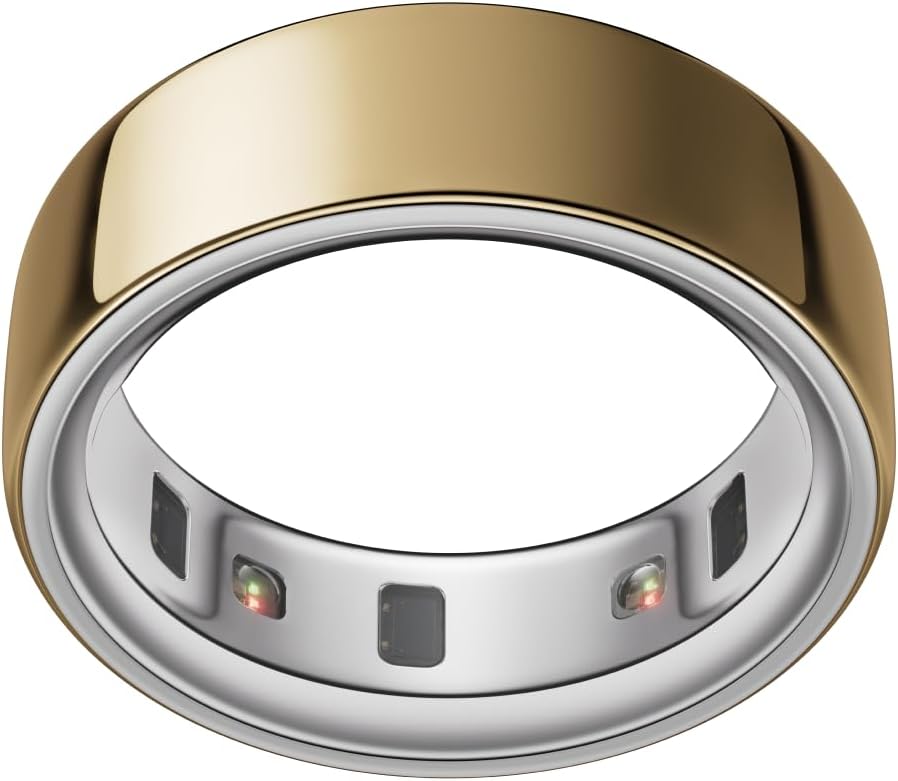
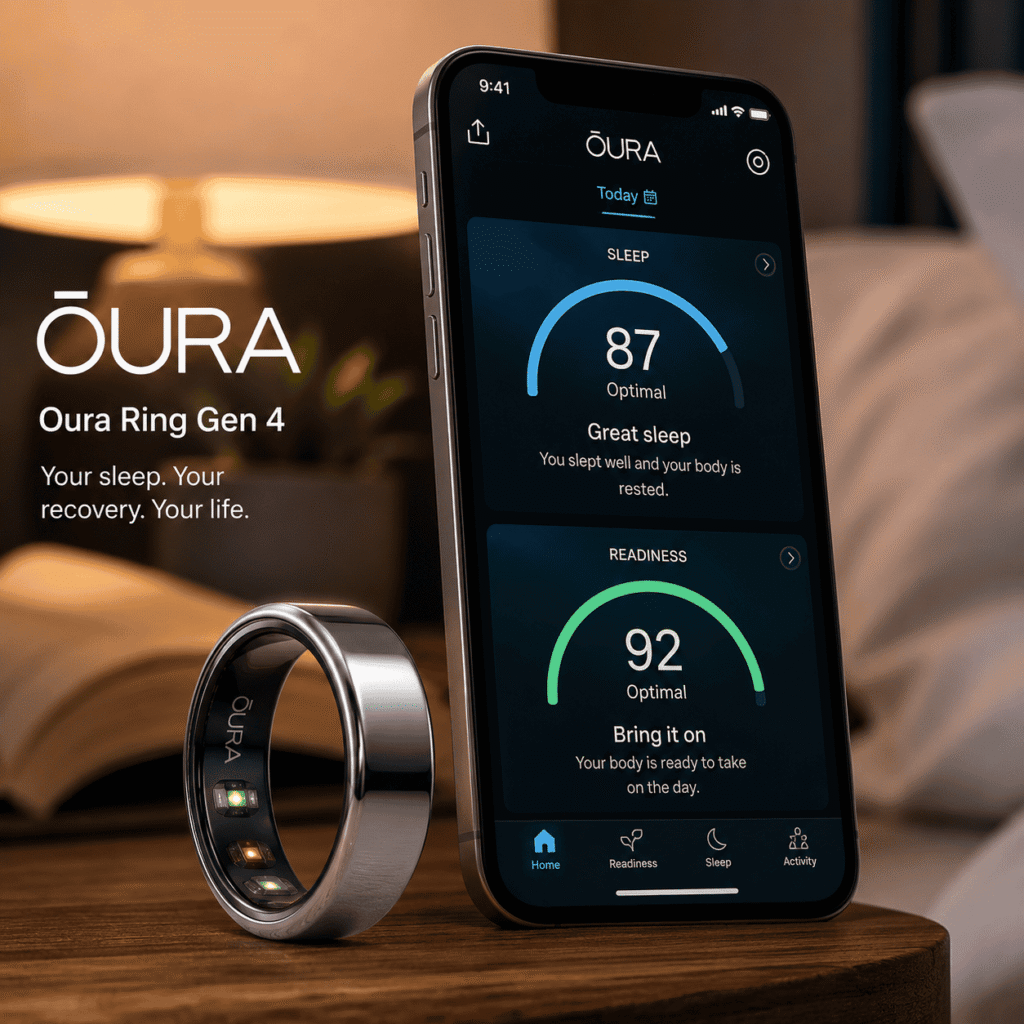
If you only read about one sleep tracker, make it this one. The Oura Ring Gen 4 isn’t just a good sleep tracker. It’s built specifically around sleep. Every hardware and software decision — from the ring form factor to the sensor array to the app’s educational insight layer — was made with sleep quality in mind.
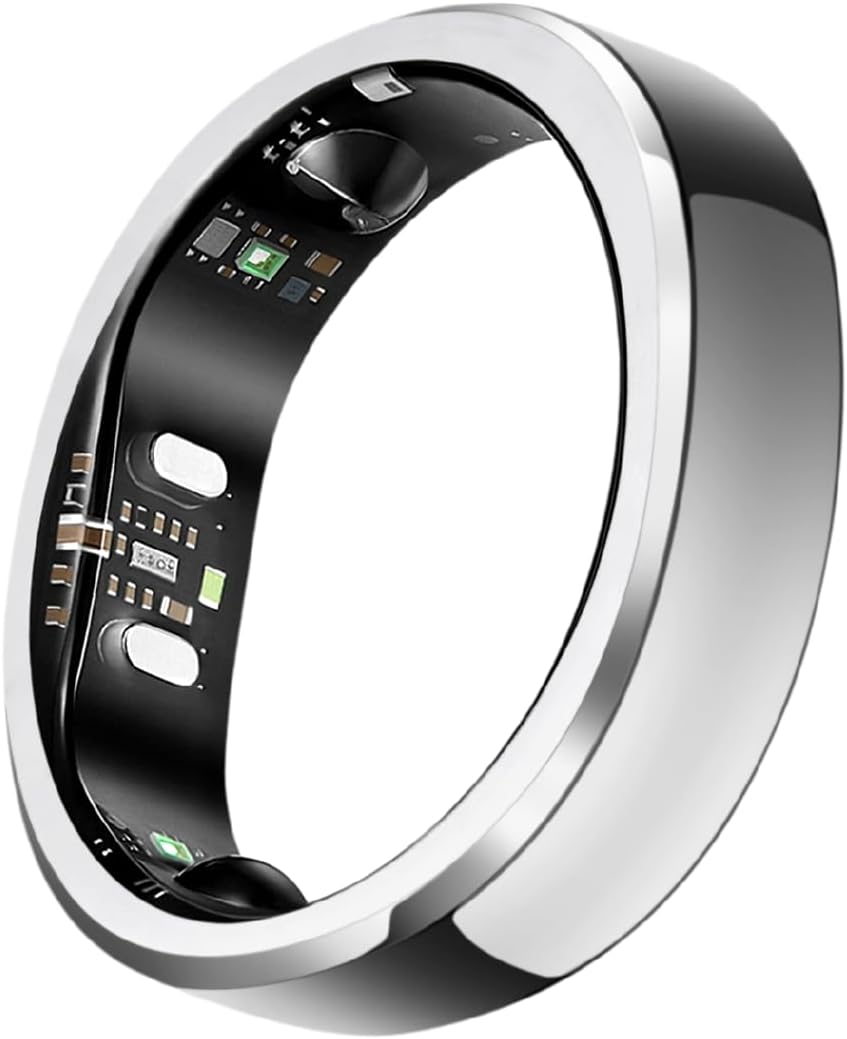
The ring sits on your finger, where optical HR measurement works better than anywhere else on the body — which is why it competes so strongly among the Best Sleep Trackers. Blood vessels in the finger are closer to the surface, meaning there’s less tendon and bone interference and reduced motion artifact. The result: more accurate HRV readings and more reliable sleep stage classification than any wrist-worn tracker at this price point.
Sleep tracking features:
- All four sleep stages (light, deep, REM, awake) with timeline breakdown
- Nightly HRV measurement (RMSSD) from the finger
- Skin temperature deviation monitoring
- Respiratory rate during sleep
- Resting heart rate overnight
- Sleep Score (0–100) with individual stage contributor breakdown
- Readiness Score incorporating sleep quality, temperature trends, and HRV
What makes Oura special isn’t the data — it’s the insight layer. The app doesn’t just tell you what happened. It explains why your deep sleep was 18% below average last night. It shows you which behaviors correlate with your best sleep scores over time. After six weeks, those insights become genuinely personal.
Comfort:
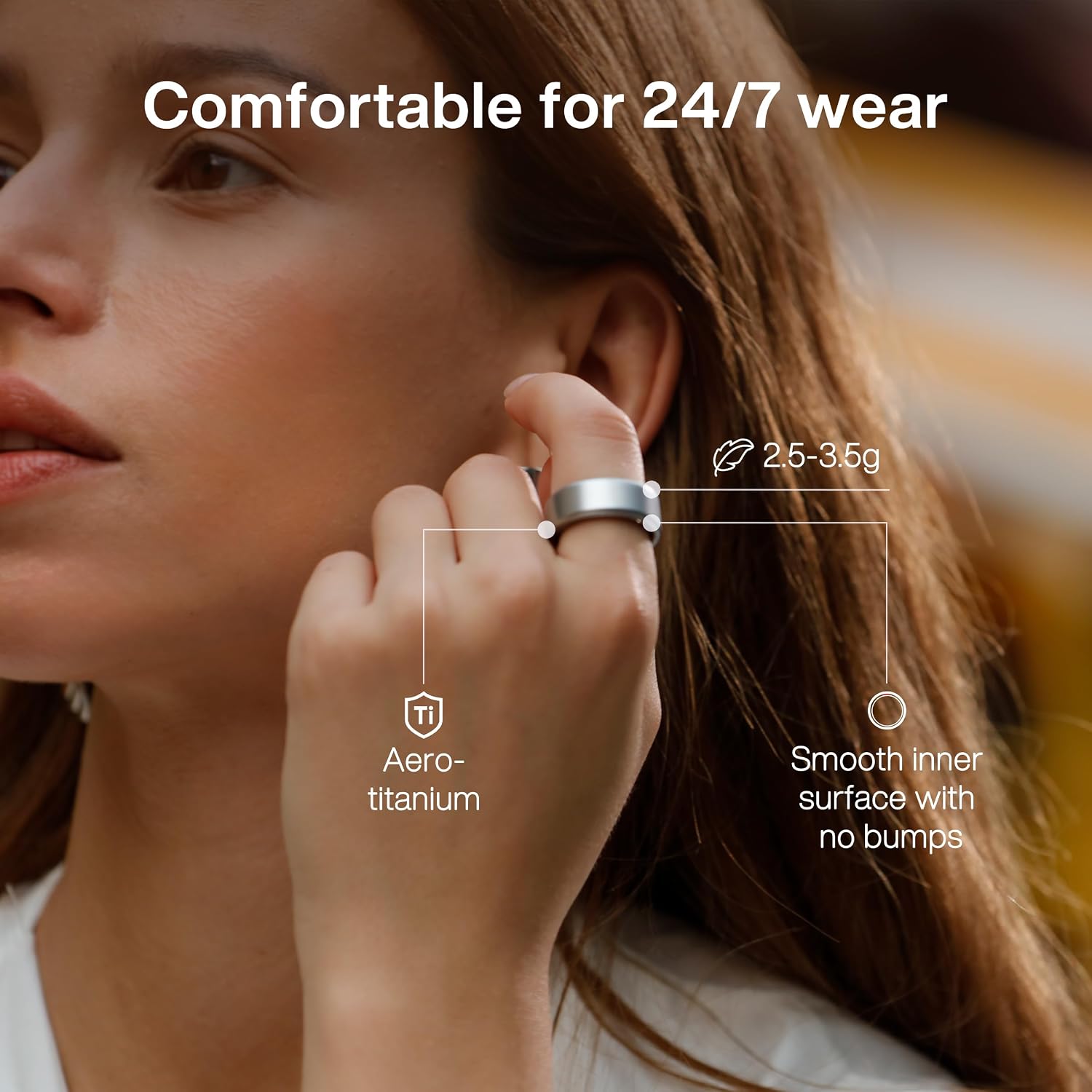
Titanium outer shell, 4–6 grams depending on ring size. You genuinely forget it’s there. This matters enormously for consistent overnight tracking.
Battery:
5–8 days depending on ring size and usage. Charges in about 20–80 minutes via the included dock.
Subscription:
~$6/month (or ~$70/year). Required for full access to Readiness Score, Sleep Score, and Oura Advisor AI coaching. Without it, you get limited data — don’t skip the subscription.
One critical note:
Ring sizing is permanent. Oura ships a free sizing kit before your ring ships. Use it at different times of day — fingers swell in heat and shrink in cold. Getting the wrong size is the most common Oura mistake.
Best for:
Women, biohackers, wellness-focused users, light sleepers, and anyone who finds wristbands uncomfortable at night.
Skip it if:
You need GPS, smart notifications, or active workout coaching.
| Feature | Oura Ring Gen 4 |
|---|---|
| Sleep Stage Accuracy | ⭐⭐⭐⭐⭐ |
| Comfort for Sleep | ⭐⭐⭐⭐⭐ |
| HRV Accuracy | ⭐⭐⭐⭐⭐ |
| App Quality | ⭐⭐⭐⭐⭐ |
| Battery Life | ⭐⭐⭐⭐ |
| Value | ⭐⭐⭐⭐ |
Amazon Rating: ⭐ 4.4/5 Approx. Price: ~$300–350 + ~$6/month subscription
For a comparison with WHOOP, see our detailed WHOOP vs Oura breakdown. Women looking at ring options specifically will find our smart ring for women guide useful.
2. WHOOP 5.0 — Best Overall Sleep Tracker for Athletes
The WHOOP Sleep Coach is one of the most genuinely useful features in any consumer sleep device. It doesn’t just show you how you slept. It tells you what time to go to sleep tonight based on your recovery goal for tomorrow. Want to peak for a hard training session? Here’s your target bedtime. Want to recover from yesterday’s race? Here’s what sleep duration and quality you need.
That forward-looking coaching framework is rare. Most sleep trackers look backward. WHOOP plans ahead.
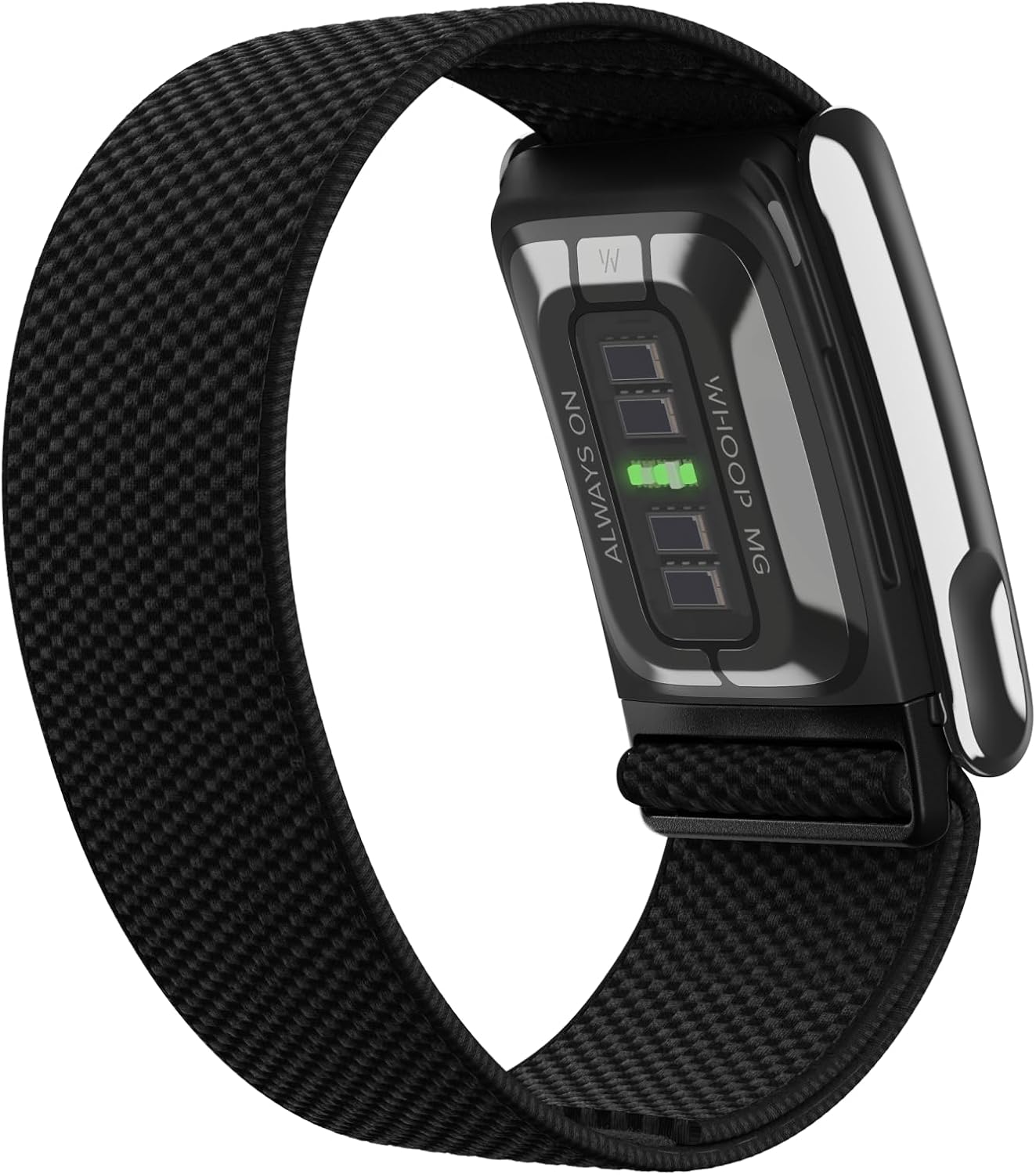
WHOOP measures sleep continuously using six LEDs sampling at 100+ Hz — far higher frequency than most consumer trackers. This density of data produces some of the most accurate HRV readings available in a wearable device. The overnight HRV average (RMSSD) forms the backbone of WHOOP’s Recovery Score, which tells you daily whether your body absorbed last night’s training or is still under load.
WHOOP’s on-wrist charging system is uniquely practical for sleep tracking. You never remove WHOOP to charge — a battery pack clips on while you’re wearing it. No data gaps. No missed sleep nights because you forgot to put it back on.
Comfort:
WHOOP’s slim, screenless profile makes it the most discreet wristband sleep tracker available. The knit and sport hydro bands cause minimal disruption for side sleepers. The wristband design does create occasional pressure point awareness that a ring completely avoids — but most users adapt within 1–2 weeks.
Best for:
Athletes, competitive fitness enthusiasts, CrossFit athletes, cyclists, and anyone comparing the Best Sleep Trackers to understand the direct relationship between their sleep quality and next-day training performance.
Skip it if:
You want a subscription-free device, GPS, a display, or you don’t plan to engage with the data every morning. WHOOP’s value is proportional to your engagement.
| Feature | WHOOP 5.0 |
|---|---|
| Sleep Stage Accuracy | ⭐⭐⭐⭐⭐ |
| Sleep Coaching | ⭐⭐⭐⭐⭐ |
| HRV Accuracy | ⭐⭐⭐⭐⭐ |
| Comfort for Sleep | ⭐⭐⭐⭐ |
| Battery Life | ⭐⭐⭐⭐ (on-wrist charging) |
| Value for Athletes | ⭐⭐⭐⭐⭐ |
Amazon Rating: ⭐ 4.3/5 Subscription: Required (~$18–30/month). Verify current pricing at whoop.com. Approx. Price: Subscription-based — device included with membership.
See our full guide to the best WHOOP alternatives if the subscription cost is a concern.
3. Garmin Venu 3 — Best Subscription-Free Sleep Tracker | Best Value
The Garmin Venu 3 is the best argument that you don’t need to pay a monthly subscription to get excellent sleep tracking.
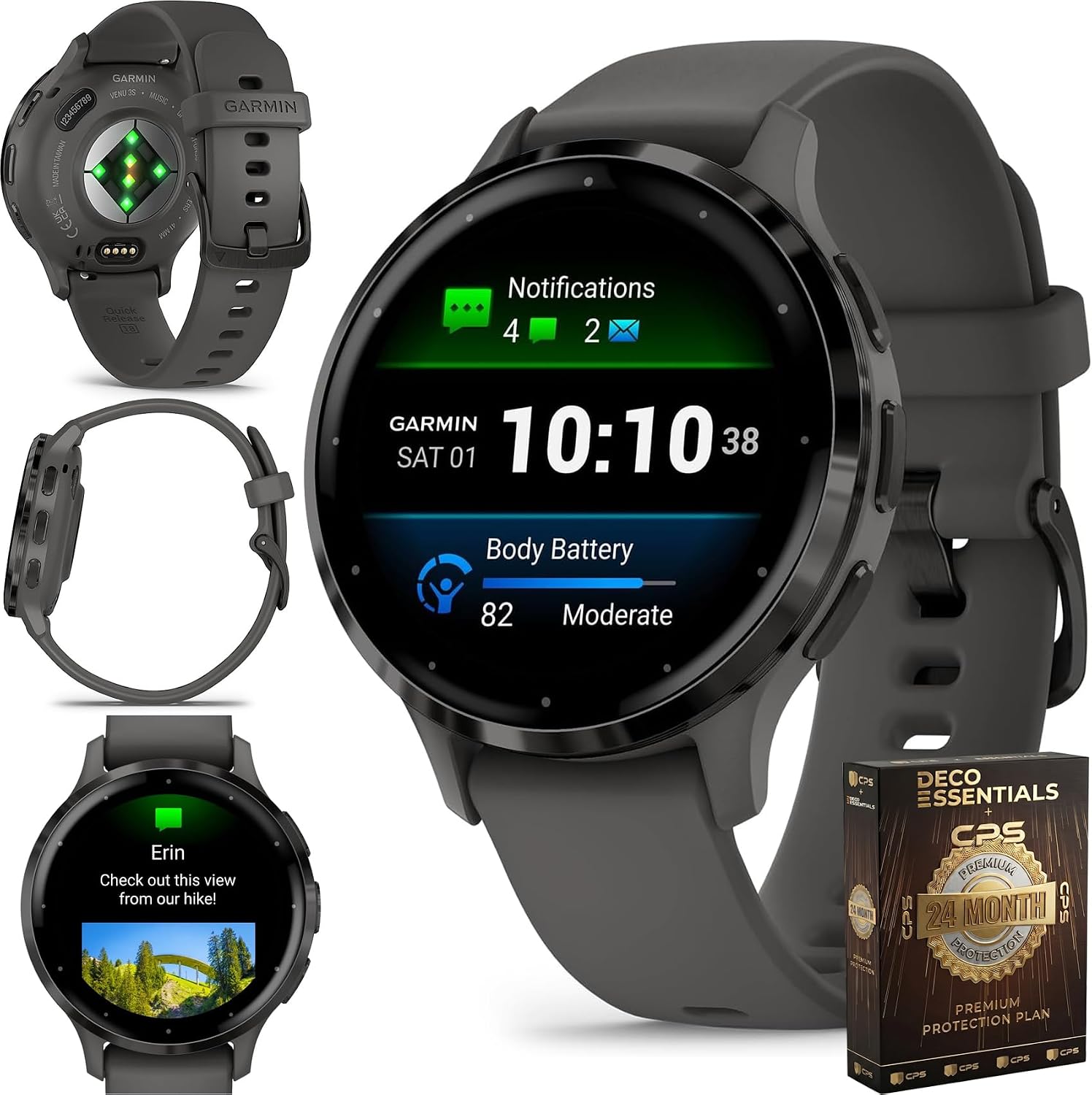
Garmin has invested heavily in sleep science in recent years. The Venu 3’s Nap Tracker detects and analyzes naps separately from overnight sleep — a surprisingly useful feature for shift workers, parents, and anyone recovering from sleep debt. Sleep Coach on the Venu 3 provides recommended sleep window guidance based on your sleep history and current Body Battery status.
The Body Battery energy system updates overnight to show how much your sleep restored your energy reserves. Combined with HRV Status (a rolling 5-week HRV trend), you get meaningful morning recovery context — all without paying a cent beyond the hardware.
The Venu 3 is Garmin’s most wellness-oriented everyday watch. It includes guided breathing and meditation sessions, guided yoga and Pilates workouts, and a Sleep Score with stage breakdown. Garmin Connect .
The limitation: charging overnight creates data gaps unless you charge during waking hours. Most Venu 3 users charge during morning routines, commutes, or desk time.
The Venu 3S (smaller case) is available for users with narrower wrists.
Best for: Everyday health-conscious users, busy professionals, beginners wanting solid sleep data without recurring fees, and Google/Android ecosystem users.
Skip it if: You need GPS for running (Garmin Forerunner 265 is the better choice), or you want the deepest possible HRV-based sleep coaching.
| Feature | Garmin Venu 3 |
|---|---|
| Sleep Stage Accuracy | ⭐⭐⭐⭐ |
| Sleep Coaching | ⭐⭐⭐⭐ |
| HRV Accuracy | ⭐⭐⭐⭐ |
| Comfort for Sleep | ⭐⭐⭐ |
| Battery Life | ⭐⭐⭐⭐⭐ (14 days) |
| Value | ⭐⭐⭐⭐⭐ (no subscription) |
Amazon Rating: ⭐ 4.5/5 Subscription: None Approx. Price: ~$300–350
For a deeper look at how Garmin compares to Oura, see our Garmin vs Oura comparison. Our WHOOP vs Garmin head-to-head is also worth a read.
4. Withings Sleep Analyzer — Best Bedside Sleep Monitor | Best for Sleep Apnea Awareness
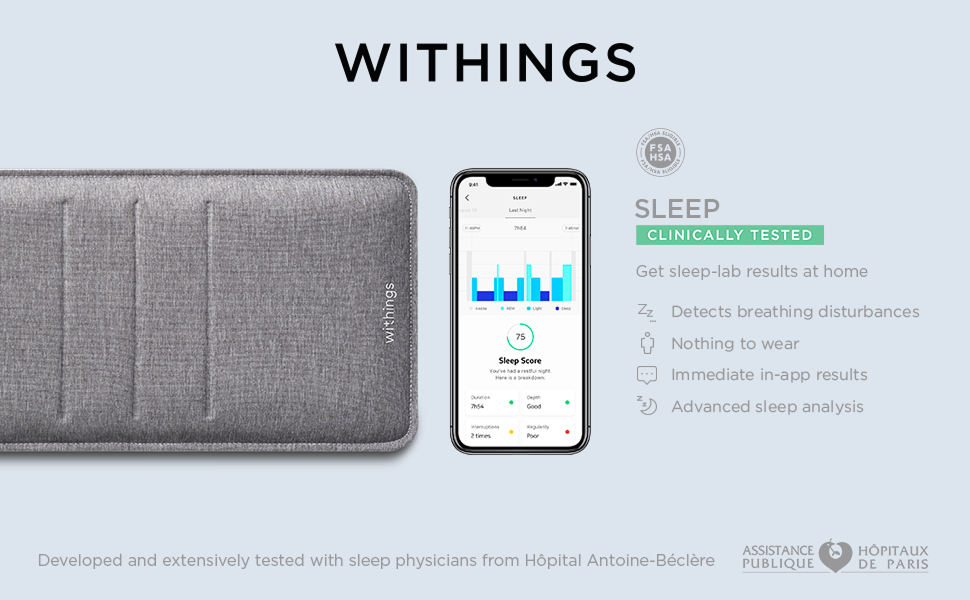
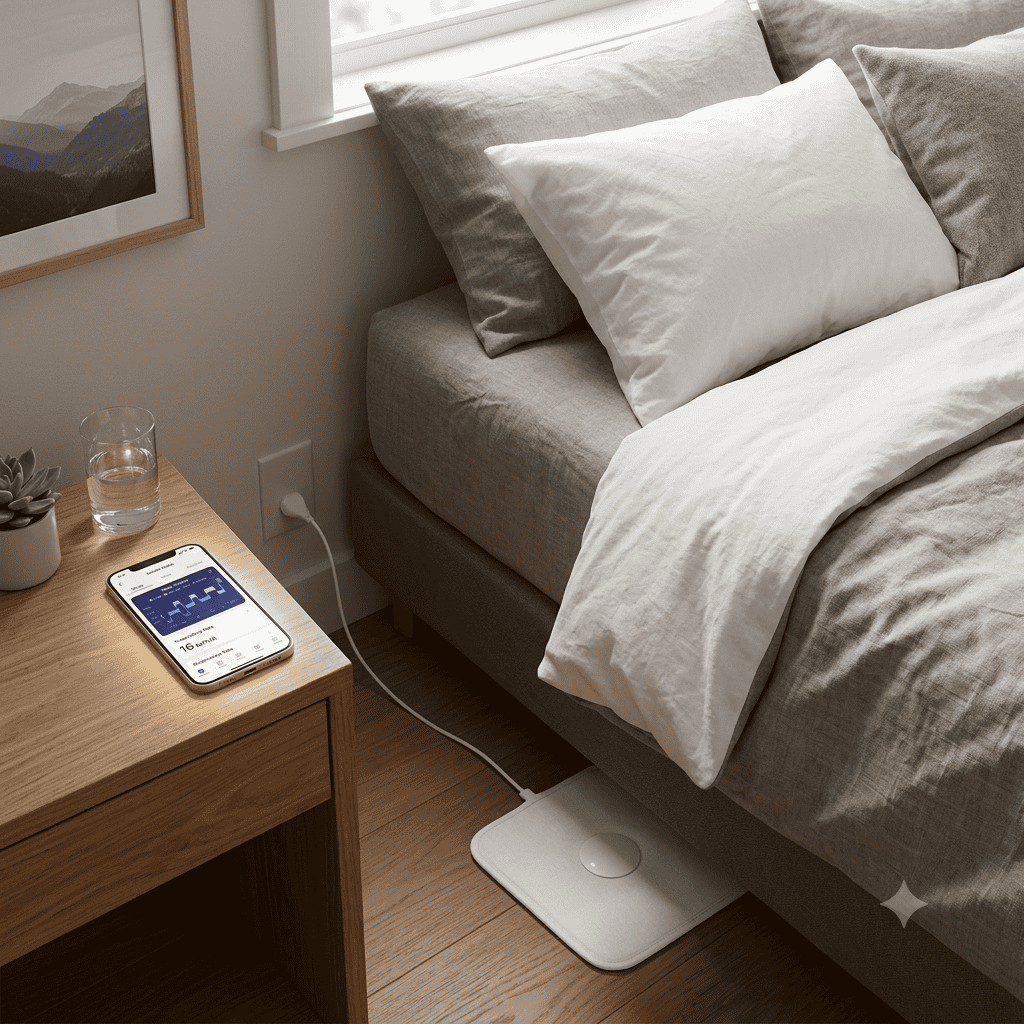
Here’s a device most people overlook — and shouldn’t. The Withings Sleep Analyzer is a thin mat that slides under your mattress. You don’t wear anything. You don’t charge a wristband. Also You don’t need to remember to put it on at night. You just sleep.
The mat uses cardiopulmonary sensors and a medical-grade algorithm to track:
- Sleep cycles (light, deep, REM, awake)
- Heart rate (via ballistocardiography — detecting the vibrations of your heartbeat through the mattress)
- Respiratory rate throughout the night
- Sleep score with AI-powered recommendations
- Snoring detection with decibel measurement
- Sleep disturbance events flagging irregular respiratory patterns that may warrant medical follow-up
Important: The Withings Sleep Analyzer is not a medical diagnostic device and cannot diagnose sleep apnea. However, it does flag irregular breathing events overnight that may prompt a user to discuss sleep quality concerns with a physician. For wellness awareness of potential sleep disruption patterns, it provides more respiratory monitoring context than most wrist-worn devices.
The companion Withings Health Mate app is free — no subscription required — and provides detailed nightly reports, 30-day trend charts, and actionable tips.
Battery: Plugs into the wall. No charging ever.
Comfort: Zero — there’s nothing to wear. This is particularly valuable for users who can’t tolerate wearing any device at night.
Best for: Anyone who finds wearing a device uncomfortable during sleep; partners who want mutual sleep data without two devices; users who want respiratory pattern monitoring; people interested in detailed snoring analysis.
Skip it if: You want daytime health tracking, GPS, or a wearable device for activity and recovery data.
| Feature | Withings Sleep Analyzer |
|---|---|
| Sleep Stage Accuracy | ⭐⭐⭐⭐⭐ |
| Respiratory Monitoring | ⭐⭐⭐⭐⭐ |
| Comfort | ⭐⭐⭐⭐⭐ (nothing to wear) |
| Snoring Detection | ⭐⭐⭐⭐⭐ |
| Daytime Tracking | ❌ |
| Subscription | ❌ None |
Amazon Rating: ⭐ 4.3/5 Subscription: None Approx. Price: ~$100–130
5. Fitbit Sense 2 — Best Fitbit for Sleep Tracking
Among Fitbit’s lineup, the Sense 2 is the most health-focused — and for sleep tracking specifically, it’s the stronger choice over the Charge 6. The Sense 2 includes an electrodermal activity (EDA) sensor — a technology that detects electrical changes in skin conductance driven by the sympathetic nervous system. During the day, EDA body response sessions give you a direct physiological measure of your stress response. Overnight, the Sense 2 correlates stress patterns with sleep quality — a connection that’s more useful than most wearables acknowledge.
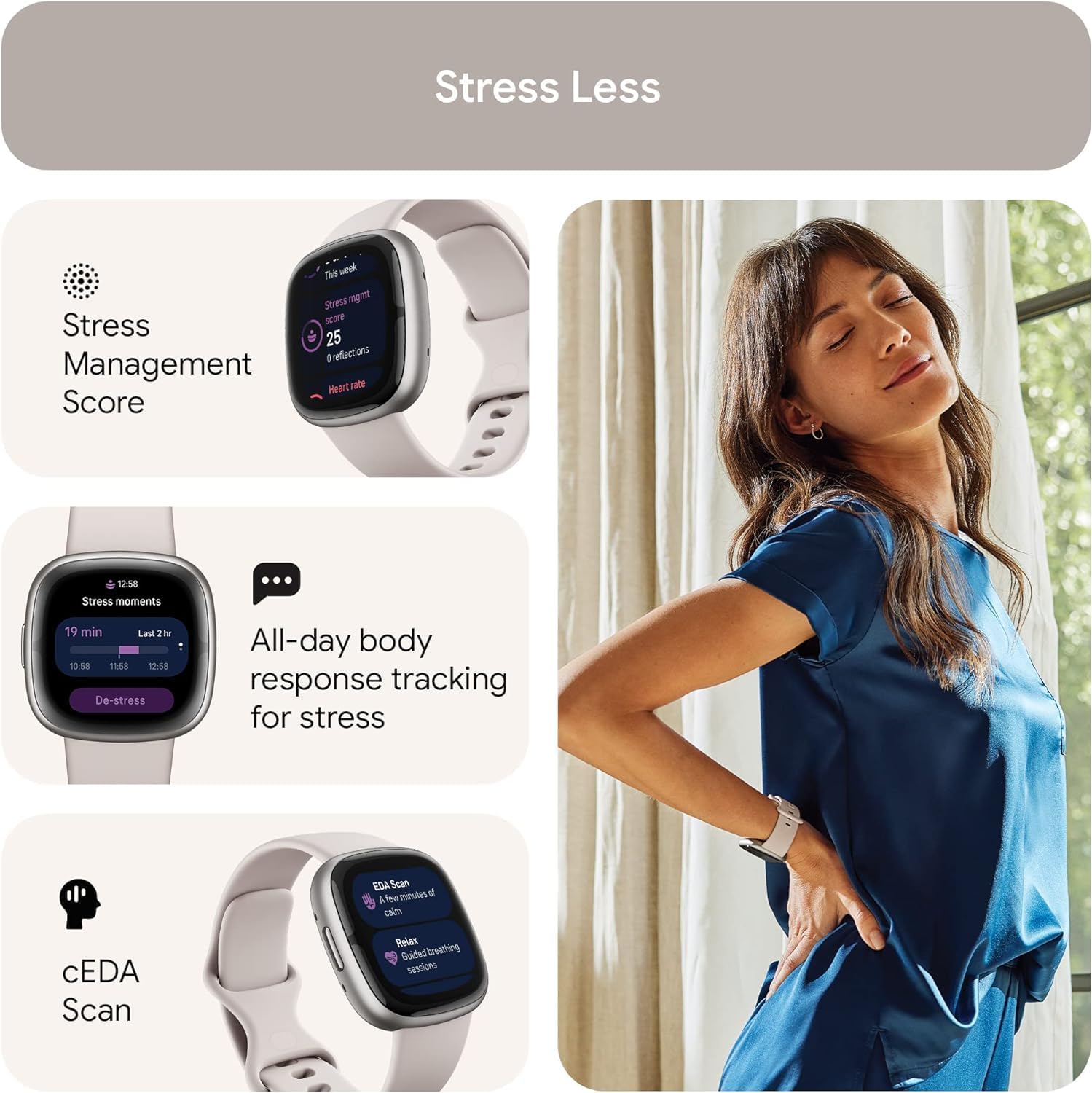
Sleep features include:
- Sleep stages (light, deep, REM, awake)
- Sleep Score (0–100)
- Resting heart rate overnight
- Blood oxygen (SpO2) — useful for flagging potential nighttime breathing irregularities
- Skin temperature tracking
- Breathing Rate
The Fitbit app provides a Sleep Profile — a monthly analysis of your sleep patterns including how your sleep compares to age-matched benchmarks. The Sleep Profile character (animals like bear, dolphin, parrot) is a simplified but engaging way to understand your dominant sleep pattern type.
Fitbit Premium ($9.99/month) unlocks a Daily Readiness Score incorporating sleep, HRV, and activity — the closest Fitbit gets to a proper recovery score. Without Premium, you still get solid sleep stage tracking and a Sleep Score.
Battery: ~6 days.
Best for: Health-focused users comparing the Best Sleep Trackers who want real-time EDA stress detection alongside solid sleep insights, as well as Google ecosystem users who benefit from Google Pay and Google Maps.
Skip it if: You’re a serious athlete — the recovery depth doesn’t match WHOOP or Oura. Also, Fitbit’s long-term platform direction under Google ownership remains a question worth considering before committing.
| Feature | Fitbit Sense 2 |
|---|---|
| Sleep Stage Accuracy | ⭐⭐⭐⭐ |
| EDA Stress Detection | ⭐⭐⭐⭐⭐ |
| HRV Accuracy | ⭐⭐⭐ |
| App Quality | ⭐⭐⭐⭐ |
| Battery Life | ⭐⭐⭐⭐ |
| Value | ⭐⭐⭐⭐ |
Amazon Rating: ⭐ 4.1/5 Subscription: Optional ($9.99/month for full Readiness Score) Approx. Price: ~$200–250
6. Fitbit Charge 6 — Best Budget Fitness Sleep Tracker
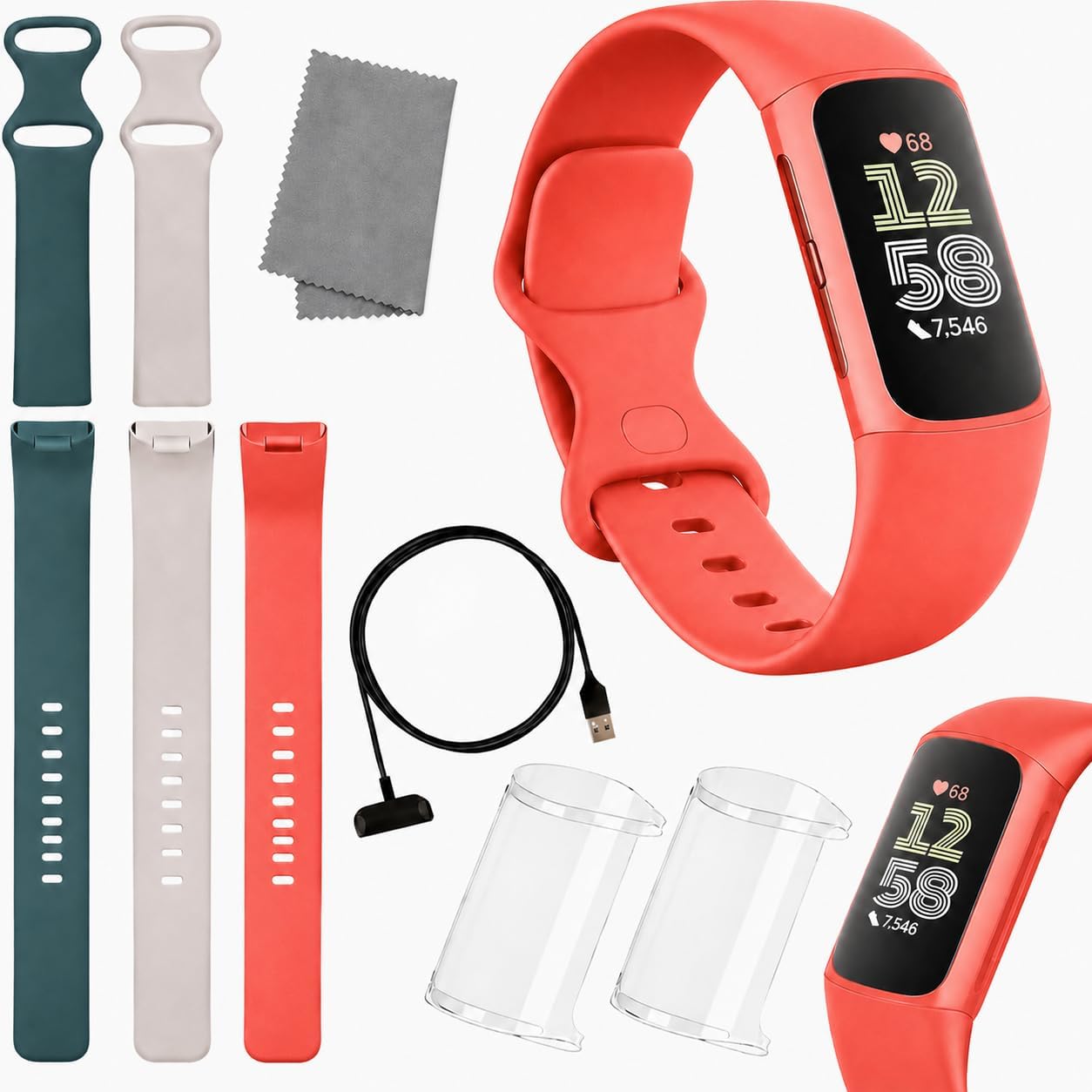
The Fitbit Charge 6 is the most capable affordable sleep tracker on this list — and one of the few devices at its price point that includes built-in GPS for outdoor activity tracking.
For sleep specifically, the Charge 6 provides:
- Sleep stages (light, deep, REM, awake)
- Sleep Score (0–100)
- Smart wake alarm (vibrates during light sleep stage to minimize grogginess)
- SpO2 overnight monitoring
- Skin temperature tracking
- Estimated oxygen variation graph (useful for flagging potential breathing irregularities)
- Stress Management Score
The Stress Management Score — built from HRV, activity, and sleep data — gives the Charge 6 a meaningful health monitoring edge over basic fitness bands.
Fitbit Premium unlocks the Daily Readiness Score, deeper sleep analysis, and guided wellness programs. But the core sleep data is solid without it.
Battery: ~7 days.
Best for: Budget-conscious buyers, beginners, and Google ecosystem users who want solid sleep tracking plus GPS activity logging in a slim band under $200.
Skip it if: You want the deepest sleep coaching, advanced recovery metrics, or the Sense 2’s EDA sensor. Fitbit’s recovery depth is limited compared to the top-tier devices.
| Feature | Fitbit Charge 6 |
|---|---|
| Sleep Stage Accuracy | ⭐⭐⭐⭐ |
| App Quality | ⭐⭐⭐⭐ |
| HRV Accuracy | ⭐⭐⭐ |
| Battery Life | ⭐⭐⭐⭐ |
| Value | ⭐⭐⭐⭐⭐ |
| GPS | ✅ Built-in |
Amazon Rating: ⭐ 4.2/5 Subscription: Optional ($9.99/month) Approx. Price: ~$130–160
For a full comparison of Fitbit against WHOOP, see our WHOOP vs Fitbit guide.
7. Garmin Forerunner 265 — Best Sleep Tracker for Runners
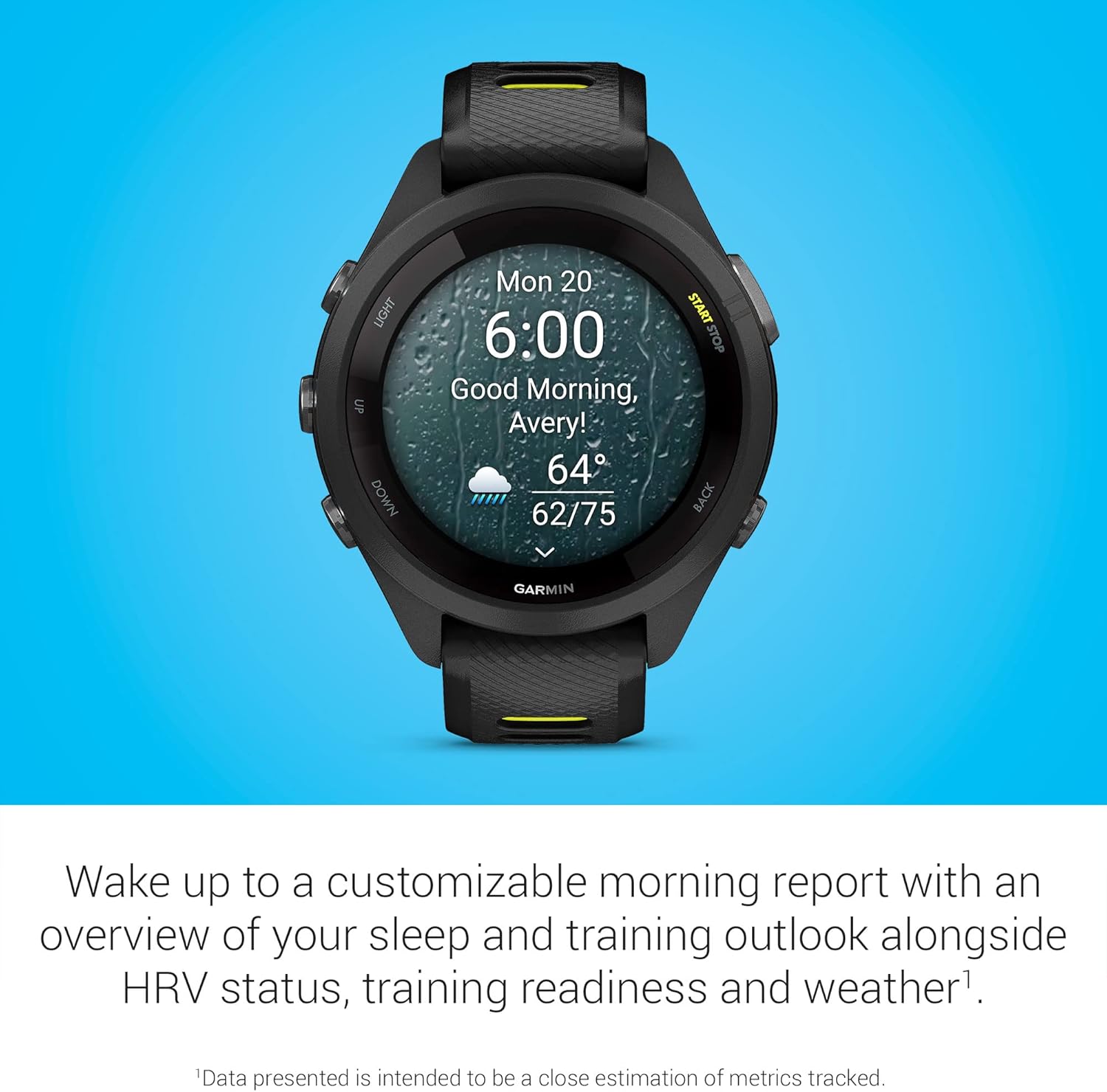
The Forerunner 265 earns its place on this list as the best sleep tracking experience for runners and endurance athletes who don’t want a separate recovery device.
Sleep on the Forerunner 265 integrates directly with the watch’s training analytics. After a hard long run, your overnight HRV and Body Battery recharge rate shows you exactly how well your body absorbed that effort. Daily Suggested Workouts adapt to your current sleep-informed readiness — so if you slept poorly and your Body Battery is at 35%, WHOOP won’t suggest a threshold workout. A gentle recovery run appears instead.
Sleep features include:
- Sleep stages with nightly breakdown
- Body Battery overnight recharge curve
- HRV Status (5-week rolling trend)
- Sleep Score
- Nap detection
- Respiration rate tracking
Multi-band GPS on the 265 is the best GPS for runners in the budget range — far superior to single-band GPS for route accuracy in dense urban or tree-covered environments.
Charging note: Most Forerunner 265 users charge during commutes or desk time to preserve overnight data continuity.
Best for: Runners, cyclists, and multisport athletes who want sleep and recovery data integrated into a serious training platform without monthly fees.
| Feature | Garmin Forerunner 265 |
|---|---|
| Sleep Stage Accuracy | ⭐⭐⭐⭐ |
| Sleep + Training Integration | ⭐⭐⭐⭐⭐ |
| HRV Accuracy | ⭐⭐⭐⭐ |
| Battery Life | ⭐⭐⭐⭐⭐ (13 days) |
| GPS Accuracy | ⭐⭐⭐⭐⭐ |
| Value | ⭐⭐⭐⭐⭐ (no subscription) |
Amazon Rating: ⭐ 4.7/5 Subscription: None Approx. Price: ~$300–350
8. Apple Watch Series 11 — Best Sleep Tracker for iPhone Users
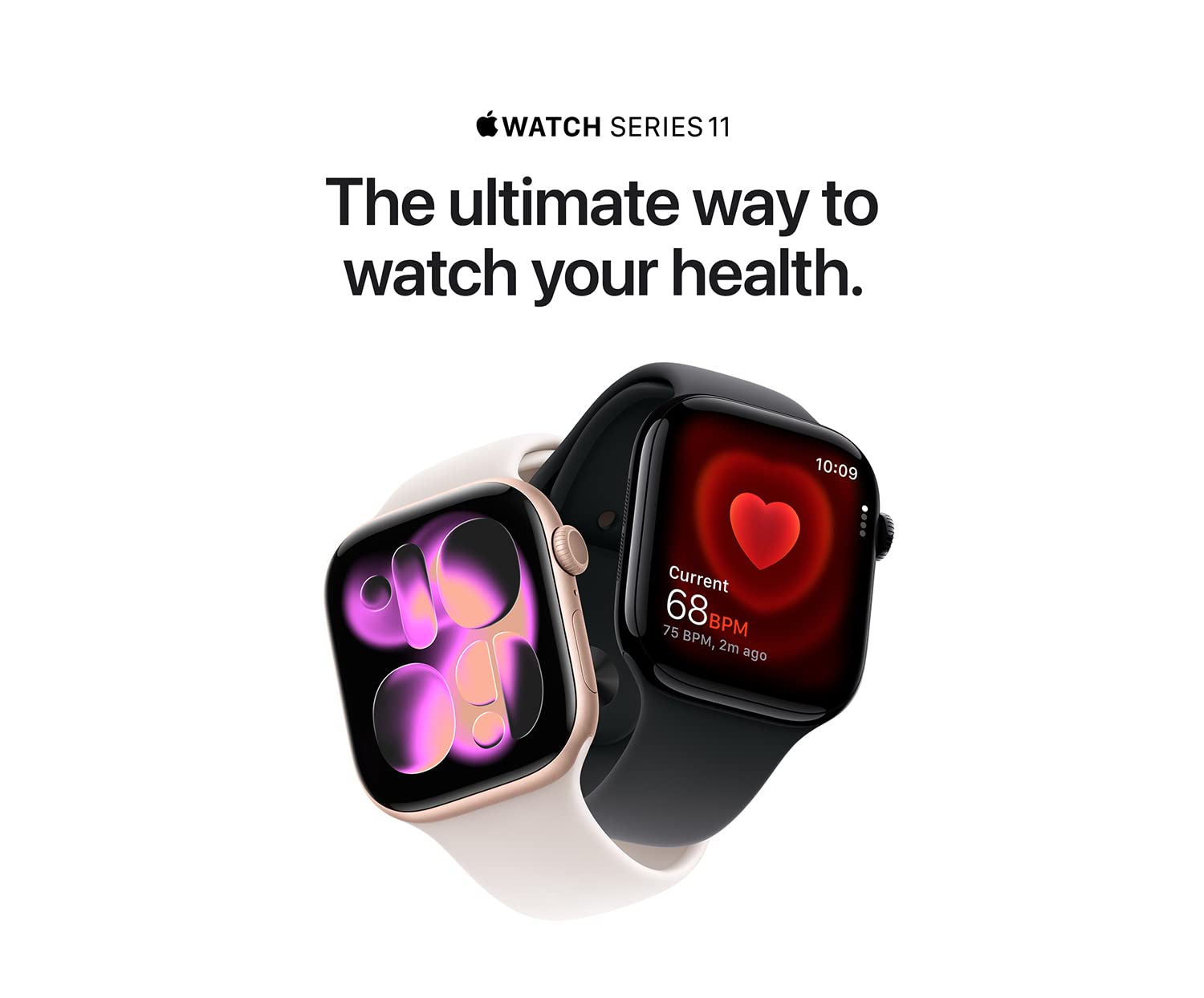
Apple has steadily improved its sleep tracking capabilities with each Watch generation. Series 11 brings improved sensor hardware, expanded sleep insights, and tighter integration with Apple Health — which now serves as a central hub for sleep data from third-party apps including Oura and WHOOP.
Sleep features:
- Sleep stages (REM, core, deep, awake)
- Sleep Score and trends
- Respiratory rate monitoring
- SpO2 (Sleep Apnea Notifications on supported models — not a diagnosis, a wellness alert)
- Skin temperature measurement
- Heart rate during sleep
- Heart rate variability during sleep
Sleep Apnea Notifications: Apple Watch Series 11 (and select Series 9/10 models) can flag potential sleep apnea patterns and notify users to consult a physician. This is a wellness notification — not a medical diagnosis — but it’s a meaningful consumer health feature for sleep apnea awareness.
The biggest limitation for dedicated sleep tracking: ~18-hour battery requires daily charging. Most iPhone users charge overnight — exactly when sleep tracking should happen. You’ll need to change your charging habit (charge during an evening watch, morning shower, or commute) to use Apple Watch for sleep.
Apple Watch’s Sleep Focus mode creates a dedicated sleep environment that dims the screen, silences notifications, and activates sleep tracking automatically at your bedtime.
Best for: iPhone users who want their sleep data in the Apple Health ecosystem and are willing to adjust their charging routine.
Skip it if: You primarily want a sleep tracker and can’t commit to charging during the day.
| Feature | Apple Watch Series 11 |
|---|---|
| Sleep Stage Accuracy | ⭐⭐⭐⭐ |
| App Ecosystem | ⭐⭐⭐⭐⭐ |
| Battery Life | ⭐⭐ |
| Smartwatch Features | ⭐⭐⭐⭐⭐ |
| iPhone Integration | ⭐⭐⭐⭐⭐ |
| Value | ⭐⭐⭐⭐ (for iPhone users) |
Amazon Rating: ⭐ 4.5/5 Subscription: None (Fitness+ optional) Approx. Price: ~$350–400
9. Samsung Galaxy Watch Ultra — Best Sleep Tracker for Samsung Users
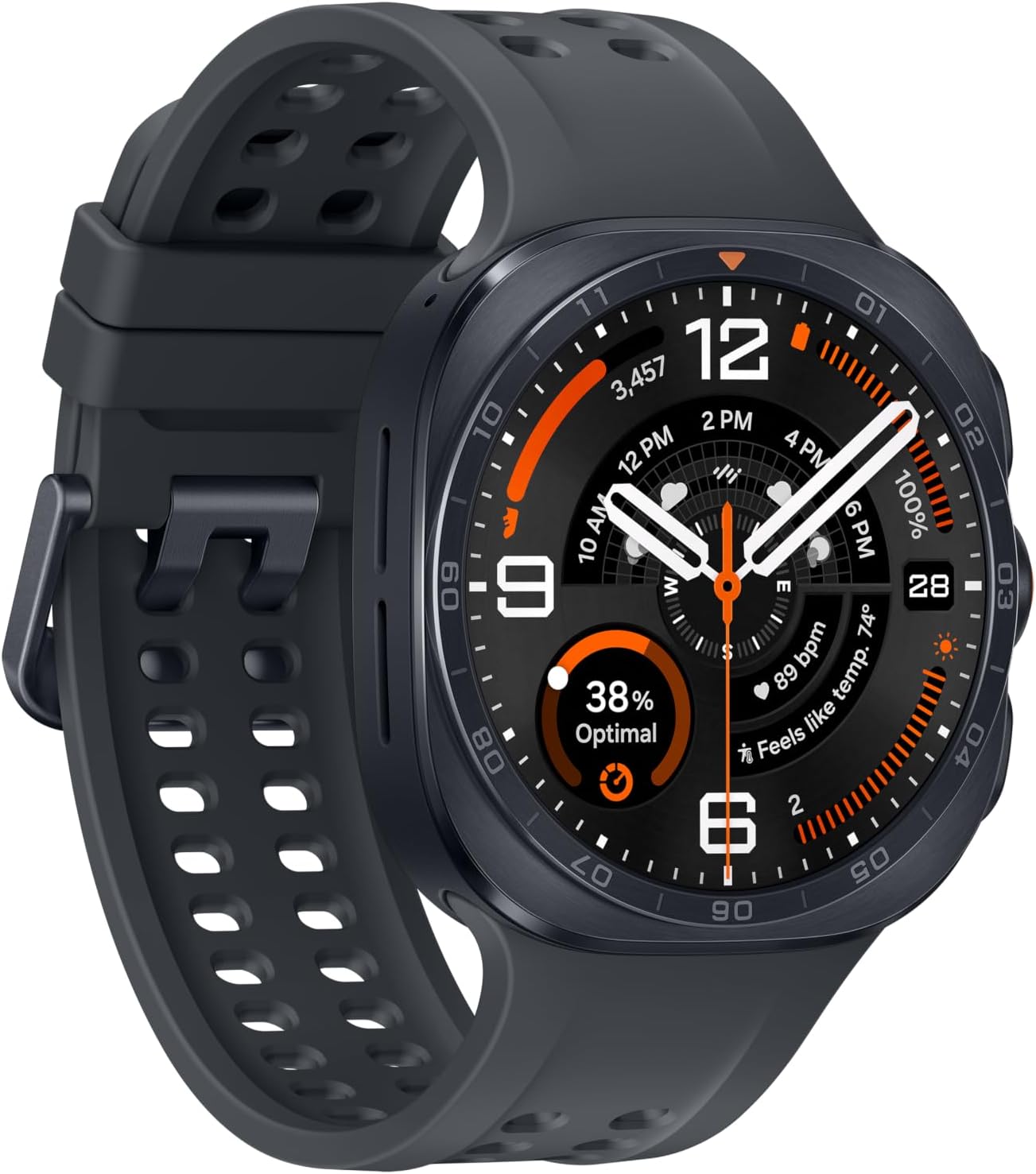
The Samsung Galaxy Watch Ultra is Samsung’s most premium health tracking device — and its sleep tracking has matured into a genuinely competitive system.
Sleep Coaching on the Galaxy Watch Ultra analyzes your sleep patterns over a four-week period and delivers a sleep report including Sleep Score, efficiency analysis, and specific coaching recommendations. The Energy Score — Samsung’s daily readiness metric — factors in sleep quality, HRV, and physical activity to generate a morning readiness number.
Sleep features:
- Sleep stages (light, deep, REM, awake)
- Snoring detection
- SpO2 overnight
- Skin temperature tracking
- Heart rate monitoring during sleep
- Sleep coaching with monthly report
- Blood pressure monitoring (select markets)
Samsung’s Advanced Sleep Analysis classifies your sleep pattern and identifies recurring issues — difficulty falling asleep, early morning waking, inconsistent sleep timing — and targets coaching recommendations accordingly.
The Watch Ultra’s titanium case and 10ATM water resistance make it the most durable smartwatch for active users on this list. Battery life runs to ~60 hours with typical use — enough for several nights before charging.
Best for: Samsung Galaxy phone users who want a premium all-in-one health, fitness, and smartwatch device with solid sleep tracking built in.
Skip it if: You don’t use a Samsung phone — some features are ecosystem-dependent. Also skip if budget is tight; the Watch Ultra is the most expensive device on this list.
| Feature | Samsung Galaxy Watch Ultra |
|---|---|
| Sleep Stage Accuracy | ⭐⭐⭐⭐ |
| Sleep Coaching | ⭐⭐⭐⭐ |
| Battery Life | ⭐⭐⭐⭐ |
| Smartwatch Features | ⭐⭐⭐⭐⭐ |
| Durability | ⭐⭐⭐⭐⭐ |
| Value for Samsung Users | ⭐⭐⭐⭐ |
Amazon Rating: ⭐ 4.4/5 Subscription: None Approx. Price: ~$600–650
10. Amazfit Balance — Best Budget Sleep Tracker with Smartwatch Features
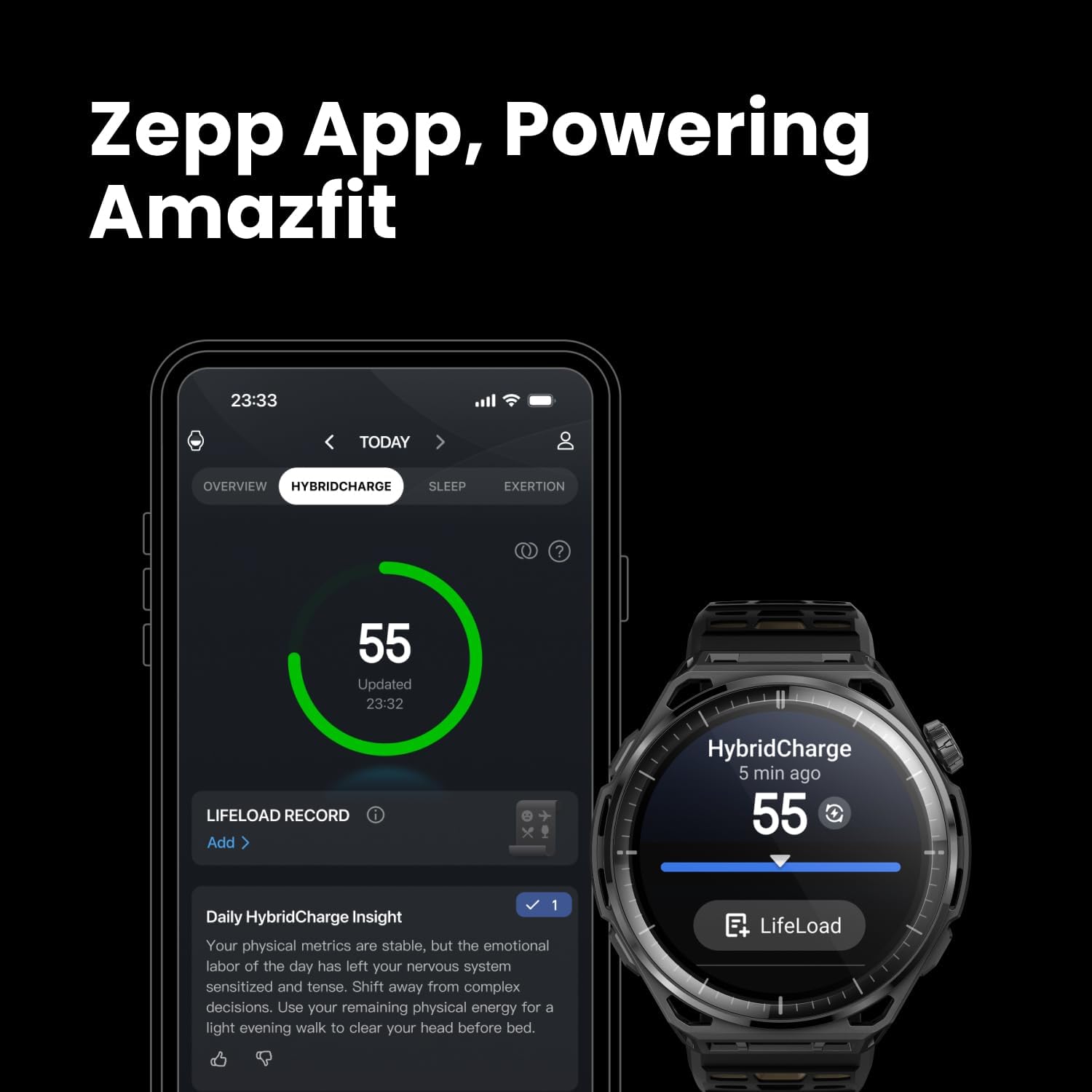
At under $150, the Amazfit Balance delivers more sleep tracking depth than you’d expect at this price point.
Sleep features:
- Sleep stages (light, deep, REM, awake)
- Sleep Score
- Heart rate monitoring overnight
- SpO2 during sleep
- Stress tracking (HRV-based)
- Skin temperature tracking
- Zepp Coach AI workout suggestions based on sleep data
The companion Zepp app is free, functional, and provides 14-day sleep trend tracking and monthly reports. No subscription required for any feature.
The honest limitation: Amazfit’s sleep algorithms are less mature than the top contenders on our list of the Best Sleep Trackers. Sleep stage classification is useful for general awareness but less precise than Oura, WHOOP, or Garmin. For casual health tracking and basic sleep awareness on a tight budget, it more than gets the job done. For athletes making training decisions based on sleep data, invest in something higher on this list.
Battery: ~14 days smartwatch mode. Charging takes about 2 hours.
Best for: Budget-conscious beginners, casual health trackers, and anyone who wants smartwatch features plus sleep data for under $150.
| Feature | Amazfit Balance |
|---|---|
| Sleep Stage Accuracy | ⭐⭐⭐ |
| Battery Life | ⭐⭐⭐⭐⭐ (14 days) |
| Value | ⭐⭐⭐⭐⭐ |
| App Quality | ⭐⭐⭐ |
| Smartwatch Features | ⭐⭐⭐⭐ |
| Subscription | None |
Amazon Rating: ⭐ 4.3/5 Approx. Price: ~$100–150
11. Polar Ignite 3 — Best Slim Fitness Sleep Tracker
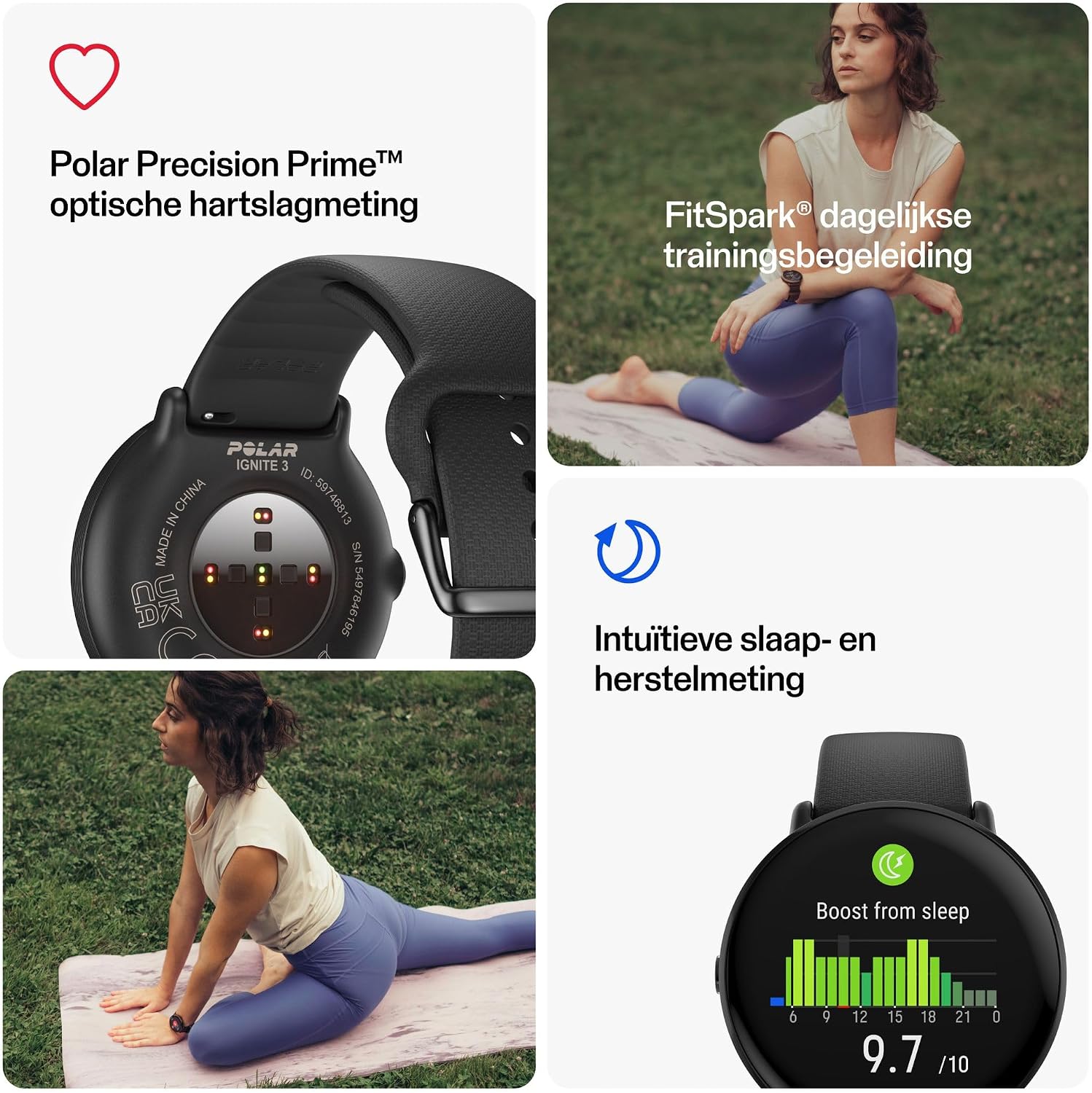
The Polar Ignite 3 is the most stylish-looking device on this list — and its Nightly Recharge sleep feature is one of the most scientifically grounded sleep recovery tools in any fitness watch.
Nightly Recharge measures two independent components every night:
- ANS (Autonomic Nervous System) Charge: Assesses how well your nervous system recovered during the first hours of sleep — the most physiologically restorative window.
- Sleep Charge: Evaluates sleep duration, continuity, and stage distribution.
The separation of ANS recovery from sleep staging is more nuanced than most consumer devices. A night where you slept 8 hours but had elevated sympathetic nervous system activity will produce a lower ANS charge — even if total sleep time looks fine. That distinction is useful for athletes managing overtraining.
Polar’s SleepWise feature translates sleep data into a prediction of your mental alertness at different times the following day — particularly helpful for shift workers, travelers managing jet lag, or anyone whose cognitive performance is important during specific daytime hours.
Battery: ~5 days, which is modest relative to Garmin. Charge before a long trip if you don’t want gaps.
Temperature sensor: The Ignite 3 doesn’t include a skin temperature sensor — which is a limitation for women’s cycle tracking and temperature-based illness detection relative to Oura and WHOOP.
Best for: Fitness enthusiasts who want a slim, stylish sleep tracker with genuinely scientific recovery analysis and no subscription.
| Feature | Polar Ignite 3 |
|---|---|
| Sleep Stage Accuracy | ⭐⭐⭐⭐ |
| ANS Recovery (Nightly Recharge) | ⭐⭐⭐⭐⭐ |
| Battery Life | ⭐⭐⭐ |
| Comfort | ⭐⭐⭐⭐ |
| App Quality | ⭐⭐⭐⭐ |
| Subscription | None |
Amazon Rating: ⭐ 4.3/5 Approx. Price: ~$200–250
12. Google Pixel Watch 3 — Best Sleep Tracker for Google Users
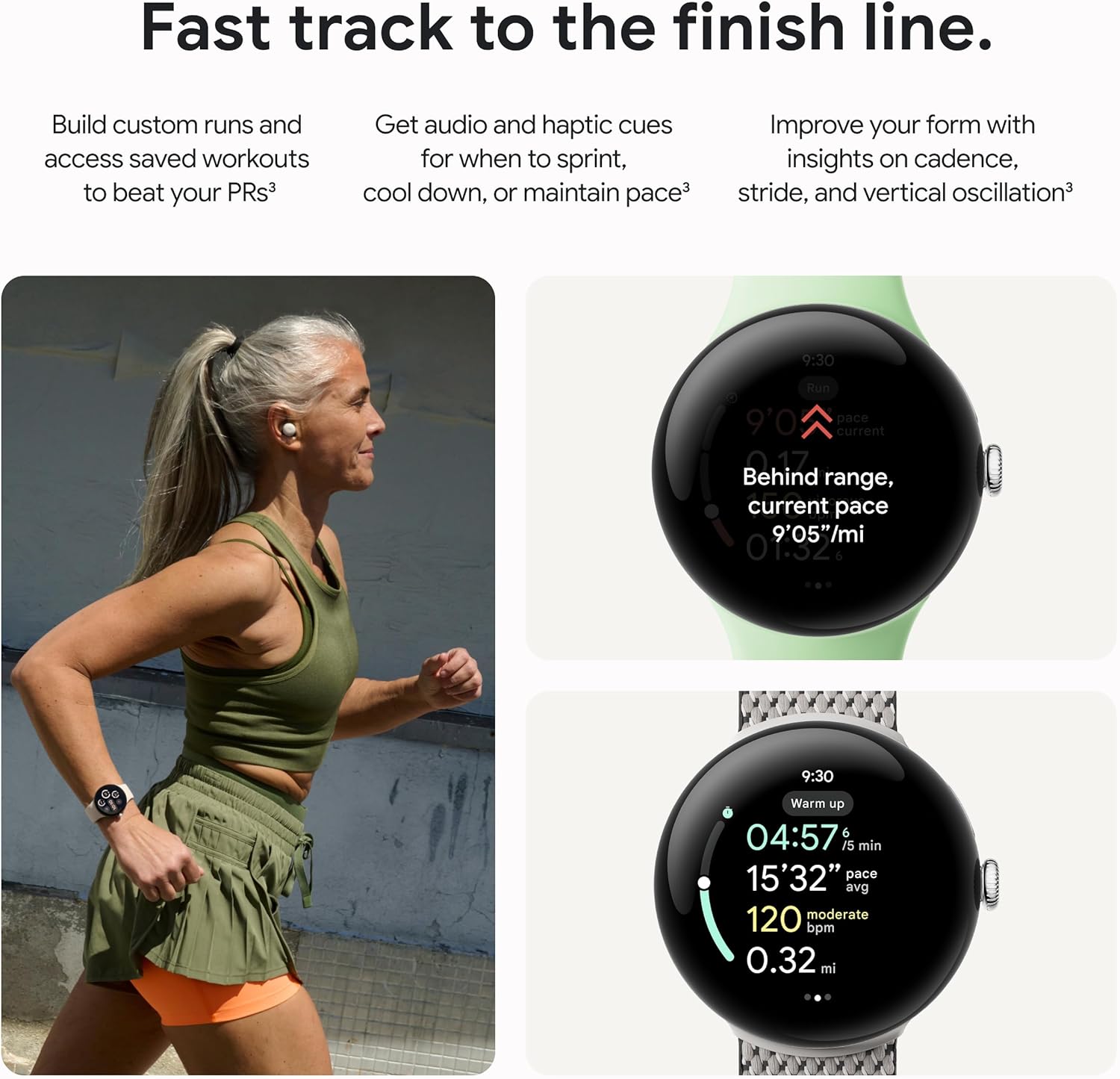
The Google Pixel Watch 3 runs Wear OS 4 and delivers Google’s tightest health tracking integration within the Android ecosystem. Fitbit’s health platform powers the Pixel Watch 3’s health features — including sleep tracking — making it essentially a Fitbit health engine inside a Google smartwatch.
Sleep features:
- Sleep stages (light, deep, REM)
- Sleep Score
- SpO2 overnight monitoring
- Skin temperature tracking
- Resting heart rate overnight
- Smart alarm within a 30-minute window
Fitbit Daily Readiness Score is accessible through Fitbit Premium ($9.99/month) — the same optional subscription as other Fitbit-powered devices. Without Premium, you get solid sleep stage data and a Sleep Score.
The Google Health platform integrates Pixel Watch 3 data with Google Health Connect, enabling smooth data flow between the watch and compatible third-party apps.
Battery life runs approximately 24 hours — slightly better than Apple Watch but still requires daily charging. Charge during a morning workout or commute rather than overnight to maintain sleep data continuity.
Best for: Android and Google Workspace users who want tight Google ecosystem integration with Fitbit-quality health tracking built in.
Skip it if: You’re not in the Google ecosystem — platform value drops significantly outside of Android.
| Feature | Google Pixel Watch 3 |
|---|---|
| Sleep Stage Accuracy | ⭐⭐⭐⭐ |
| Google Integration | ⭐⭐⭐⭐⭐ |
| Battery Life | ⭐⭐⭐ |
| App Quality | ⭐⭐⭐⭐ |
| Value | ⭐⭐⭐⭐ |
| Subscription | Optional ($9.99/month Fitbit Premium) |
Amazon Rating: ⭐ 4.3/5 Approx. Price: ~$300–350
Smart Ring vs Smartwatch for Sleep
| Factor | Smart Ring (Oura, Samsung Galaxy Ring) | Smartwatch (Garmin, Apple, Fitbit) |
|---|---|---|
| Overnight Comfort | ✅ Excellent — lightweight, minimal | ⚠️ Variable — depends on band and case size |
| Biometric Accuracy | ✅ Finger position = better PPG signal | ✅ Good, slightly less precise |
| Display | ❌ None | ✅ Glanceable at-a-glance data |
| GPS | ❌ | ✅ Built-in on most models |
| Smart Features | ❌ No notifications or payments | ✅ Full smartwatch functionality |
| Battery | ✅ 5–8 days | ⚠️ 1–14 days depending on model |
| Durability | ✅ Titanium, very durable | ✅ Most models very durable |
| Best For | Sleep, recovery, wellness | Active tracking + sleep combined |
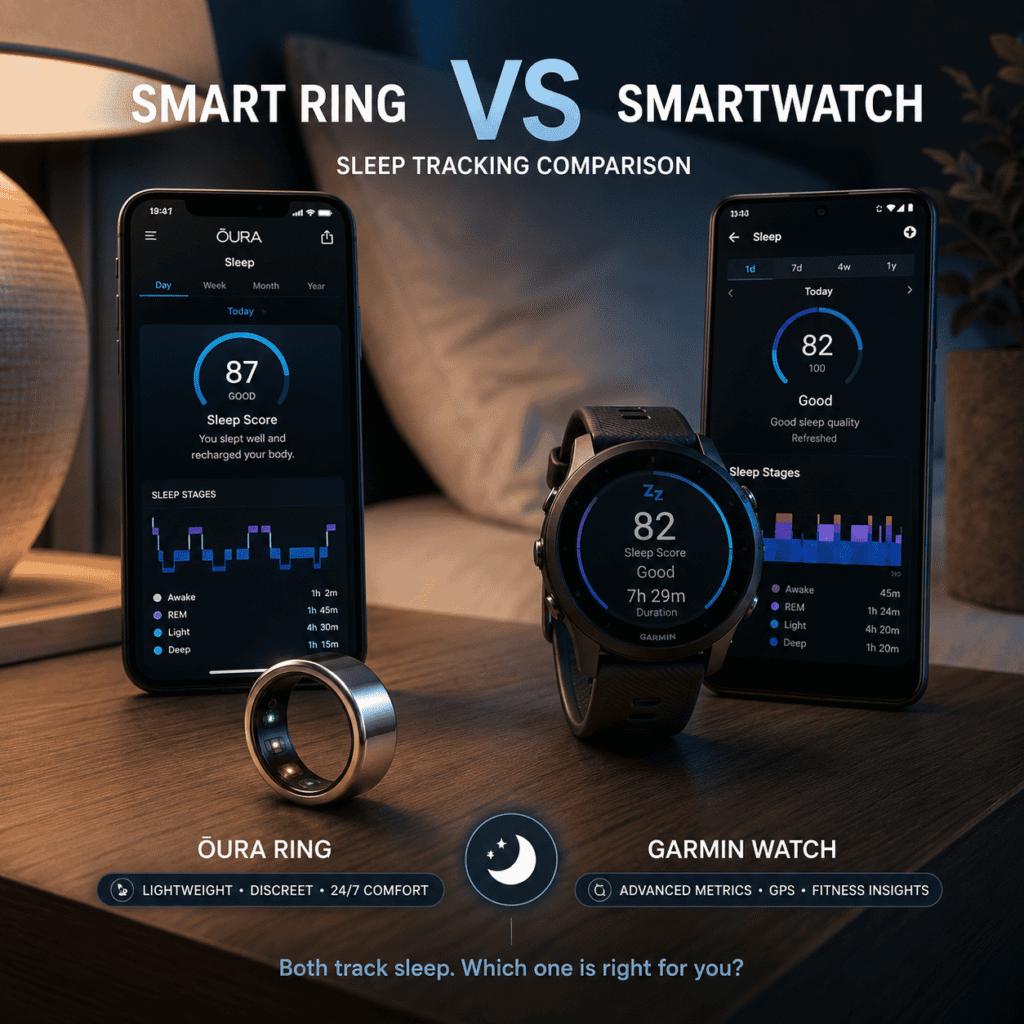
WHOOP vs Oura for Sleep
| Category | WHOOP 5.0 | Oura Ring Gen 4 |
|---|---|---|
| Sleep Stage Accuracy | ⭐⭐⭐⭐⭐ | ⭐⭐⭐⭐⭐ |
| Sleep Coaching (bedtime rec.) | ✅ Excellent | ✅ Excellent |
| HRV Measurement | ✅ High frequency | ✅ Finger — slightly more accurate |
| Form Factor | Wristband | Ring |
| Overnight Comfort | ⭐⭐⭐⭐ | ⭐⭐⭐⭐⭐ |
| Subscription | ~$18–30/month | ~$6/month |
| Training Integration | ✅ Excellent (Strain Score) | ✅ Good (Activity Score) |
| Temperature Tracking | ✅ | ✅ |
| Best For | Athletes managing training load | Sleep, wellness, biohackers |
Bottom line: WHOOP wins for athletes who need sleep data tightly integrated with training load and strain recovery. Oura wins for sleep-focused users, women’s health, and anyone prioritizing comfort at the lowest subscription cost.
Garmin vs Fitbit for Sleep
| Category | Garmin Venu 3 | Fitbit Sense 2 |
|---|---|---|
| Sleep Stage Accuracy | ⭐⭐⭐⭐ | ⭐⭐⭐⭐ |
| Sleep Coaching | ✅ Nap tracker, Sleep Coach | ✅ Sleep Profile monthly report |
| HRV Tracking | ✅ HRV Status (5-week trend) | ⭐⭐⭐ Basic |
| Stress Detection | ✅ Real-time Stress Level | ✅ EDA sensor (best-in-class) |
| Battery | ~14 days | ~6 days |
| Subscription | None | Optional $9.99/month |
| Ecosystem | Garmin Connect (free, excellent) | Google/Fitbit |
| GPS | ✅ | ✅ |
| Best For | Athletes, wellness, anyone | Stress-focused wellness users |
Bottom line: Garmin Venu 3 wins for battery, no subscription, and deeper overall health metrics. Fitbit Sense 2 wins for EDA stress detection and a more accessible sleep profile experience for beginners.
Subscription vs No-Subscription Sleep Trackers
| Device | Subscription | Monthly Cost | What You Lose Without It |
|---|---|---|---|
| WHOOP 5.0 | Required | ~$18–30 | Device unusable |
| Oura Ring Gen 4 | Required | ~$6 | Readiness Score, Sleep Score, AI coaching |
| Fitbit Charge 6 | Optional | $9.99 | Daily Readiness Score, deep sleep reports |
| Fitbit Sense 2 | Optional | $9.99 | Daily Readiness Score, health programs |
| Google Pixel Watch 3 | Optional | $9.99 | Daily Readiness Score |
| Garmin (all models) | None | $0 | Nothing — all features free |
| Apple Watch (all) | None | $0 | Nothing (Fitness+ is optional add-on) |
| Samsung Galaxy Watch Ultra | None | $0 | Nothing |
| Polar Ignite 3 | None | $0 | Nothing |
| Amazfit Balance | None | $0 | Nothing |
| Withings Sleep Analyzer | None | $0 | Nothing |
The subscription-free verdict: If recurring fees are a concern, Garmin (Venu 3 or Forerunner 265), Polar Ignite 3, or Withings Sleep Analyzer deliver meaningful sleep tracking without any ongoing cost.
Are Sleep Trackers Actually Accurate?
The honest answer: consumer sleep trackers are reasonably accurate for general sleep awareness — and meaningfully less accurate than clinical polysomnography (PSG).
Published research on consumer sleep wearables generally finds that they track total sleep time reasonably well (within 10–15% of PSG), but that sleep stage classification — particularly the distinction between light and deep sleep — is less reliable. According to research referenced by the American Academy of Sleep Medicine, wearable sleep trackers consistently overestimate total sleep time and may misclassify sleep stages in ways that individual users don’t notice.
That doesn’t mean they’re useless. It means you should use them for trends, not absolute numbers. If your deep sleep has dropped 30% over the past two weeks alongside a higher resting HR, that’s a meaningful signal worth paying attention to — even if the precise percentages aren’t clinically accurate.
HRV measurement is generally more reliable than sleep staging. Devices that use continuous overnight sampling — WHOOP, Oura — produce more consistent HRV readings than spot measurements during brief wake windows.
The practical takeaway: Use sleep tracker data to identify patterns, spot trends, and make behavioral changes. Don’t treat a single night’s “21% deep sleep” reading as gospel. Look at rolling 2–4 week averages to find the signal amid the noise.
How We Tested and Selected These Products
We evaluated these sleep trackers based on:
- User community feedback across Reddit, Amazon verified reviews, and dedicated fitness forums
- Published consumer wearable research from peer-reviewed sources including studies comparing PPG-based sleep tracking to polysomnography
- Comparative testing methodology looking at sleep stage correlation, HRV consistency across consecutive nights, and morning readiness score utility
- App quality assessment evaluating insight depth, data visualization, actionability of recommendations, and subscription model transparency
- Real-world wear testing feedback from athletes, everyday users, shift workers, and beginners
- Long-term ownership considerations including firmware update history, battery durability over time, and customer support quality
Every recommended device on this list is currently available on Amazon with a verified rating of 4.3 stars or higher.
Benefits of Tracking Sleep
Sleep trackers, when used correctly, can provide real-world benefits:
- Pattern recognition: Identifying which behaviors — alcohol, late meals, caffeine timing, screen use — reliably correlate with worse sleep quality in your specific body
- Sleep debt awareness: Quantifying how consistently under-slept you’ve become across a training block or work period
- Recovery optimization: Understanding how well your sleep restored your physical readiness before making training decisions
- Behavioral change motivation: Research consistently shows that awareness of health behaviors increases motivation to change them
- Physician conversations: Data from a sleep tracker can serve as a useful starting point for discussing sleep quality concerns with a doctor — particularly for users who notice consistent SpO2 dips or respiratory irregularities
According to the CDC, approximately one in three American adults doesn’t get enough sleep — and the downstream health consequences include increased risk for obesity, diabetes, cardiovascular disease, and mental health challenges. Sleep tracking doesn’t solve these problems, but it can motivate consistent sleep prioritization.
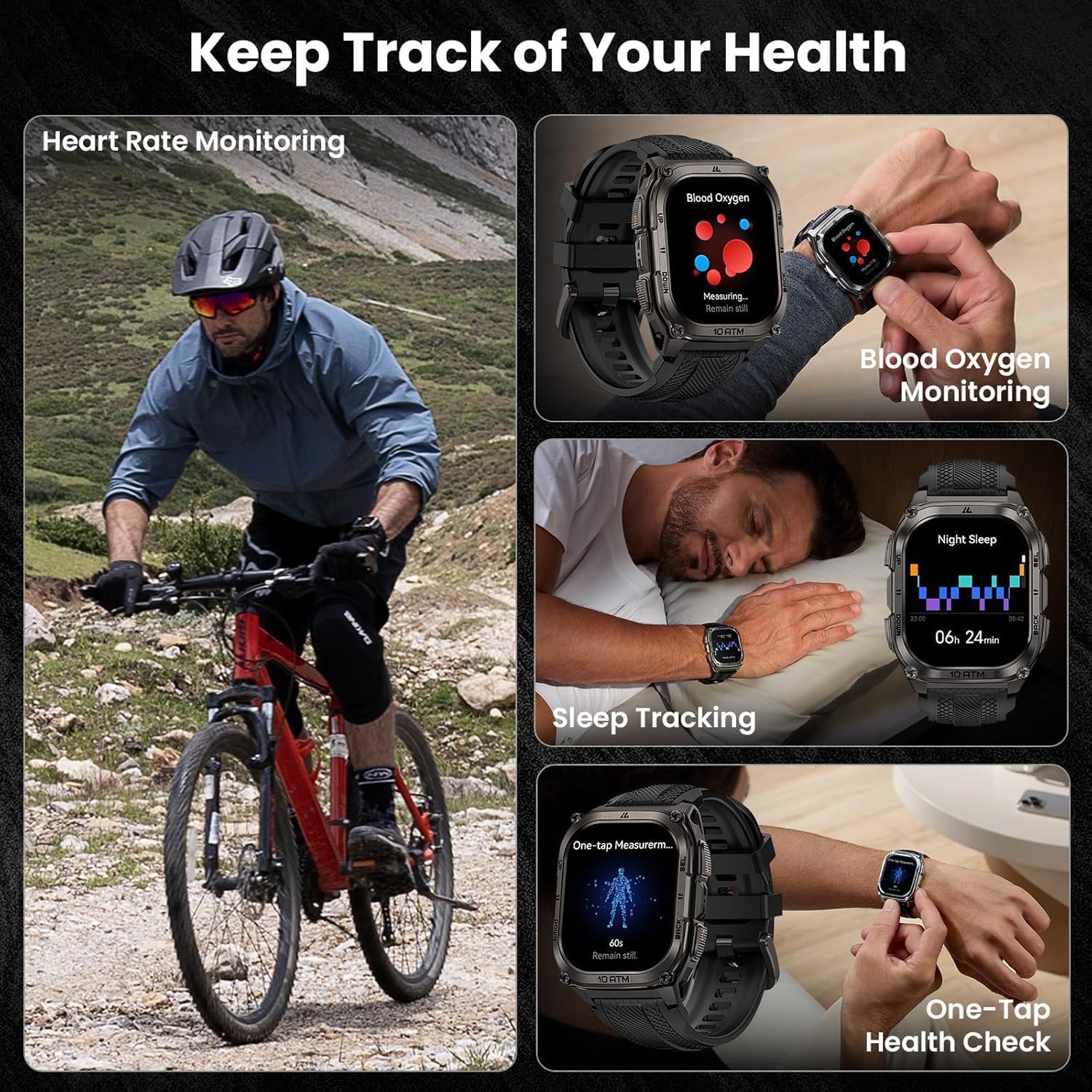
Who Should Buy a Sleep Tracker
Buy a sleep tracker if you:
- Consistently feel unrefreshed after a full night’s sleep
- Train hard and want to understand how sleep affects your recovery
- Want to understand which lifestyle habits are affecting your rest
- Travel frequently and deal with jet lag or schedule disruption
- Are interested in optimizing your overall health data
Consider alternatives if you:
- Have been diagnosed with a sleep disorder (talk to a physician about clinical monitoring options)
- Are already struggling with health anxiety — obsessive tracking of sleep metrics can worsen sleep quality (a phenomenon some researchers call “orthosomnia”)
- Won’t engage with the data consistently — a tracker only adds value if you use the insights
Buying Guide: How to Choose the Best Sleep Tracker
1. Prioritize Form Factor for Overnight Comfort
You need to wear it every night. If it’s uncomfortable, you’ll stop wearing it.
Smart rings (Oura, Samsung Galaxy Ring) are the most comfortable for sleep. Slim wristbands (WHOOP, Fitbit Charge 6) are next. Larger sports watches (Garmin Fenix, Samsung Galaxy Watch Ultra) are wearable but noticeably heavier. Bedside devices (Withings Sleep Analyzer) eliminate the comfort question entirely.
2. Decide Whether You Want a Subscription
Some of the best sleep trackers require subscriptions. WHOOP is unusable without one. Oura is significantly less useful without one. Fitbit’s Readiness Score is locked behind Premium.
If subscriptions frustrate you, Garmin, Polar, Amazfit, and Withings provide excellent sleep data with no ongoing fees.
3. Understand What “Sleep Stages” Actually Means for That Device
Not all sleep stage tracking is equal. Higher-frequency optical sampling (WHOOP, Oura) produces more granular and reliable data than once-per-minute readings. Temperature sensors add another physiological data point that improves staging accuracy. Check whether HRV is measured continuously overnight or just during brief windows.
4. Look at the App — Not Just the Hardware
A sleep tracker is only as useful as the insights the app provides. Before buying, look at screenshots of the app interface and read user reviews specifically about data visualization, actionability of recommendations, and whether the app improves over time via software updates.
5. Consider Battery Life Relative to Charging Habits
A device that requires daily charging needs to be charged during waking hours if you want overnight data. Before buying, have a realistic plan: Will you charge during a morning shower? During a commute? At your desk? If you can’t answer this, choose a device with longer battery life.
6. Evaluate Women’s Health Features (If Relevant)
Women tracking menstrual cycles alongside sleep should prioritize Oura Ring Gen 4 or WHOOP for temperature-based cycle correlation with sleep and recovery data. Garmin’s menstrual health tracking integrates with the training calendar. See our smart ring for women guide for more detail.
7. Ecosystem Matters
- iPhone users benefit from Apple Watch’s deep iOS integration
- Samsung phone users get the most from Galaxy Watch Ultra
- Google/Android users benefit from Pixel Watch 3 or Garmin’s Google Health Connect compatibility
- WHOOP and Oura Ring work across all platforms
Common Mistakes Buyers Make
1. Choosing a sleep tracker without testing overnight comfort first Many users buy a larger smartwatch and discover within a week that they can’t sleep comfortably in it. Know your preference before spending $300+.
2. Treating daily sleep scores as absolute measurements A single night’s “18% deep sleep” reading isn’t clinically meaningful. Look for 2–4 week trends, not individual data points.
3. Developing “orthosomnia” — sleep anxiety driven by tracker data Some users become so focused on achieving perfect sleep scores that the anxiety itself disrupts their sleep. If you notice this pattern, consider taking a device break or disabling granular nightly notifications.
4. Buying WHOOP without accounting for the long-term subscription cost At $18–30/month, WHOOP costs $216–$360 per year. Calculate your 24-month total before committing.
5. Ignoring the Oura ring sizing process Oura Ring sizing is permanent. Finger circumference varies by time of day, temperature, and hydration. Use the free sizing kit carefully and measure at multiple times before ordering.
6. Expecting immediate useful insights Most devices need 2–4 weeks to establish a personal baseline. The first week’s data is calibration — don’t make major decisions based on it.
7. Buying a sleep tracker to replace a physician’s advice Sleep trackers are wellness tools, not medical diagnostic instruments. If you consistently wake exhausted, have concerns about breathing disruption during sleep, or notice persistent SpO2 dips, see a doctor. A sleep tracker can complement — not replace — that conversation.
8. Skipping the subscription on Oura The $6/month Oura membership unlocks Readiness Score, Sleep Score, and Oura Advisor. The ring is significantly less useful without it. Budget for both when making your purchase decision.
Subscription Costs Explained
Understanding subscription models before you buy prevents frustration later.
WHOOP: Membership-only model. You pay monthly and get the hardware included. No membership = no device functionality. Pricing has changed across hardware generations — always verify at whoop.com.
Oura Ring: Hardware purchase plus optional membership. At $6/month, it’s the most affordable recovery-focused subscription. Core sleep stage data is somewhat accessible without it, but the Readiness Score (the most useful daily metric) requires Premium.
Fitbit / Google Pixel Watch: Optional Fitbit Premium at $9.99/month. Core sleep stages and Sleep Score are free. Daily Readiness Score, deeper sleep analysis, and guided programs require Premium.
Garmin / Polar / Amazfit / Withings: No subscription. All features free with hardware purchase. These platforms update via software and add features without charging you more.
30-year cost analysis: A perspective shift If you’re debating between WHOOP ($300/year) and a Garmin Forerunner 265 ($0/year after the $300 purchase), do the math. After three years, WHOOP has cost ~$900 in subscriptions alone. That’s the price of three Forerunner 265s — or one Garmin Fenix 8. Factor this into your decision honestly.
Sleep Tracker vs Professional Sleep Study
| Factor | Consumer Sleep Tracker | Polysomnography (PSG) Sleep Study |
|---|---|---|
| Accuracy | Consumer-grade estimate | Clinical standard |
| What it measures | Sleep stages via PPG + movement | Brain waves, eye movement, breathing, HR, SpO2, more |
| Diagnostic capability | None | Can diagnose sleep disorders |
| Setting | Your own bed, every night | Sleep clinic, 1–2 nights |
| Cost | $100–650 upfront | $1,000–3,000+ (insurance may cover) |
| Ongoing data | Every night for months/years | One or two snapshots |
| Convenience | Wears or sits passively | Attended, in a lab |
| Best for | Trend awareness, behavioral change, wellness | Diagnosing sleep apnea, insomnia, narcolepsy |
Consumer sleep trackers and clinical sleep studies serve fundamentally different purposes. If you have concerns about a sleep disorder — particularly if you snore, wake gasping, experience excessive daytime sleepiness, or notice consistent SpO2 dips in your tracker data — consult a physician. A sleep tracker is not a substitute for diagnosis or treatment.
How to Improve Sleep Beyond Tracking
The best sleep tracker in the world won’t fix a bad sleep environment or poor sleep hygiene. Research consistently supports these evidence-based strategies from the National Sleep Foundation and American Academy of Sleep Medicine:
Consistent timing: Going to bed and waking at the same time every day — including weekends — is the single most powerful regulator of circadian rhythm.
Sleep environment: A cool (around 65–68°F / 18–20°C), dark, quiet bedroom measurably improves sleep quality. Even small light sources can suppress melatonin production.
Caffeine cutoff: Most adults metabolize caffeine slowly. A coffee at 2pm still has half its effect at 8pm for some people. Tracking your sleep data before and after adjusting caffeine timing often reveals a clear connection.
Pre-sleep wind-down: 30–60 minutes without screens and bright light before bed supports melatonin production. Your tracker data will often reflect this — HRV improves, resting HR drops faster.
Alcohol: Even one glass of wine before bed typically suppresses REM sleep and elevates overnight resting HR. Most sleep trackers will show this clearly within a few weeks of comparison data.
Exercise timing: Regular exercise improves sleep quality — but high-intensity evening workouts elevate core body temperature and HR, which can delay sleep onset. Experiment with timing using your tracker data.
Expert Tips
Tip 1: Build a baseline before making changes Wear your tracker without changing any behaviors for the first 2 weeks. You need a baseline before interventions make sense.
Tip 2: Correlate one variable at a time Change one thing — eliminate evening alcohol, move workouts earlier, add a wind-down routine — and measure the impact over 1–2 weeks before adding another change.
Tip 3: Trust trends, not individual nights One bad night’s data tells you almost nothing. A consistent 3-week pattern tells you something worth acting on.
Tip 4: Don’t chase perfect scores A Sleep Score of 75 is fine. Obsessing over pushing it to 90 creates anxiety that itself degrades sleep quality. Use your tracker as a guide, not a judge.
Tip 5: Time your HRV-based insights to major decisions The most useful time to check your Recovery or Readiness Score is when you’re deciding whether to push a training session or take a rest day. That’s where data-driven decisions have real consequences.
Tip 6: Use your tracker data as a conversation starter with your doctor If you notice consistent patterns — elevated overnight HR, persistent SpO2 dips, poor REM quality — bring that data to your physician. It provides context that can be genuinely useful in a clinical conversation.
Maintenance Tips
- Clean smart rings regularly: Use a soft, dry cloth. Avoid soap, which can build up inside the ring and affect sensor contact.
- Inspect wristbands weekly: Sweat, lotion, and moisture accumulate under wristbands and can cause skin irritation. Remove and air-dry the band regularly.
- Keep firmware updated: Sleep tracking algorithms improve with software updates. Check for updates monthly and install them.
- Charge before travel: Before any trip where charging may be difficult, ensure your device is fully charged.
- Give the ring a break: For ring users, remove the ring briefly on non-sleeping days to let your skin breathe.
- Reset baseline after illness: Most devices let you flag illness days. Use this feature — illness significantly depresses HRV and can skew your baseline for weeks if unaccounted for.
Privacy & Data Security Considerations
Sleep data is health data — and health data is among the most sensitive information you generate.
Before buying any sleep tracker, understand:
Where your data is stored: Most major platforms (Oura, WHOOP, Garmin, Apple, Samsung) store health data in encrypted cloud environments. Review each company’s privacy policy for specifics.
Who your data is shared with: Some platforms use aggregated, anonymized data for research. Read the privacy policy for third-party data-sharing provisions.
Apple Health and Google Health Connect: These serve as local health data hubs on your phone, giving you aggregated visibility and allowing you to control which apps can access which data types.
Data portability: Reputable platforms allow you to export your health data. Garmin Connect, Oura, WHOOP, and Fitbit all provide data export options. Know how to access yours before you accumulate years of data.
General guidance: Use devices from established companies with clear, published privacy policies. Avoid obscure brands that offer minimal privacy documentation. Be thoughtful about which apps you grant Health data access to.
People Also Ask
Which sleep tracker is the most accurate?
Featured Snippet Answer: The most accurate consumer sleep trackers are the Oura Ring Gen 4 and WHOOP 5.0. Both use continuous overnight HRV monitoring from high-frequency sensors. Oura’s finger-based measurement reduces motion artifact and improves PPG signal quality. No consumer device matches clinical polysomnography — but these two consistently outperform the competition in user accuracy reports and independent comparative reviews.
Do sleep trackers really improve sleep?
Sleep trackers improve sleep primarily by increasing awareness. Research published in journals on behavioral sleep medicine consistently shows that self-monitoring motivates behavioral change. That said, the tracker itself doesn’t improve your sleep — your response to the data does. Users who identify patterns, make targeted changes, and track outcomes typically see measurable improvement in sleep duration and consistency over 4–8 weeks of consistent use.
Is WHOOP or Oura better for sleep?
Both are excellent, but they serve different users. WHOOP’s Sleep Coach gives forward-looking bedtime recommendations based on recovery goals — ideal for athletes. Oura’s Sleep Score breaks down each stage contributor with educational depth — better for general wellness and sleep improvement focus. Oura wins on overnight comfort (ring vs. wristband) and costs significantly less per month (~$6 vs. ~$18–30). WHOOP wins for athletic training integration.
Is Garmin more accurate than Fitbit for sleep tracking?
Garmin generally edges Fitbit for HRV precision and training integration, while Fitbit’s Sleep Profile and EDA stress monitoring (Sense 2) offer unique insights. Garmin’s free app platform and longer battery life make it the better long-term investment for most users. Fitbit’s app is more beginner-accessible and its monthly subscription unlocks a Daily Readiness Score if you need that metric. Neither matches the accuracy depth of Oura or WHOOP for dedicated sleep analysis.
Which sleep tracker has no subscription?
Garmin (all models), Polar Ignite 3, Withings Sleep Analyzer, Amazfit Balance, Samsung Galaxy Watch Ultra, Apple Watch Series 11, and COROS devices all provide sleep tracking with no required subscription. Garmin’s free Garmin Connect platform is the most feature-complete free sleep and health app available on any wearable platform.
Can a smartwatch detect sleep apnea?
No consumer smartwatch can diagnose sleep apnea. Apple Watch Series 11 (and select Series 9/10) can deliver Sleep Apnea Notifications — wellness alerts that flag irregular breathing patterns suggesting further evaluation may be warranted. The Withings Sleep Analyzer detects respiratory disturbances overnight that may indicate sleep-disordered breathing. Both are wellness awareness features — not medical diagnoses. If you’re concerned about sleep apnea, consult a physician and pursue a clinical sleep study.
Which sleep tracker is best for adults?
For adults prioritizing comfort and accuracy: Oura Ring Gen 4. For adults who also train actively: WHOOP 5.0 or Garmin Forerunner 265. And For adults who want no subscription: Garmin Venu 3 or Withings Sleep Analyzer. For adults on a budget: Amazfit Balance or Fitbit Charge 6. There’s no single best answer — the right device depends on your goals, lifestyle, and comfort preferences.
What is the best budget sleep tracker?
The Amazfit Balance (~$100–150) delivers the most sleep tracking depth at the lowest price on this list — with sleep stages, HRV, SpO2, and no subscription. For a slightly higher budget with GPS and Google integration, the Fitbit Charge 6 (~$130–160) is the best budget fitness sleep tracker available. Both represent strong value for first-time sleep tracker buyers.
Frequently Asked Questions
How long does it take to see results from sleep tracking?
Most people start seeing useful patterns within 2–3 weeks of consistent wear. Meaningful behavioral correlation data typically emerges after 4–8 weeks when you’ve accumulated enough nights to identify reliable trends versus random variation.
Can I use a sleep tracker if I work night shifts?
Yes — most trackers allow you to customize your sleep schedule so that daytime sleep is tracked correctly. Garmin’s Nap Tracker, Oura’s flexible sleep detection, and WHOOP’s automatic sleep detection all handle irregular sleep timing. Look specifically for devices that don’t assume a fixed nighttime sleep window.
What sleep tracker works best for couples who share a bed?
The Withings Sleep Analyzer uses two separate sensor zones and can track two sleepers simultaneously — making it the best option for couples who want mutual sleep data without two separate wearable devices. Both partners need their own Withings Health Mate account.
Is it okay to wear a sleep tracker every night?
For most users, yes — continuous wear is how sleep trackers generate their most valuable data. Keep the device clean, rotate your ring finger if you use a ring, and take occasional breaks if skin irritation develops under a wristband.
Do sleep trackers help with jet lag?
Some devices provide specific jet lag tools. Garmin’s Jet Lag Advisor gives timing recommendations for light exposure, meals, and activity to accelerate circadian rhythm adjustment. Oura can flag how your biometrics respond to time zone shifts. Both are useful companions for frequent travelers.
Are sleep trackers safe to wear during pregnancy?
No consumer wearable has been specifically safety-tested or FDA-cleared for use during pregnancy. Consult your healthcare provider before using any health monitoring device during pregnancy.
What happens if I forget to wear my sleep tracker one night?
Most platforms handle occasional missing nights gracefully — they simply show no data for that night and continue with your baseline. WHOOP’s on-wrist charging system reduces the frequency of missing nights since you never need to remove it.
Can sleep trackers measure lucid dreaming or dream content?
No. Consumer sleep trackers cannot detect or log specific dream content, lucid dreaming episodes, or nightmare frequency. They classify sleep into physiological stages (light, deep, REM) — but REM sleep is simply the stage most associated with dreaming, not a window into specific dream experiences.
Should I tell my doctor about my sleep tracker data?
Yes — if you notice concerning patterns (consistent SpO2 dips, severely fragmented sleep, persistent next-day fatigue despite adequate sleep time), bring that data to your physician. It can provide useful context for a clinical conversation. Always emphasize that the data represents estimates from a consumer device.
Which sleep tracker is best for older adults?
The Withings Sleep Analyzer is ideal for older adults who may struggle with wearing devices overnight — nothing to put on, nothing to charge, just place it under the mattress. The Garmin Venu 3 is also excellent for older adults who want a comprehensive health watch with sleep, fall monitoring context, and safety features.
Final Verdict
The best sleep tracker for you depends entirely on what you want from the experience.
For the deepest sleep insights available in the most comfortable form: Oura Ring Gen 4 is our Editor’s Choice. Nothing in this category combines comfort, accuracy, and actionable guidance as effectively — especially for women and biohackers who want detailed biological context around their sleep.
For athletes who need sleep and recovery tightly integrated with training load: WHOOP 5.0 delivers the most sophisticated recovery-training connection available, with a Sleep Coach that actively guides your bedtime decisions.
If For runners and athletes who want no subscription ever: Garmin Forerunner 265 provides solid sleep tracking, outstanding GPS, and a free platform that keeps getting better.
For everyday wellness without recurring fees: Garmin Venu 3 is the best subscription-free sleep tracker with the most complete wellness feature set.
For the best bedside sleep experience — nothing to wear: Withings Sleep Analyzer tracks two sleepers simultaneously with respiratory monitoring that no wrist device matches.
If For iPhone users who want it all in one place: Apple Watch Series 11 with its Apple Health ecosystem — just solve the battery charging timing.
For budget buyers just getting started: Amazfit Balance at under $150 gives you more than enough to begin your sleep optimization journey.
Check current pricing on Amazon, read verified user reviews, and choose the sleep tracker that fits how you actually live — and how committed you are to using the data you collect.
For more comparisons and buying guides, explore our full wearable fitness tracker comparison, our roundup of the best fitness wearables, and our dedicated best recovery trackers guide. If you’re considering a premium recovery tracker, our WHOOP vs Oura comparison and Garmin vs Oura breakdown cover those head-to-heads in depth.
Sweet dreams.