This article may contain affiliate links. If you purchase through our links, we may earn a commission at no extra cost to you.
Search “Garmin sleep tracking review Reddit” and you’ll find two very different camps: people who trust their Garmin’s sleep data enough to plan training around it, and people convinced it’s making numbers up. Both reactions are understandable, and both are missing part of the picture.
Here’s the short version: Garmin’s sleep tracking is genuinely useful for spotting trends — how alcohol affects your HRV, whether a hard training block is catching up with you, whether your sleep is improving month over month. It is not, and was never designed to be, a substitute for a clinical sleep study. The confusion usually comes from expecting night-by-night precision out of a tool that’s actually built for pattern recognition.
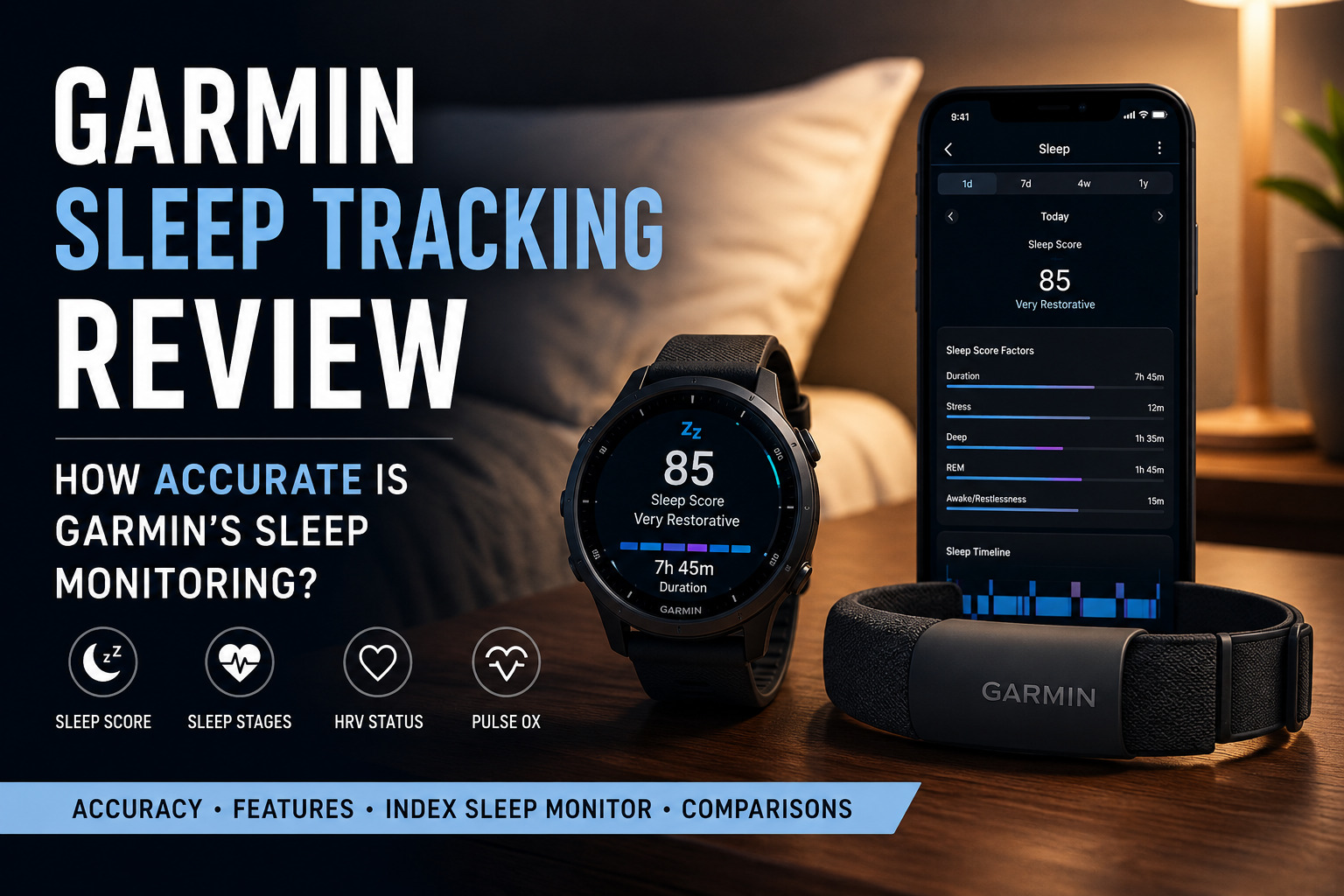
This Garmin Sleep Tracking Review breaks down Garmin’s strengths and common errors, examining how the Index Sleep Monitor changes things and comparing Garmin to WHOOP, Apple Watch, and Oura to help you decide.
Quick Verdict
- Overall assessment: Reliable for trends, not for treating any single night’s numbers as fact
- Best feature: HRV-informed Body Battery and Training Readiness scoring, which ties sleep data into something actionable
- Biggest limitation: Sleep-stage classification — REM in particular — has shown meaningful error rates in independent testing
- Best for: Athletes and Garmin ecosystem users who want sleep data folded into a broader training picture
- Not ideal for: Anyone wanting clinical-level sleep-stage precision or a device built primarily around sleep
Short Answer: Is Garmin Sleep Tracking Accurate?
Garmin accurately tracks your total sleep time, especially on newer models with the Elevate Gen 5 sensor. However, sleep-stage breakdown remains less reliable. Independent research shows REM tracking is its weakest area on older hardware. Treat the nightly score as a trend indicator, not a lab-grade measurement.
How Garmin Sleep Tracking Works
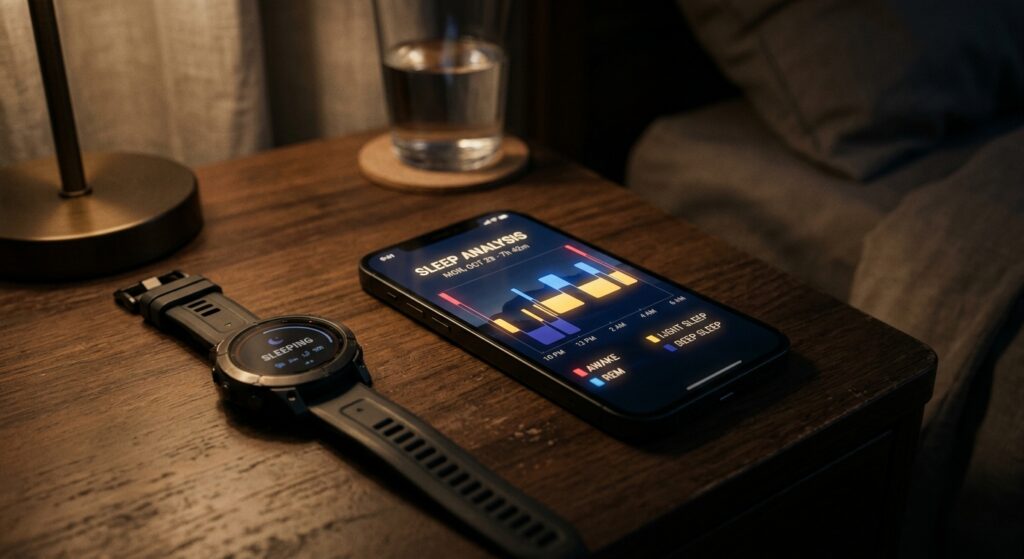
Garmin estimates sleep using three inputs: wrist-based heart rate from its Elevate optical sensor, heart rate variability, and movement from the accelerometer. Overnight, these feed a proprietary algorithm — built on Garmin’s Firstbeat Analytics engine, the same system behind Body Battery and Training Status — that classifies each period into awake, light, deep, or REM sleep, then rolls the night into a single Sleep Score from 0 to 100.
This matters because it’s fundamentally different from how a sleep lab works. Garmin isn’t reading brain activity. It’s inferring sleep stages from how your heart rate behaves and how still you are, which is a reasonable proxy but an indirect one. That distinction explains most of what follows in this Garmin Sleep Tracking Review.
How Accurate Is Garmin Sleep Tracking?
Garmin has published its own validation data. A 2019 study using the Garmin vívosmart 3 found 69.7% overall accuracy for sleep-stage classification against reference polysomnography-scored data, with a Cohen’s kappa of 0.54 — a statistical measure of agreement beyond chance. For context, two trained sleep-lab technicians scoring the same polysomnography data typically agree with each other about 83% of the time (kappa 0.78), which is the ceiling no consumer wearable has reached yet, Garmin included.
Independent research since then has been more mixed. A 2025 study in Sleep Advances testing six consumer devices against polysomnography found the Garmin Vivosmart 4 correctly identified only 33.1% of REM sleep epochs — the lowest of the six devices tested, well behind the Apple Watch Series 8 (68.6%) and WHOOP 4.0 (62.0%). The same study found Garmin misclassified more than 41% of true REM periods as light sleep. Separately, a lab study using the Garmin Forerunner 945 found it significantly overestimated total sleep time and underestimated deep sleep compared to polysomnography.
Here’s where it gets interesting. Those studies tested older models like the Vivosmart 4 and Forerunner 945. Both launched years before Garmin introduced HRV-based sleep staging.
They also lack the current Elevate Gen 5 sensor. This new sensor powers modern devices like the Fenix 8 and Venu 4. Garmin states Gen 5 significantly improves overnight HRV tracking. That specific metric is crucial for accurate sleep staging.
However, independent peer-reviewed testing on this newer hardware remains limited. Garmin’s current flagships are likely more accurate than older study models. Still, that improvement lacks precise independent quantification. Worth knowing before you assume a five-year-old study describes the watch on your wrist today.
Table 1: Garmin Sleep Tracking Accuracy by Metric
| Metric | Garmin Usefulness | Main Limitation |
|---|---|---|
| Sleep duration | Reasonably reliable for total time asleep on newer HRV-capable models | Older Garmin models showed meaningful overestimation of total sleep time in lab testing |
| Sleep/wake detection | Strong — high sensitivity for detecting that you’re asleep | Weaker at catching brief nighttime wake-ups; quiet stillness can register as light sleep |
| REM sleep | Useful for long-term trend direction | Independent testing found REM to be Garmin’s most error-prone stage, especially on older hardware |
| Deep sleep | Better for week-over-week patterns than single-night precision | Studies disagree on the direction of bias — see note below |
| Light sleep | The largest, most consistently detected category | Tends to absorb misclassified deep and REM periods |
| HRV | One of Garmin’s stronger metrics; tracks meaningful recovery trends | Skewed by alcohol, illness, and poor overnight fit; needs weeks to set a personal baseline |
| Heart rate | High correlation with reference devices in validation research | Optical accuracy drops with a loose band or excessive movement |
| Pulse Ox | Useful for overnight breathing-variation trends | Not validated as a medical-grade blood oxygen reading |
| Sleep Score | Useful single-number trend indicator | An algorithmic composite — can diverge from how a night actually felt |
A quick note on that deep sleep discrepancy: one peer-reviewed study found Garmin significantly underestimated deep sleep, while a separate study found Garmin devices tended to overestimate it — a key detail worth highlighting in any Garmin Sleep Tracking Review. Both are legitimate findings — they tested different Garmin models, different populations, and different lab conditions, and neither is wrong. It’s a useful reminder that “Garmin’s accuracy” isn’t one fixed number; it varies by device generation, algorithm version, and who’s wearing it.
Don’t want to sleep in a watch?
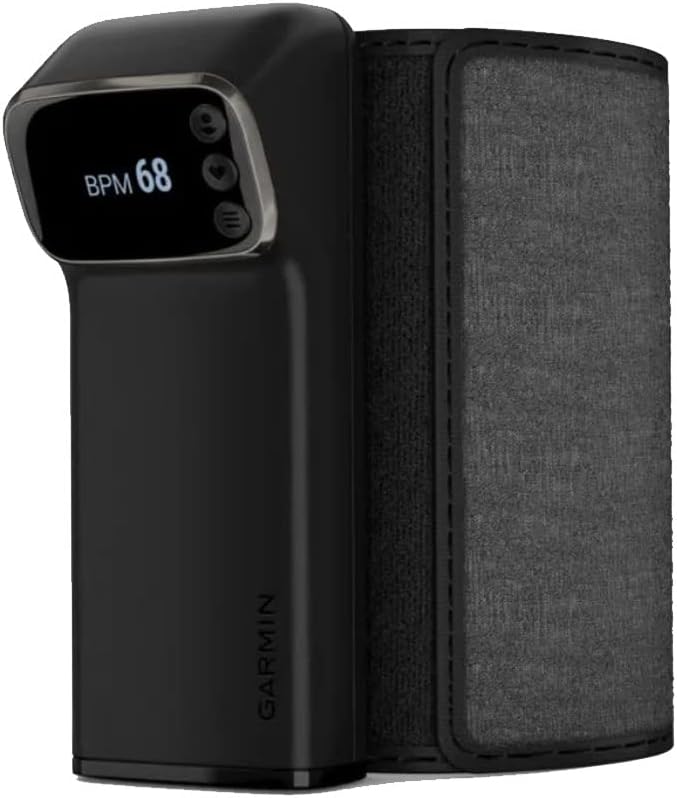
The Index Sleep Monitor gives you Garmin’s full sleep and recovery data from a screen-free upper-arm band — no watch required.
What Garmin Sleep Tracking Gets Right
- Sleep/wake detection is consistently strong — Garmin’s own study found 95.8% sensitivity for identifying sleep periods
- HRV tracking correlates well with heart rate variability measured by reference devices, and is arguably Garmin’s most scientifically grounded metric
- Trend tracking over weeks and months is where Garmin earns its keep — a single off night matters less than the pattern it’s part of
- Integration with training load means sleep data actually changes what Garmin recommends the next day, rather than sitting in isolation
Where Garmin Sleep Tracking Can Go Wrong
- REM classification has the highest documented error rate of any Garmin sleep metric, particularly on pre-Elevate Gen 5 devices
- Wake detection during quiet stillness — lying awake but motionless can register as light sleep, since the algorithm leans on movement as a signal
- Loose or nighttime-uncomfortable fit reduces optical sensor accuracy, which cascades into every downstream metric
- Data sync errors, including sleep sessions logged on the wrong calendar day, are a recurring complaint in Garmin’s own user forums — an app/software issue, not a sensor accuracy issue, but one worth knowing about
- Multiple Garmin devices worn inconsistently (switching between a watch and, say, a bike computer) can create gaps that confuse night-to-night comparisons
Why Is Garmin Sleep Tracking So Bad for Some Users?
It’s worth pushing back gently on the premise before answering it. “Bad” usually means one of a few specific things, not a blanket failure:
Older hardware. If you’re wearing a Vivosmart 4, an original Vivoactive, or an early Forerunner, you’re on hardware and algorithms that predate Garmin’s HRV-based staging update — the version most heavily represented in the accuracy research above.
Fit, not firmware. A watch worn loosely, or shifted around during sleep, loses consistent skin contact — and optical heart-rate sensors need that contact to work.
Mismatched expectations. A “poor” or “fair” sleep score after a night that felt fine is often the algorithm correctly detecting elevated HRV-based stress or fragmented sleep that you didn’t consciously register, not the device being wrong—a nuance explored in our full Garmin Sleep Tracking Review. That’s a different problem than measurement error, and we cover that distinction more in the next section.
Software quirks, not sensor quirks. A number of long-running threads across Garmin’s forums and Reddit describe sleep sessions syncing to the wrong day or watches logging sleep after being taken off overnight — real, documented software bugs that Garmin has patched over time, distinct from the sensor’s underlying accuracy.
As highlighted in any comprehensive Garmin Sleep Tracking Review, where Garmin tends to perform best is consistent nightly wear, a properly sized and snug band, and newer Elevate Gen 5 hardware. Where it struggles most: older devices, loose fit, and irregular sleep schedules that make baseline comparisons harder to establish.
How Garmin Calculates Sleep Score
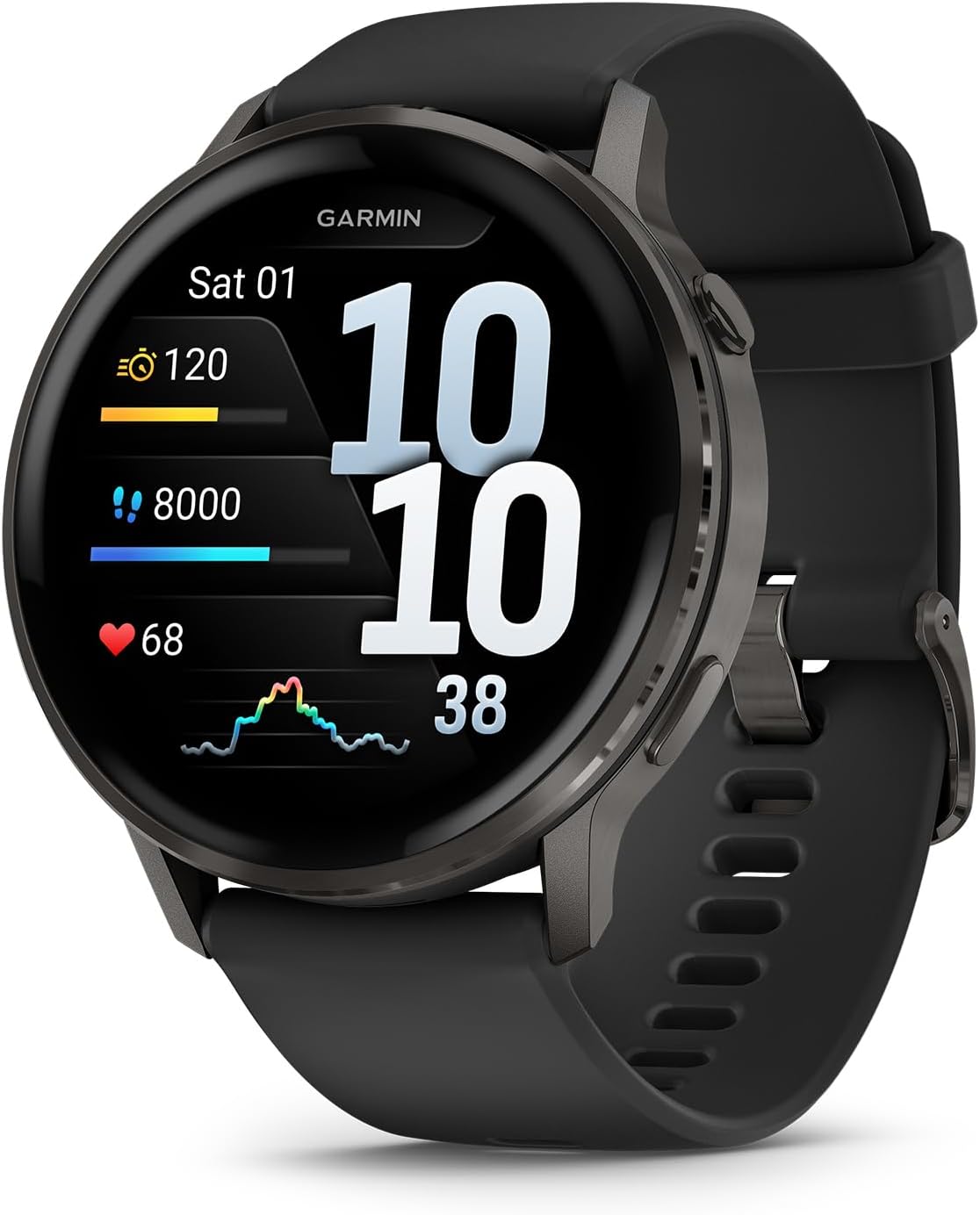
Garmin’s Sleep Score, powered by its Firstbeat Analytics engine, weighs several factors together: total sleep duration, the proportion of time spent in deep and REM sleep, and how restless the night was, based on movement and awakenings. Garmin doesn’t publish the exact underlying formula, but the company has described duration and sleep-stage quality as the two heaviest-weighted components, with restlessness and interruptions factored in as well.
According to Garmin’s own aggregated user data, the average Sleep Score across its user base was 72 in 2024, up slightly from 70 in 2023, with roughly three out of four users landing in the “fair” or “good” range. Has anyone gotten a 100 sleep score on Garmin? We don’t have verified evidence — no confirmed screenshot or Garmin-published data — confirming a perfect 100. Because the score requires near-ideal readings across duration, stage quality, and restlessness simultaneously, it’s a difficult number to hit, though scores in the low-to-mid 90s are plausible and anecdotally reported by users with very consistent, undisrupted sleep.
Can Garmin Get Sleep Score Wrong?
Yes — but “wrong” covers two different situations, and it’s worth separating them.
Measurement error is when the sensor or algorithm genuinely misreads what happened — misclassifying a stage, missing a brief wake-up, or losing signal from a loose fit. This is a real limitation, documented in the research above.
A technically correct score that doesn’t match how you feel is different. Garmin users have reported getting long REM totals alongside a low “mental recovery” or overall sleep score — a mismatch that comes from the algorithm weighing overnight HRV-based stress heavily, even when raw sleep-stage minutes look fine. Elevated resting heart rate from a late meal, alcohol, or an oncoming illness can suppress HRV enough to drag the score down, even on a night that felt restful. That’s not the device being inaccurate — it’s measuring something real (autonomic stress) that doesn’t always match subjective sleep quality.
Is Sleeping With a Garmin Watch Good?
For most people, yes — with a few caveats as noted in any comprehensive Garmin Sleep Tracking Review. Wearing a properly fitted Garmin watch to bed captures the HRV and heart-rate data the sleep and recovery algorithms depend on, and the multi-day battery life on most current models means nightly charging isn’t required.
That said, sleeping with a watch isn’t for everyone. A larger case can feel bulky for side sleepers, and some people simply don’t like wearing anything on their wrist at night. Garmin’s answer to that specific problem is the Index Sleep Monitor, covered in detail below — a screenless upper-arm band built for exactly this use case. If you’d rather not commit to a watch at all, our guide to the best sleep trackers on the market covers screen-free alternatives across several brands, Garmin included.
Garmin Index Sleep Monitor Review
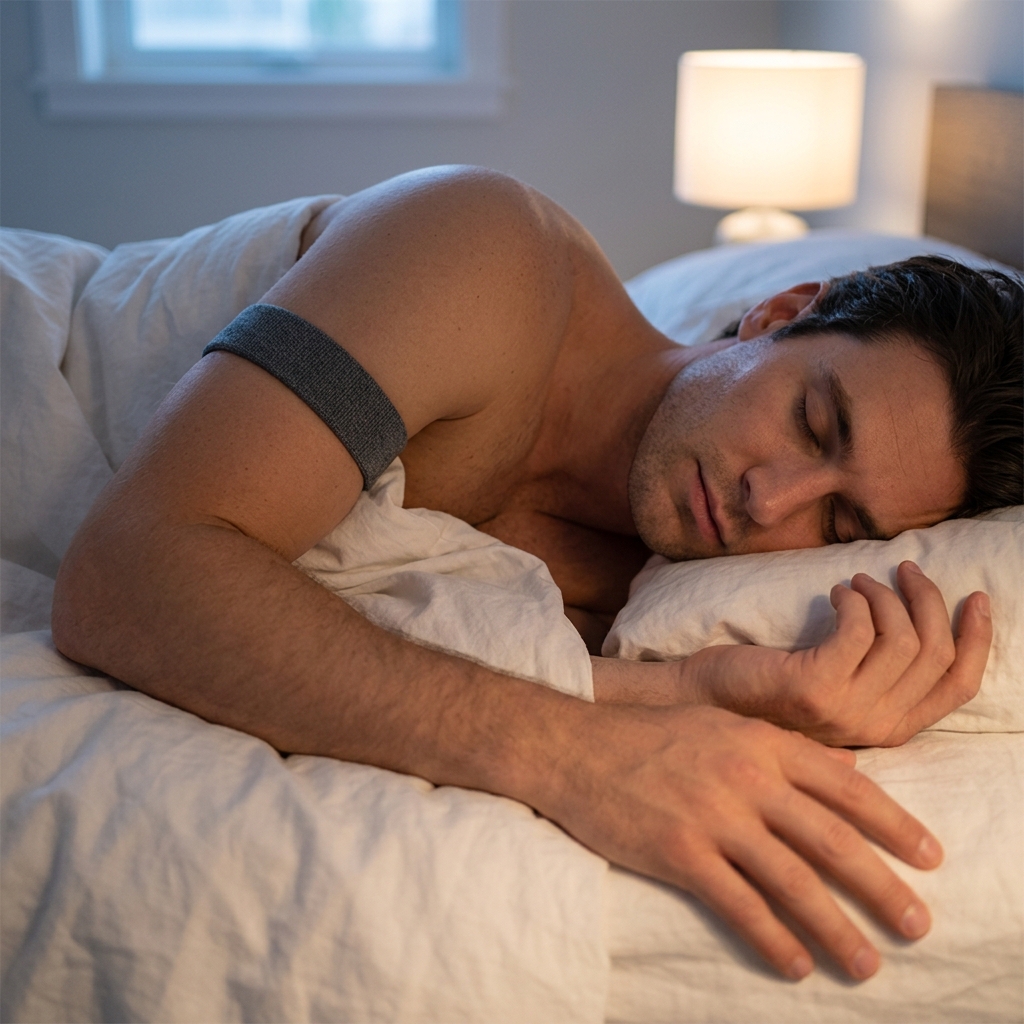
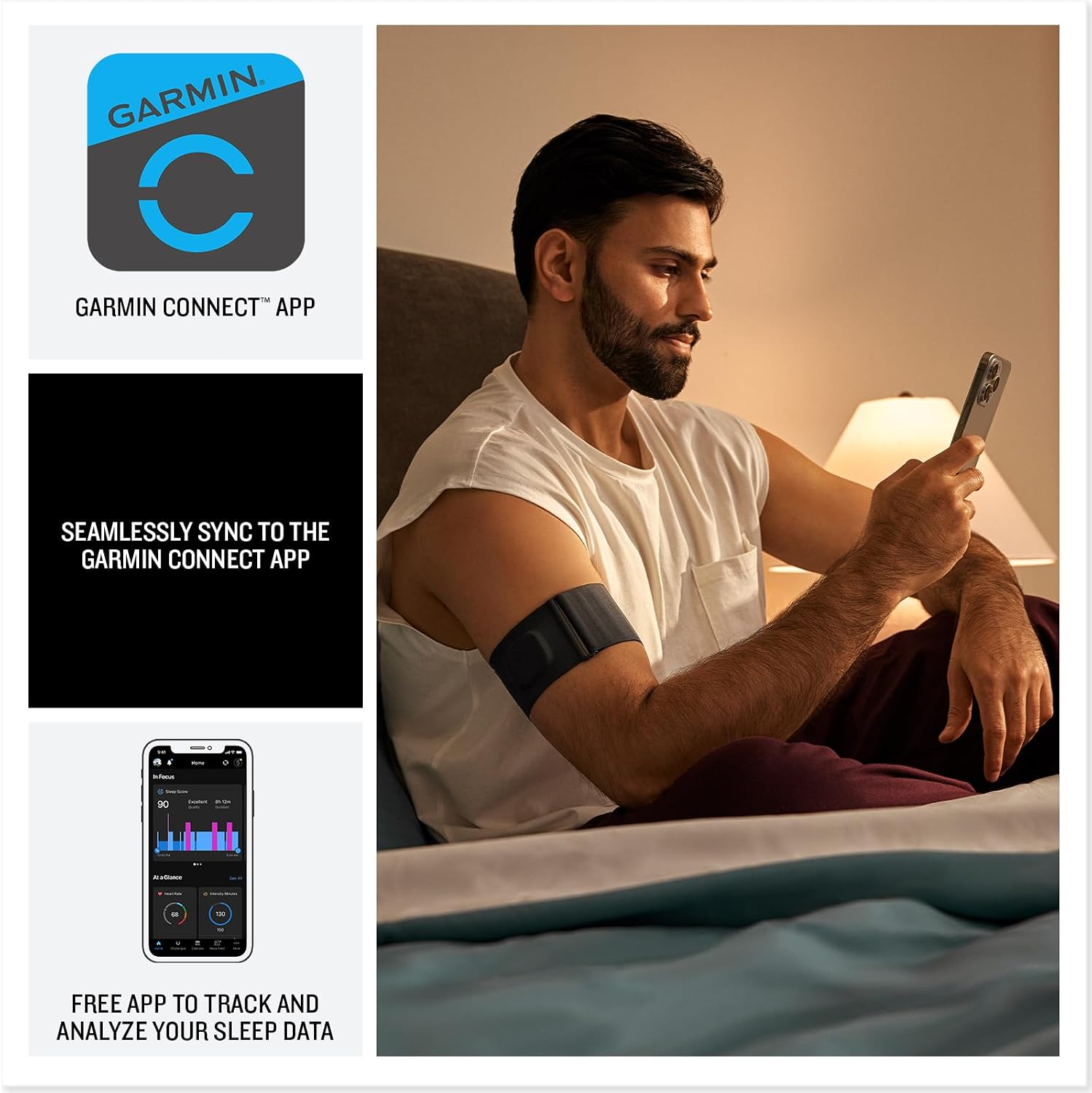
Garmin’s first screenless wearable, released in June 2025 at $169.99, solves a specific problem: you want Garmin-ecosystem sleep data without wearing a watch to bed. It’s a small sensor module — built around Garmin’s Elevate Gen 5 optical sensor — seated inside a wide, breathable nylon-spandex band that wraps around the upper arm instead of the wrist.
There’s no screen, no GPS, and no buttons; a status LED on the back of the module is the only on-device feedback. It tracks sleep score, sleep stages, HRV status, Pulse Ox, breathing variations, skin temperature, Body Battery, stress, and advanced women’s health metrics, all synced to the Garmin Connect app the next morning. Battery life is rated up to seven nights with continuous Pulse Ox tracking, and the band itself is machine washable once the sensor module is removed.
Pros:
- More comfortable for many sleepers than a watch case on the wrist
- Doesn’t require owning a Garmin watch at all
- Backfills sleep-dependent metrics like Training Readiness for people who train with a watch but don’t sleep in it
- Machine-washable band
- Up to seven nights of battery life
Cons:
- One more device to charge and remember to wear
- No display — you’re fully reliant on the Garmin Connect app for any data
- Upper-arm placement won’t suit everyone, and correct sizing matters more than it does for a wrist strap
- At $169.99, it’s an added cost on top of any Garmin watch you already own
Who should buy it: Garmin owners who don’t want to sleep in their watch, people focused specifically on recovery and HRV trends, and anyone curious about overnight breathing-variation data.
Who should skip it: Anyone who already sleeps comfortably in their Garmin watch — the Index Sleep Monitor doesn’t track anything a compatible watch isn’t already capturing.
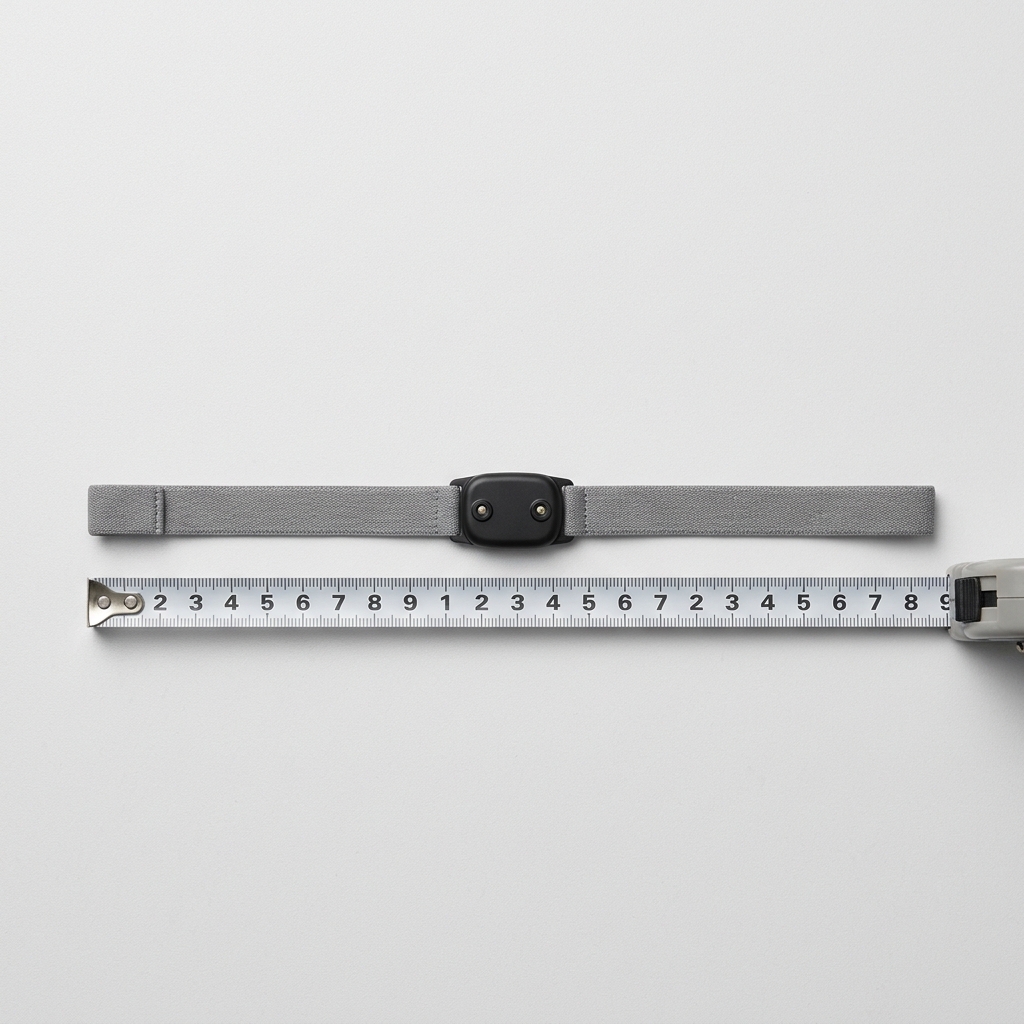
Garmin Index Sleep Monitor Size Chart
| Size | Upper-Arm Circumference | Best For |
|---|---|---|
| S/M | 8–11.7 in (20–29 cm) | Smaller to average upper-arm sizes |
| L/XL | 10.5–16.6 in (26–42 cm) | Larger upper-arm sizes |
Measure your upper-arm circumference before ordering — the two sizes overlap slightly in the middle range, and Garmin’s official sizing is the most reliable reference if you’re between sizes, as highlighted in our Garmin Sleep Tracking Review.
Garmin Index Sleep Monitor Compatibility
The Index Sleep Monitor works entirely on its own through the Garmin Connect app — you do not need to own a Garmin watch to use it. If you do own a compatible Garmin smartwatch, the two work together: on nights you sleep in the band instead of the watch, its data backfills sleep-dependent metrics like Training Readiness and Body Battery that would otherwise have gaps. Garmin hasn’t published a scenario where owning both creates a conflict; the systems are designed to complement rather than compete with each other.
Garmin Index Sleep Monitor vs. WHOOP
Both are screen-free devices built around recovery data, but as noted in any detailed Garmin Sleep Tracking Review, they solve the problem differently. The Index Sleep Monitor is a one-time $169.99 purchase (plus whatever Garmin watch you may already own) with no mandatory subscription. WHOOP has no separate hardware purchase at all — the device is bundled into a membership running $199 to $359 a year, and it stops functioning without an active plan.
For sleep-only use, the Index Sleep Monitor has an edge: it’s designed specifically to be worn overnight and nothing else, and it’s meaningfully cheaper over time if you’re not chasing WHOOP’s deeper strain and training-load analytics. WHOOP pulls ahead for people who want a dedicated recovery and training-load ecosystem, including features like ECG on higher tiers. If you’re deciding between the two ecosystems more broadly rather than just the sleep piece, our Garmin vs. WHOOP comparison goes deeper on fitness tracking, and our WHOOP alternatives guide is useful if the subscription-only model is a dealbreaker.
- Best for Garmin ecosystem users: the Index Sleep Monitor, since it plugs directly into data you’re likely already collecting
- Best for recovery-focused users: WHOOP, if structured strain and training-load coaching matter more than one-time-purchase economics
Garmin vs. Apple Watch for Sleep Tracking
Is Apple or Garmin more accurate for sleep? It depends which metric you care about. In the Sleep Advances comparison referenced earlier, the Apple Watch Series 8 led all six devices tested for REM detection accuracy (68.6%), well ahead of the Garmin Vivosmart 4 (33.1%). Apple Watch also generally does well at basic sleep/wake detection. Where Garmin pulls ahead is ecosystem depth — Body Battery, Training Readiness, and HRV Status weave sleep data into a broader recovery picture in a way Apple’s Vitals app doesn’t attempt to match. Apple Watch also requires nightly charging on most models, which works against consistent every-night wear, something Garmin’s multi-day battery life doesn’t force you to think about. For a closer look at how Apple’s ecosystem handles recovery data specifically, our Apple Watch vs. WHOOP comparison is a useful adjacent read, even though it isn’t a Garmin-specific matchup.
Garmin vs. Oura for Sleep Tracking
Oura is more singularly focused on sleep and recovery, and independent testing has generally favored it for sleep-stage accuracy over Garmin’s older, more commonly studied hardware. Garmin’s advantage is breadth — GPS, sports profiles, and structured training features that Oura’s ring form factor was never built to offer. If sleep-tracking precision is your top priority and you don’t need a training computer, Oura (or the Index Sleep Monitor, if you want to stay in the Garmin ecosystem) is worth a look; our full Garmin vs. Oura comparison and separate Oura Ring Review cover that matchup in more depth, including current pricing for both of Oura’s ring generations.
Table 2: Garmin vs. WHOOP vs. Apple Watch vs. Oura
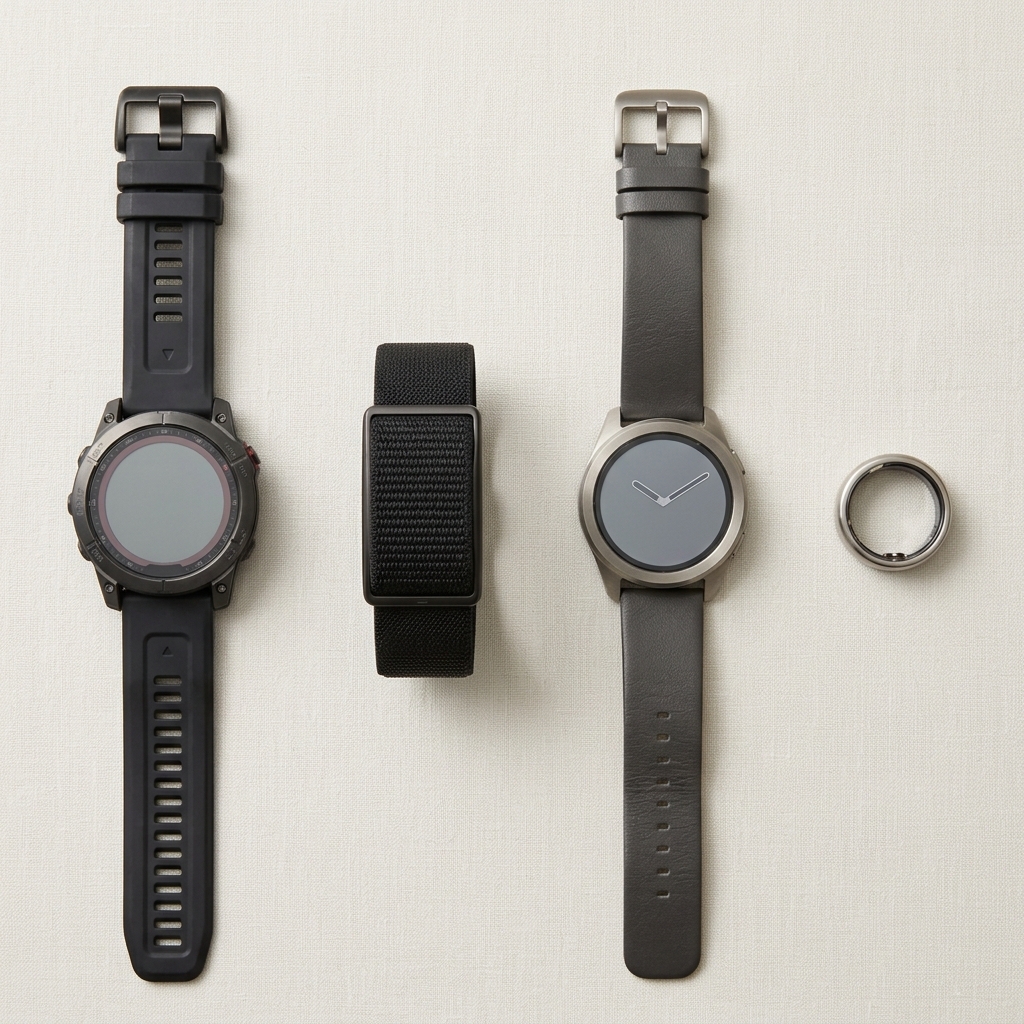
| Feature | Garmin | WHOOP | Apple Watch | Oura |
|---|---|---|---|---|
| Sleep Tracking | Solid trend tracking; newer Elevate Gen 5 models improve on the older, more-studied hardware | Strong stage-level accuracy in published research | Strong sleep/wake detection; mixed on stage differentiation | Frequently a top performer for sleep-stage accuracy in independent testing |
| Recovery | Body Battery + Training Readiness, deeply tied to training load | Strain/Recovery scoring is the platform’s core focus | Basic, via the Vitals app | Readiness score combining sleep, HRV, and activity |
| Sleep Score | 0–100, Firstbeat-based | Recovery percentage, not a direct sleep score | No dedicated sleep score | 0–100 Sleep Score |
| HRV | Tracked nightly against a personal baseline | Tracked continuously | Tracked via the Vitals app | Tracked nightly |
| Battery | Days to weeks depending on model and GPS use | Multi-day; wearable while charging | About 18 hours; daily charging required | 5–8 days (Ring 4); up to a week (Ring 5) |
| Subscription | Optional (Garmin Connect+) | Required to use the device at all | Not required | Required for full insights |
| Ecosystem | Extensive sports and training features | Recovery- and training-load focused | Broad Apple health and app ecosystem | Sleep- and wellness-focused; no sports depth |
| Best For | Athletes who want one device for training and sleep trends | Athletes prioritizing deep recovery and strain analytics | iPhone users wanting one all-purpose device | Sleep-focused users who want a screen-free wearable |
Is Garmin Sleep Tracking Any Good?
Yes, for the right use case. If you already want a Garmin for training, GPS, or its broader health ecosystem, the sleep tracking is a genuine value-add, and current-generation hardware with the Elevate Gen 5 sensor is a real step up from the devices most sleep-tracking studies have actually tested. If sleep tracking is your only priority and you don’t need any of Garmin’s sports features, a more sleep-dedicated device — Oura, the Index Sleep Monitor, or WHOOP — is likely to serve that narrower goal better.
Who Should Buy Garmin for Sleep Tracking?
- You already want (or own) a Garmin for running, cycling, or general fitness
- You want sleep data connected to a broader training and recovery picture, not tracked in isolation
- You’re comfortable treating the Sleep Score as a trend, not a nightly verdict
- You’d rather not add a subscription on top of hardware you own
Who Should Consider Something Else?
- Sleep-stage precision matters more to you than any other feature
- You want a device built specifically for sleep and recovery, with no interest in GPS or sports tracking
- You’re comparing structured recovery coaching platforms — WHOOP’s subscription model may fit better
- You want the research-backed sleep-stage track record Oura has built up over several device generations
How to Improve Garmin Sleep Tracking Accuracy
- Wear the watch snugly, roughly a finger-width above the wrist bone, not loose
- Keep the same device on consistently rather than alternating between a watch and other Garmin hardware
- Give the algorithm 2–3 weeks to establish an accurate personal HRV baseline before trusting comparisons
- Update firmware regularly — Garmin has shipped meaningful sleep-algorithm improvements through software updates before
- If wrist wear isn’t comfortable, consider the Index Sleep Monitor instead of skipping overnight tracking altogether
Frequently Asked Questions
Is Garmin sleep tracking accurate?
This Garmin Sleep Tracking Review indicates that while it is reasonably accurate for sleep duration and basic sleep/wake detection, it is less consistent for sleep-stage classification — particularly REM, based on independent research. Newer Elevate Gen 5 hardware likely performs better than the older devices most commonly tested.
How accurate is my Garmin for sleep?
It depends on your specific device and how you wear it. Current-generation Garmin watches with the Elevate Gen 5 sensor and a snug fit tend to perform better than older models. Though exact accuracy hasn’t been independently published for every current watch.
Is Garmin sleep tracking any good?
Yes, for trend tracking and for anyone who wants sleep data tied into a broader training and recovery picture. It’s less suited to anyone who needs precise, night-by-night sleep-stage data.
Can Garmin get sleep score wrong?
Yes, in two different ways — genuine measurement error, and a technically correct score that simply doesn’t match how a night felt because it’s weighing HRV-based stress alongside raw sleep-stage minutes.
Is sleeping with a Garmin watch good?
For most people, yes — it’s what powers the sleep and recovery algorithms. If wrist wear isn’t comfortable, the Index Sleep Monitor is a screen-free alternative built for the same purpose.
Is Apple or Garmin more accurate for sleep?
Independent testing has generally favored Apple Watch for REM detection specifically, while Garmin offers deeper integration between sleep data and training recommendations. Neither is a clear all-around winner.
What is the Garmin Index Sleep Monitor?
A screenless, upper-arm sleep-tracking band from Garmin, released in 2025 at $169.99, that tracks sleep score, sleep stages, HRV, Pulse Ox, and more without requiring a Garmin watch.
How does Garmin calculate sleep score?
Using its Firstbeat Analytics engine, Garmin combines total sleep duration, the proportion of deep and REM sleep, and overnight restlessness into a single 0–100 score. The exact formula isn’t publicly disclosed.
Final Verdict
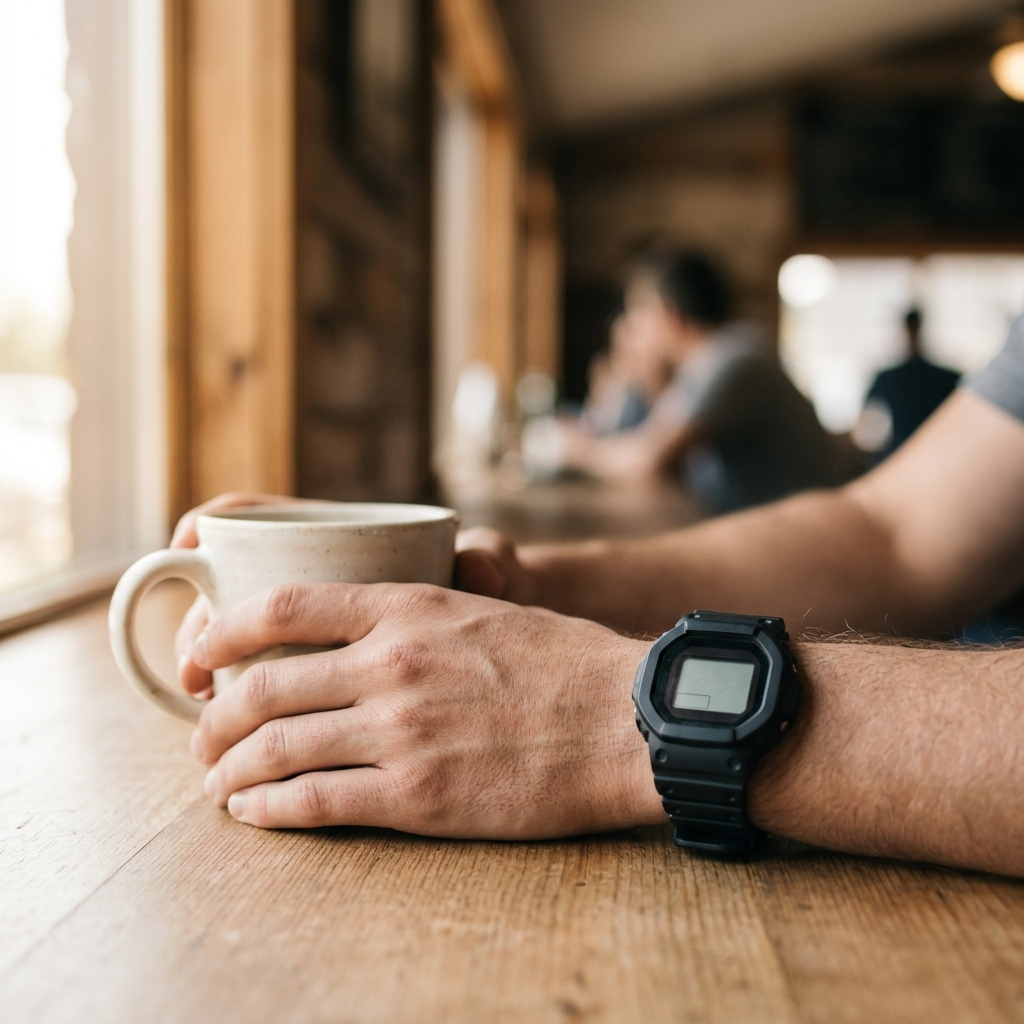
Should you trust Garmin for sleep tracking? As covered in this Garmin Sleep Tracking Review, trust it for what it’s actually built to do — spotting patterns in your sleep and recovery over time — and treat any single night’s score as one data point, not a verdict.
- Best for Garmin ecosystem users: the sleep tracking is a strong bonus layered onto a device you likely already want for other reasons
- Best for fitness-focused users: Garmin’s tie-in between sleep, HRV, and Training Readiness is more actionable than most sleep-only trackers offer
- Best for people who dislike sleeping with a watch: the Index Sleep Monitor solves that specific problem without leaving the Garmin ecosystem
- Consider WHOOP if recovery analytics and structured training-load coaching are a higher priority than a one-time hardware purchase
- Consider Oura if a ring form factor and best-in-class sleep-stage research are more important to you than sports and training features
- Consider Apple Watch if you’re already deep in Apple’s ecosystem and want one all-purpose device
References
- Garmin Health, sleep-stage validation study summary (vívosmart 3, 2019)
- Garmin Newsroom, Index Sleep Monitor launch announcement
- Garmin official product page, Index Sleep Monitor
- REI product listing, Index Sleep Monitor sizing
- Sleep Advances (Oxford Academic), six-device polysomnography validation study (2025)
- PubMed / PMC, Garmin Forerunner 945 vs. polysomnography lab study
- MDPI Sensors, five-device sleep-tracker accuracy study
- JMIR mHealth and uHealth, systematic review of Fitbit/Garmin/WHOOP vs. polysomnography
- Tom’s Guide, average Garmin Sleep Score data (2023–2024)
- Tom’s Guide, Garmin Fenix 8 vs. Forerunner 970 pricing and hands-on comparison
Author Bio
Adedoyin Joseph covers wearable technology and health tech for EmeraldLifestyle.com, focusing on sleep and recovery devices. This review is based on Garmin’s official documentation, independent peer-reviewed sleep-tracking research, and verified product specifications